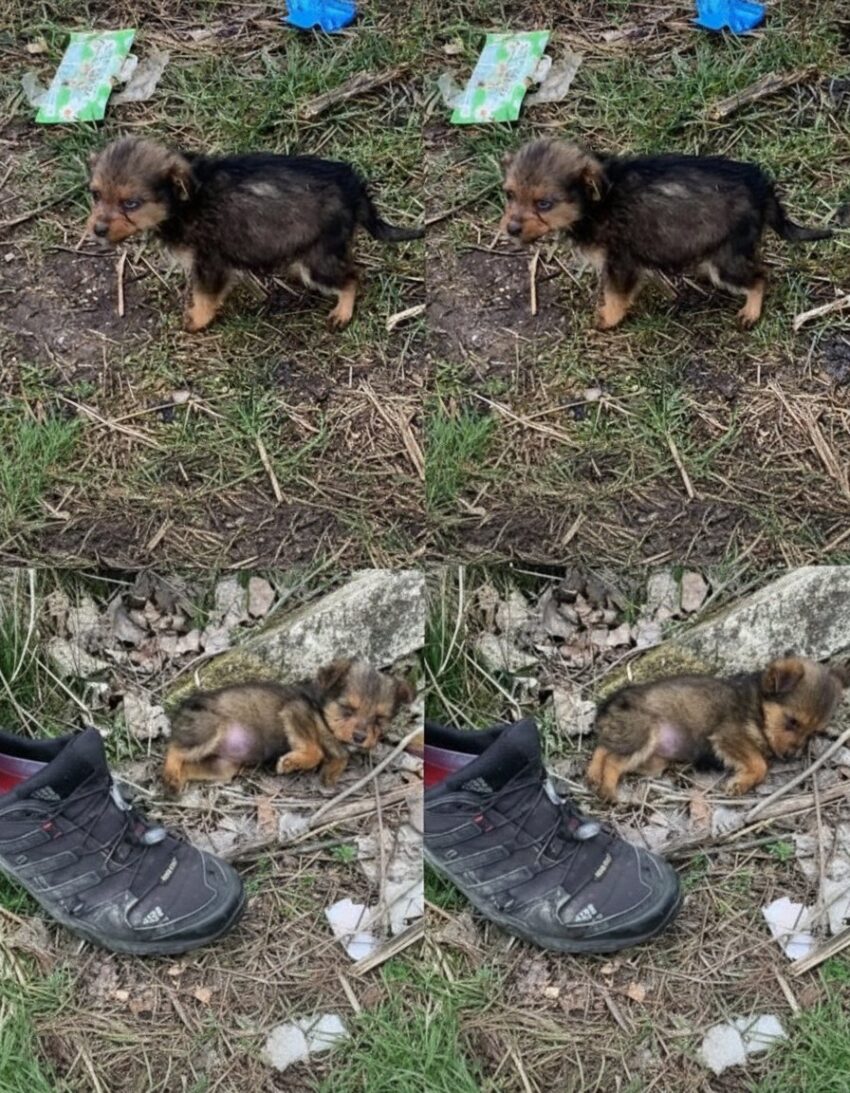
In the dusty outskirts of a small town in central Serbia, where stray dogs roam among abandoned construction sites and overflowing dumpsters, a man named Goran Marinkovic was finishing his usual afternoon walk in March 2020 when something made him stop dead in his tracks. Between two broken concrete slabs, half-hidden by dry weeds and plastic bags, lay what looked like a discarded toy. Only it wasn’t a toy. Curled up inside the hollow of an old, torn Adidas sneaker — using it as both bed and roof — was a puppy so small and emaciated that his ribs showed through paper-thin skin. His fur was patchy, his eyes crusted almost shut with infection, and he was shivering uncontrollably despite the spring sun. The shoe, size 44, was easily three times longer than the puppy himself. Goran, a 48-year-old animal rescuer who has saved hundreds of strays in the region around Kruševac, later admitted that in twenty years of walking those streets he had never seen anything quite so heartbreaking.

Goran knelt slowly, afraid any sudden movement would frighten the tiny creature into the thorns. The puppy didn’t run. He simply didn’t have the strength. When Goran extended a finger, the little dog pressed his entire face against it, as if checking whether the warmth was real. That was the moment Goran decided the puppy would never spend another minute alone. He wrapped him in his jacket and carried him the two kilometers home, whispering the whole way, “You’re safe now, little garbage boy.” The nickname “Smesten” — Serbian for “garbage” — stuck immediately, though no one imagined it would one day belong to one of the most joyful dogs in the Balkans.At home, the reality was worse than Goran feared. The puppy weighed barely 800 grams — less than a bag of sugar — and veterinarians estimated he was around four weeks old, far too young to survive without a mother. His body temperature was dangerously low, he was severely dehydrated, and blood tests revealed advanced parasites, anemia, and the beginning stages of pneumonia. The vet gave him a guarded prognosis: “If he makes it through the first 48 hours, he has a chance. But it will be a long fight.” Goran, who had already bottle-fed dozens of orphans, turned his living room into an intensive-care ward. He set up a heating pad inside a cardboard box, prepared puppy milk replacer every two hours day and night, and administered antibiotics and dewormers with a syringe no bigger than an eyedropper. He barely slept, waking at every whimper.What followed was nothing short of a miracle wrapped in stubborn determination. On the third day, Smesten managed to lift his head and lap milk from a shallow lid instead of being force-fed. On the fifth day he barked — a sound so weak it was almost a squeak, but it made Goran cry for the first time in years. By the end of the second week, the puppy who once fit entirely inside a shoe was attempting to climb out of his box, falling on his nose, and trying again. His fur began to grow back in soft waves of black, tan, and unexpected splashes of caramel that made strangers stop and ask if he was part Pomeranian, part miracle.But the most astonishing transformation was emotional. Smesten, who had every reason to fear humans after being apparently dumped like trash, chose trust instead. He followed Goran from room to room, sleeping on his feet while Goran worked at the computer, and greeting every visitor with a helicopter tail that threatened to lift his whole body off the ground. When Goran’s other rescued dogs — a one-eyed shepherd mix named Luna and a three-legged terrier called Pega — sniffed the newcomer cautiously, Smesten rolled onto his back in instant submission, paws in the air, as if to say, “I come in peace and I bring cuddles.”Word of the “puppy who lived in a shoe” spread quickly. Local children started leaving drawings and bags of puppy food on Goran’s doorstep. A Belgrade television crew arrived unannounced and filmed Smesten racing in circles around the garden, leaping for a toy balls with the energy of ten puppies. The old sneaker was carefully cleaned and turned into a donation box that still sits in a Kruševac pet store today — people drop coins through the torn mesh, and every dinar goes to stray animals.

Four months after the rescue, Smesten weighed almost eight kilograms and had developed a personality that can only be described as pure sunshine. He learned to ring a bell by the door when he needed to go out, stole exactly one sock per day (always the left one), and developed an inexplicable passion for riding in the front basket of Goran’s bicycle, ears flapping like flags. Tourists in Kruševac began asking to meet “the famous Smesten,” and Goran, usually a private man, found himself giving impromptu talks about responsible pet ownership in school classrooms, with Smesten sitting politely on his lap wearing a tiny red bandana.Today, five years later, Smesten is a sturdy, glossy, and inseparable from the man who refused to walk past a dying puppy. The old sneaker hangs framed on the living-room wall, a relic of the day two lives changed forever. Goran says Smesten taught him that the smallest creatures often carry the biggest lessons about resilience and forgiveness. Smesten, for his part, seems to have only one mission left: to prove every single day that love can rewrite even the cruelest beginning.
In a world that often feels overwhelmed by suffering, their story — born in the mud beside a forgotten construction site in Serbia — travels far beyond the Balkans. It reminds us that sometimes all it takes is one person who refuses to look away, one outstretched hand, and one old shoe that becomes the unlikeliest cradle of hope. And somewhere out there, a tiny black-and-tan dog with caramel eyebrows is still wagging his tail hard enough to power a small city, proving that no life, against all odds, always finds a way to surprise us with joy.
