Jack had spent his whole life in the far reaches of rural Iowa, where the fields rolled out like open pages and the wind carried the same familiar stories from one season to the next. He wasn’t the social type—never had been. People drained him. The land didn’t. Give him a tractor, fresh air, and a wide morning sky, and he felt more human than he ever did in town. At home, though, it was different. His wife, his two daughters, and his toddler son were the only people who cracked him open. They got the version of Jack who built blanket forts, who chased them around pretending to be a dinosaur, who laughed so hard he forgot the weight of the world. His wife would tease him about it sometimes—how he saved all his warmth for the kids—but he’d just pull her into a hug, letting silence do the talking.
One early spring morning, after a brutal winter finally loosened its grip, Jack rolled out on his John Deere to start harrowing the fields. The snow had melted, the ground was soft and waking up, and the smell of damp earth made him feel like the world was beginning again. He got assigned the edge plot, right up against the woods. Perfect. Fewer people. More quiet.
He took a quick smoke break, leaning against the tractor and watching the clouds drift like lazy sheep across the sky. “This is the life,” he muttered. No crowds. No schedules. Just the soil breathing under him. When he finally fired up the engine and eased onto the edge field, something strange cut through the tractor’s rumble—a series of low, sharp howls.
Wolves? This close? In broad daylight?
That didn’t happen here.
He slowed the tractor, listening hard. The howls grew louder, more frantic, echoing out of the woods. Jack eased off the throttle and let the machine idle. Wolves existed in Iowa, but they rarely showed themselves, and they sure as hell didn’t act like they wanted an audience.
He rounded a bend in the tree line and rolled into a small clearing… and froze.
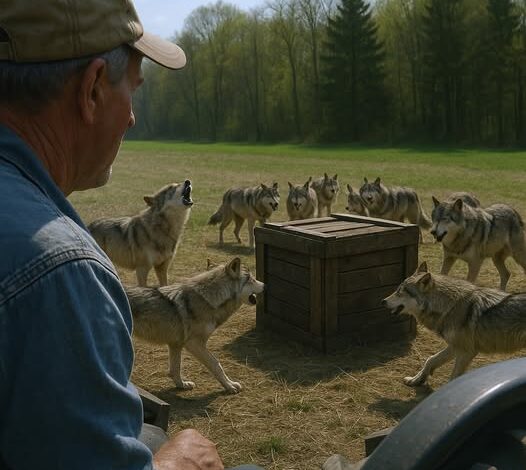
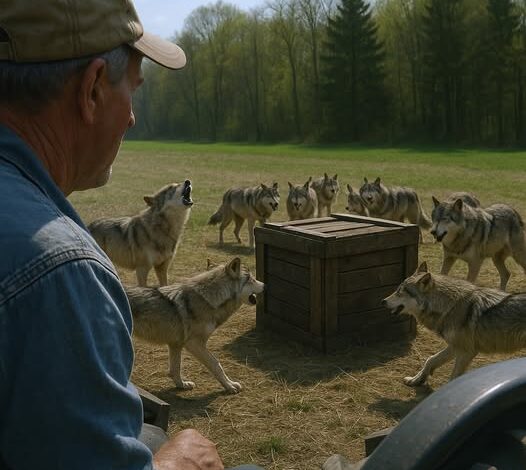
A pack of gray wolves—an entire pack—stood circling something in the center of the clearing. Not attacking it. Not tearing it apart. Circling. Calling. Pacing. And every few seconds, one wolf would dart forward and scratch at the side of a strange wooden crate sitting in the grass.
“What the hell?” Jack whispered.
The wolves saw him and didn’t bolt. Instead, they stepped back, watching him with sharp, intelligent eyes. A few trotted toward the trees, but not far—they hovered, restless, almost urging him forward.
Jack killed the engine and climbed down carefully. The wolves weren’t threatening him. They looked… desperate. Concerned. Like they’d been waiting for someone who could do something they couldn’t.
He grabbed a crowbar from the tractor and moved in slowly. The wolves slinked into the shadows, as if giving him space. As he neared the crate, he heard it—soft, muffled, and unmistakable.
A baby’s cry.
Jack’s heart slammed against his ribs. He dropped to his knees and pressed his ear to the rough boards. Another cry. Two cries.
He jammed the crowbar into the seam and pried hard. The old wood gave way with a violent crack. A board snapped loose. Jack ripped it off and looked inside.
Two infants—twins, no older than six months—wrapped in filthy rags and shivering in the cold.
For a moment, the world stopped. Jack felt his throat close, hot tears stinging his eyes. “Oh God… oh God, no.” Without thinking, he scooped them up, one in each arm, holding them close to his chest. Their tiny fingers clawed at his shirt, their little bodies shaking.
“Who did this to you?” he whispered.
The infants stared up at him with wide, innocent eyes, still crying but alive.
He rushed them to the tractor, wrapped them in his own coat, and fired up the engine. As he pulled away, he glanced back at the woods. The wolves were still there, watching silently from between the trees.
“Thank you,” he said out loud, voice thick. “You saved them.”
He tore across the fields, straight into town, slamming to a stop outside the clinic. Nurses ran toward him, horrified, grabbing the babies and rushing them inside. The sheriff arrived minutes later, grilling Jack like he was telling some tall tale. But when they went back to the clearing and saw the wolf tracks, the claw marks on the crate, and the sheer isolation of the spot, the story made grim sense.
A few days later, the truth unraveled.
The twins’ mother—a woman from a rough town twenty miles away—had dumped them there with her boyfriend. They claimed the crate was “for protection,” but their story fell apart fast. Their lives were a mess, and the twins were just another burden they wanted gone. They figured someone might find the crate by morning.
Except there were no houses nearby. No roads. No reason for anyone to pass by.
Except Jack. And except the wolves.
After the dust settled, Jack couldn’t shake the babies from his mind. He kept replaying the moment he pried open the crate—the cold little bodies, the tiny cries, the wolves circling like guardians refusing to abandon their post. His own kids kept asking about the “field babies.” His wife kept catching him staring off at nothing, eyes distant.
One night, over a quiet kitchen table, she reached across and took his hand. “Jack,” she said softly, “if they’re still not placed… maybe they’re supposed to be with us.”
He didn’t let go of her hand for a long time.
A few weeks later, they signed the adoption papers. When they brought the twins home—clean, warm, fed—they fit right into the farmhouse like they’d always been there. The older kids doted on them. Jack carried them around on his shoulders. He’d gone from a father of three to a father of five overnight, and the weight didn’t scare him. It settled onto him like something he was meant to carry.
The wolves never returned to the clearing. But Jack visited that spot every spring after, standing there in the quiet, remembering the day wild animals showed more humanity than the twins’ own parents ever had.
Sometimes, when the wind rustled through the trees, it almost sounded like a howl—soft, fading, like a reminder.
Not all beasts walk on four legs.
And not all heroes walk on two.