Rodrigo had always believed the road remembered him kindly.
As his horse moved at an unhurried pace along the familiar dirt path, hooves pressing rhythm into the dry spring earth, he felt a quiet confidence settle in his chest. The countryside unfolded like a reassurance—olive trees bending at the same angles they always had, fence posts worn smooth by time, dust lifting gently into the light. This road had shaped him before ambition ever had, before boardrooms and contracts and flights measured his worth.
Beside him, Valetipa rode easily, her posture perfect, her voice steady as she spoke about their future. She always spoke about the future as if it were a project already approved.
“…once everything finalizes,” she said, “we’ll need a city that reflects growth. Somewhere visible. Somewhere that matches where we’re going.”
Rodrigo nodded automatically. Agreement had become instinct.
But his thoughts were elsewhere. He believed his past was settled—eight years of marriage, one divorce, a clean exit. He had signed the papers, made the decisions, and told himself there were no loose ends left behind.
The horse slowed before he realized he’d pulled the reins.
A pressure formed behind his ribs, sharp and sudden, a warning without words.
Then he saw her.
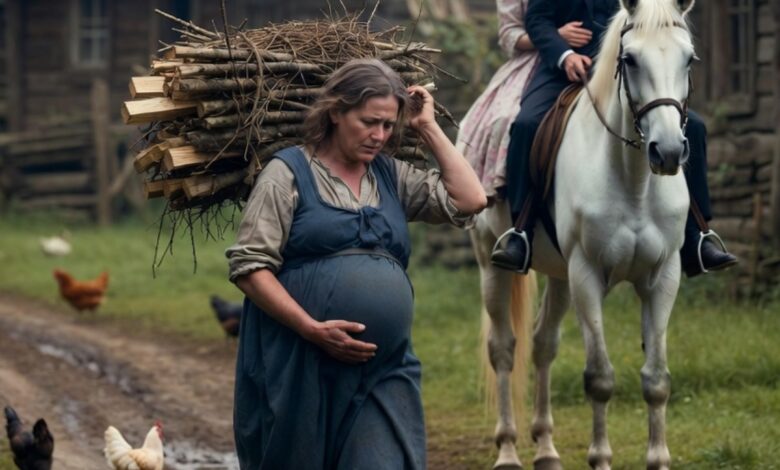
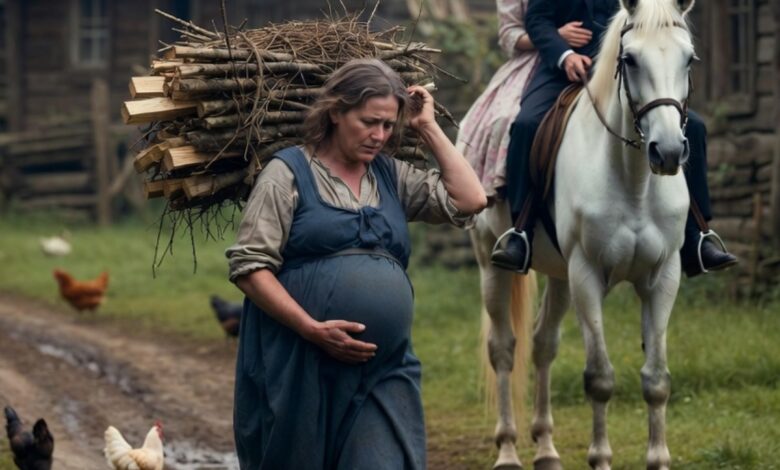
At first, she was just another figure moving along the property line—a woman carrying firewood, her steps steady, unremarkable. The kind of image the mind usually discards.
Until she lifted her head.
Their eyes met, and the world stopped.
Not slowed. Stopped.
Gabriela was changed. Her body bore the marks of work that didn’t come with titles or applause. Her face carried the quiet strength of someone who had learned to endure without witnesses. But all of that disappeared beneath one undeniable truth.
Her belly was full and round.
Pregnant.
Rodrigo’s blood went cold as memory snapped into alignment. Dates. Silence. The final weeks before the divorce. The last night they had spoken without anger.
That child was his.
Valetipa felt the shift instantly. “Rodrigo?” she asked, her voice tightening. “What’s wrong?”
He didn’t answer. He couldn’t.
Gabriela lowered her gaze, not in shame but in habit, one hand instinctively shielding her stomach as she adjusted her grip on the wood and kept walking. That small, practiced motion struck him harder than any accusation.
He dismounted without thinking and walked toward her, each step heavier than the last.
“Gabriela,” he said.
She stopped, set the firewood down carefully, one hand still resting over her belly like a boundary drawn in flesh.
“Rodrigo,” she replied evenly. “I didn’t expect to see you.”
“I didn’t know,” he said, the words useless the moment they left him.
“I know,” she answered simply.
The calm in her voice crushed him.
“Is it mine?” he asked, though the answer already lived between them.
“Yes,” she said. “He is your son.”
Something broke open inside him, quiet but complete.
“I tried to find you,” she added. “You didn’t let me.”
A memory surfaced of Valetipa at the door, composed, saying it wasn’t a good time.
“I should have insisted,” he whispered.
“No,” Gabriela said, not unkindly. “You made your choice. I made mine.”
Valetipa approached then, her gaze sharp, measuring Gabriela’s body, the pregnancy, the disruption.
“She’s pregnant,” Rodrigo said. “With my child.”
Silence fell.
“And what do you plan to do?” Valetipa asked.
Rodrigo hesitated. “I won’t pretend he doesn’t exist.”
Gabriela met his eyes. “I don’t want money. I don’t want guilt disguised as generosity.”
“I want to be there,” he said. “For my son.”
“Then learn how to arrive without imposing,” she replied. “Learn to listen before deciding.”
She lifted the firewood and turned away. “If you want to meet him when he’s born, you know where I live.”
Valetipa rode off without another word. Rodrigo remained alone on the road, watching Gabriela walk away carrying a life he had never meant to abandon—but had.
That night, sleep didn’t come.
At home, Valetipa waited with a tablet already open, plans already forming. She spoke of exposure, optics, settlements, silence. She framed a child as liability, a disruption to be managed.
Rodrigo listened—and finally heard the truth.
“You want me to erase him,” he said quietly.
“I want to protect what we’re building,” she replied.
For the first time, he saw it clearly. She didn’t love him. She loved the version of him she could control.
“I’m going back,” he said.
“If you do, our wedding is off,” she warned.
“Then it’s off,” he replied.
She left that night with efficiency mistaken for dignity. Rodrigo stayed behind, stripped of illusion but lighter for it.
When he returned to Gabriela’s house, he brought no flowers. No apologies dressed as gestures. Just groceries, and presence.
“This isn’t reconciliation,” Gabriela told him calmly. “This is responsibility.”
“I understand,” he said.
They talked about appointments, boundaries, schedules. About consistency.
“Words are cheap,” she said. “Time isn’t.”
He showed up.
Quietly. Repeatedly.
When labor came, he answered the phone on the first ring. He waited where he was told. He listened. He stayed.
When Mateo was born, small and furious at the world, Rodrigo held him with hands that finally understood weight. Not pride. Responsibility.
Weeks passed. Nights were sleepless. Mistakes were corrected without cruelty. Rodrigo adjusted without defensiveness.
Presence stopped being a performance and became routine.
One afternoon, Gabriela watched him buckle Mateo into a car seat, careful and methodical.
“You’re still here,” she said.
“I said I would be,” he replied.
Their relationship didn’t rush toward romance. Trust rebuilt itself slowly, like bone.
A year later, Rodrigo watched Gabriela kneel in the dirt beside their son, teaching him how to plant something fragile.
“You don’t rush it,” she said. “You water it. You protect it. You let it grow.”
Rodrigo understood then what the road had been trying to tell him all along.
Real growth doesn’t move upward.
It moves inward.
It stays.