The Grocery Store Angel
I was bone-tired that Thursday evening, the kind of exhaustion that settles into your marrow and makes every movement feel like wading through deep water. After pulling a twelve-hour shift at the hospital—my third double in as many weeks—all I wanted was to collapse onto my secondhand couch and pretend the world didn’t exist for at least six uninterrupted hours.
But life doesn’t pause for exhaustion, especially not for single mothers trying to hold together a household with duct tape and determination.
My feet throbbed with that deep, pulsing ache that no amount of hot water or ibuprofen could touch. The fluorescent lights in the grocery store buzzed overhead with an insistent hum that made everything feel slightly surreal, casting the familiar aisles in a dull yellow haze that somehow made the world feel even heavier than it already was. I was forty-three years old, divorced for two years, and raising two teenage daughters who were currently home with autumn colds, probably arguing over whose turn it was to feed our perpetually demanding cat.
All I needed was bread, milk, cheese, and maybe something frozen that could pass for dinner with minimal effort. Just the basics—the survival kit of a working nurse who hadn’t slept properly in what felt like years.
I paused near the entrance, brushing a loose curl behind my ear and trying to summon the energy to navigate the Thursday evening rush. That’s when I spotted Rick, the store manager, organizing shopping carts near the automatic doors. We’d known each other for years, ever since I’d helped care for his wife Glenda after her gallbladder surgery last spring.
“How’s Glenda doing?” I asked, surprised by how raspy my own voice sounded.
Rick’s weathered face brightened immediately, as though I were the first genuinely good thing he’d encountered all day. “She’s doing so much better, Ariel. She still talks about how gentle you were with her. She thinks you’ve got magic hands.”
I laughed softly, the sound catching in my throat. “She just appreciated the butterscotch pudding I brought. That’s all.”
“How are your girls holding up?”
“Still fighting over whose turn it is to feed the cat,” I said. “Celia’s got some science project involving fungi growing somewhere in her closet, and Ara’s devastated her soccer team didn’t make the finals. So we’re hanging in there, basically.”
He smiled and gave me a playful two-finger salute before returning to his work. I grabbed a cart and finally allowed myself to take a full breath, pushing forward into the maze of aisles and other exhausted people just trying to get through another day.
The Moment That Changed Everything
The store was predictably packed with the usual Thursday crowd—people stopping on their way home from work, parents with screaming children, elderly shoppers moving with careful deliberation. Carts squeaked. A toddler’s tantrum echoed from somewhere near the cereal. An automated announcement about rotisserie chicken specials crackled over the speakers with tinny enthusiasm.
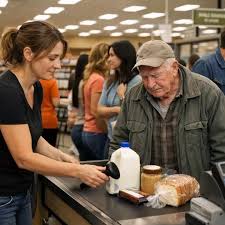
And there, in the express checkout lane just ahead of me, stood an elderly man who would change the entire trajectory of my life.
He was small and slightly hunched, wearing a faded navy jacket that had clearly seen better decades. His hands trembled visibly as he carefully placed three items on the conveyor belt: a loaf of store-brand white bread, a small jar of peanut butter, and a single quart of milk. The groceries were so simple, so essentially basic, that they almost hurt to look at—these were the purchases of someone counting every single penny.
The cashier, a young woman I recognized from previous visits, scanned the items and announced the total. The old man fumbled with his wallet, pulling out a worn debit card with fingers that shook slightly.
He swiped it through the reader.
The machine emitted a harsh, unforgiving beep.
Declined.
The man’s face flushed with visible embarrassment. He swallowed hard and tried again, sliding the card with careful precision, as though the angle or pressure might somehow change the outcome.
The machine repeated its sharp, merciless sound.
Declined.
The cashier hesitated, her eyes shifting between the elderly man and the growing line of impatient customers behind us. Her hand hovered uncertainly over the conveyor belt, clearly unsure whether to continue the transaction or begin removing items.
A woman directly behind me clicked her tongue with theatrical impatience. Someone else released a dramatic sigh that seemed designed to communicate their suffering. A man several people back actually muttered loud enough for everyone to hear, “Oh for goodness sake… some of us have places to be before we’re that age.”
The elderly man’s cheeks turned an even deeper shade of red. His gaze dropped to the counter, shoulders curling inward as though he wished he could physically disappear into the floor.
“I can… I can put some things back,” he said softly, his voice barely louder than the buzzing fluorescent lights overhead. “Maybe just the peanut butter? That might help, right?”
My chest tightened with a feeling I recognized immediately—that particular blend of fury and heartbreak that comes from witnessing unnecessary human cruelty. I hated how small his voice sounded. I hated how nobody in that line paused to help. And most of all, I hated how intimately familiar that specific brand of humiliation felt, that instinct to shrink yourself when life unravels in front of strangers who can’t be bothered to care.
Before he could reach for the jar of peanut butter to remove it, I stepped forward and placed my hand gently on his arm.
“It’s all right,” I said clearly, my voice steady despite the exhaustion. “I’ve got this.”
He turned to look at me, his eyes widening with surprise and something that looked almost like disbelief.
“Miss, are you certain?” he asked, his voice cracking slightly. “I didn’t mean to hold everyone up. I can just come back another day when my check clears.”
“You’re not holding anyone up,” I said firmly, reaching past him to grab a chocolate bar from the impulse rack and adding it to his items. “And everyone deserves something sweet. That’s the rule with my daughters—we always have to add something sweet to the cart, even if it’s small.”
“You really don’t have to do this,” he said, his eyes growing shiny with moisture he was clearly trying to contain. “I’ll manage somehow.”
“I know I don’t have to,” I replied gently. “But I want to. Sometimes we all need someone to want to help.”
The total came to just under ten dollars. I handed my card to the cashier before he could protest further and collected the receipt. The bag of groceries looked almost pathetically light as I handed it to him, and I found myself wishing I’d added more items, but I didn’t want to embarrass him further by making it obvious.
“Thank you,” he whispered, clutching the bag like it contained something precious rather than basic staples. “You have no idea what this means.”
“You’re welcome,” I said simply.
I completed my own shopping in a distracted haze, my mind lingering on the elderly man even as I navigated the aisles and selected items from my mental list. When I finally emerged from the store twenty minutes later, the evening air had turned crisp and sharp, carrying that particular autumn bite that signals winter isn’t far behind.
He was still there, standing near the edge of the parking lot as though he’d been waiting. When he saw me, he approached with careful, measured steps.
“I wanted to thank you again,” he said, his voice stronger now but still carrying the weight of emotion. “Most people would have walked right past. Most people wouldn’t have even noticed.”
“Most people are just tired and trying to get through their own day,” I said, though I wasn’t sure if I was defending them or making excuses. “But you’re welcome. I hope things get better for you soon.”
He nodded slowly, studying my face with an intensity that felt almost unsettling, as though he were memorizing every detail.
“You’re a good person,” he said finally. “I can see that. The world needs more people like you.”
Then he turned and walked down the darkening sidewalk, his figure growing smaller until the shadows swallowed him completely.
Life Goes On
I drove home with the radio off, my mind replaying the encounter in fragments. By the time I reached my small rental house with its peeling paint and overgrown lawn I never had time to properly maintain, I’d already filed the incident away as one of those small moments of human decency that flicker briefly before life’s relentless current sweeps them downstream.
I had dinner to cook, daughters to comfort through their colds, bills to sort through with mounting anxiety, work emails to answer. A house that echoed with all the memories I actively avoided examining too closely.
That moment in the grocery store was just that—a moment. A tiny act of basic human kindness in a world that had grown too busy and too cynical to notice such things anymore.
At least, that’s what I believed as I unpacked my groceries and started heating water for pasta.
I had no idea that moment would circle back to me in ways I couldn’t possibly have imagined.
Two mornings later, I was pouring my first desperately needed cup of coffee when a sharp knock on my front door startled me badly enough that I nearly dropped the mug. The sound wasn’t frantic or aggressive—just purposeful and insistent, the knock of someone with a specific reason to be there.
My neighborhood was close-knit in the way older communities tend to be, where people still checked on each other and borrowed cups of sugar. Just the previous night, I’d rushed next door to help Mrs. Chen when her blood pressure spiked dangerously. So unexpected visitors weren’t entirely unusual.
I opened the door to find a woman in her early thirties wearing a charcoal-gray business suit that looked expensive and professional. Her dark hair was pulled into a severe bun, and she carried a leather bag that clearly contained more than just paperwork. Her expression was carefully composed, but her posture betrayed a sense of urgency that immediately put me on alert.
“Ma’am,” she said, her voice polite but formal, “are you the woman who helped an elderly man at the grocery store on Thursday evening?”
It took me a moment to shift mental gears. My brain immediately ran through every patient I’d cared for during my most recent hospital shift, trying to identify who might have tracked me down.
“At the grocery store,” she clarified, seeing my confusion. “You paid for his groceries when his card was declined.”
“Oh,” I said slowly, memory flooding back. “Yes, I did. Is he okay? Did something happen?”
She nodded, but the motion seemed tight and controlled. “My name is Martha. The elderly man you helped is my grandfather, Dalton. He specifically asked me to find you. We need to talk—it’s quite important. It concerns his final request.”