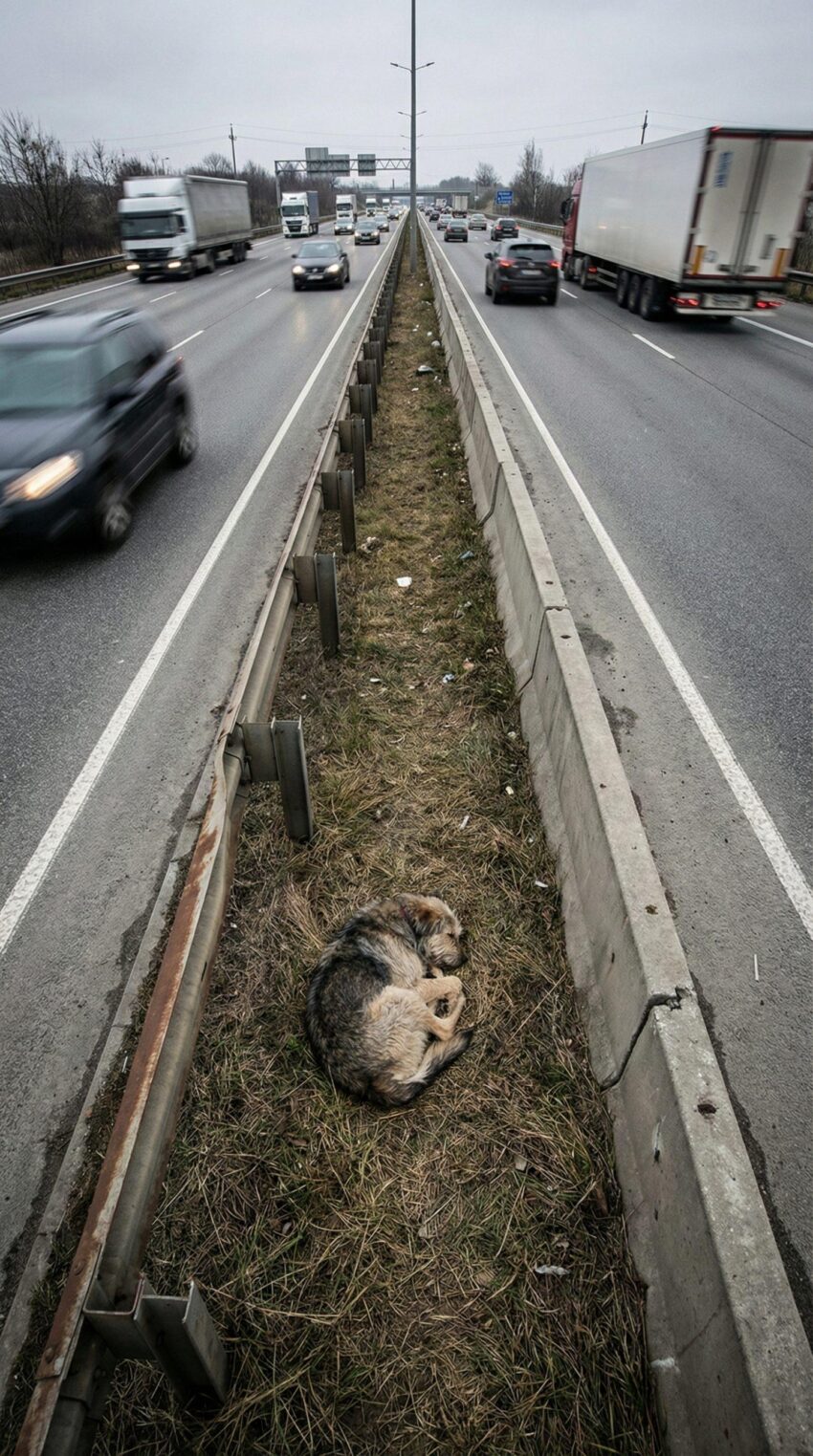
In the gray dawn of a Polish winter morning in late 2024, truck driver Marek Kowalski slammed on his brakes on the A2 motorway near Warsaw. What he thought was a pile of debris between the lanes turned out to be a sleeping dog—a shaggy, brown-and-black mutt curled tightly into a ball on the narrow divider. Cars whizzed by at 120 km/h, horns blaring, yet the dog didn’t stir. Marek later told local reporters he felt his heart drop: one wrong swerve from any vehicle, and it would be over.

Marek pulled over, hazard lights flashing, and called emergency services. Within an hour, firefighters and a local animal welfare volunteer arrived. They blocked lanes, creating a temporary shield of vehicles. The dog—later named Bruno—woke slowly, disoriented but too weak to run. He allowed them to lift him into a carrier without resistance. Veterinarians found him severely malnourished, dehydrated, and suffering from frostbite on his paws. A microchip scan revealed no owner registered in Poland. Bruno had somehow ended up in the most dangerous spot imaginable: a concrete island between roaring traffic, where survival seemed impossible.
But Bruno’s story was only beginning—and it would soon connect to tales from highways thousands of miles apart, revealing a pattern of abandonment and improbable resilience that shocked animal rescuers worldwide.
Two months earlier, in the scorching heat of Abu Dhabi, United Arab Emirates, a similar scene unfolded on the ten-lane E11 highway. A slender saluki—known for their speed and endurance—had been spotted trapped on the central barrier. Cars flew past at 140 km/h. The dog, later called Luna, huddled in the shade of a signpost, refusing to move. Social media erupted when a drone video went viral. A group of Emirati volunteers, coordinated through WhatsApp groups, mobilized. One man, Ahmed Al-Mansoori, risked his life by dashing across lanes during a rare traffic slowdown. He scooped Luna up as horns blared. She was emaciated, her once-glossy coat matted with dust and oil. Rescuers discovered she had been dumped by a breeder after failing to win races—left on the highway to fend for herself. Luna’s paws were burned from the hot asphalt she had crossed to reach the median. She survived five days without food or water before being noticed.

Across the Atlantic, in Missouri, USA, rescuers encountered an even more heartbreaking twist. In early 2025, a black Labrador mix named Shadow was found injured on the shoulder of Interstate 70 near St. Louis. But she wasn’t alone. Trailing behind her, limping but determined, was a smaller terrier mix—her loyal companion, later named Buddy. Witnesses said Shadow had been hit by a car while trying to cross with Buddy. Both dogs had been abandoned weeks earlier after their owner moved and left them behind. Shadow’s injuries were severe: broken ribs, internal bleeding. Yet she refused treatment until Buddy was safe beside her. The pair had wandered onto the highway median seeking shelter, surviving on scraps and rainwater. Their story exploded online, with thousands donating to their care. Shadow pulled through surgery; Buddy never left her side during recovery.
These three dogs—Bruno in Poland, Luna in the UAE, Shadow and Buddy in the US—shared eerie similarities: all curled up on or near highway medians, all seemingly waiting for someone who never returned, all defying odds in places where one moment of inattention means death. Rescuers began connecting the dots. Was there a global pattern of drivers abandoning pets on major routes?
Investigations revealed disturbing truths. In Poland, Bruno’s collar suggested he once belonged to a family from a nearby village. Neighbors recalled the owners moving to Germany abruptly; they claimed the dog “ran away.” But security footage from a gas station showed them stopping on the A2 shoulder, opening the car door, and driving off as Bruno chased after them. Heartbroken, he wandered onto the median, perhaps believing they would come back.
Luna’s case in Abu Dhabi exposed the dark side of the region’s pet trade. Breeders import salukis for prestige racing or hunting, discarding them when they underperform. Many end up on highways, too proud or disoriented to beg in cities. Luna had crossed three lanes of traffic to reach the barrier—miraculously avoiding collision—before collapsing from exhaustion.
In Missouri, Shadow and Buddy’s abandonment stemmed from a family eviction. The owners, facing homelessness, left the dogs in a rural area, hoping they would find their way. Instead, hunger drove them toward the interstate, where the median offered the only “safe” grass strip amid endless concrete.
The most shocking twist came when Bruno’s rescuers in Poland posted his photo online. A woman in Germany recognized him. She was the daughter of Bruno’s original owners. Tearfully, she explained that her parents had passed away suddenly in a car accident months earlier. In their will, they left instructions to rehome Bruno—but the relative tasked with it panicked and drove him to Poland (where the family had vacationed), abandoning him on the familiar motorway in a misguided attempt to “set him free” near places he knew. The relative confessed after seeing the viral photo, facing animal cruelty charges.
Bruno was flown to Germany for reunion with the daughter, who adopted him properly. Luna found a forever home with Ahmed’s family in Dubai, where she now races safely in open deserts. Shadow and Buddy were adopted together by a St. Louis couple who run a small farm—Buddy still sleeps pressed against Shadow every night.
These stories, separated by oceans yet united by the same vulnerable pose—curled tight against cold, heat, and indifference—highlight a cruel reality: highways have become dumping grounds for unwanted pets. Yet they also reveal extraordinary human compassion. Strangers risked lives, communities rallied online, and in each case, a discarded life found second chances.
Bruno, Luna, Shadow, and Buddy remind us that even in the roar of traffic, where survival hangs by seconds, hope can still curl up quietly and wait to be noticed. Their survival wasn’t luck alone—it was the refusal of ordinary people to look away.
