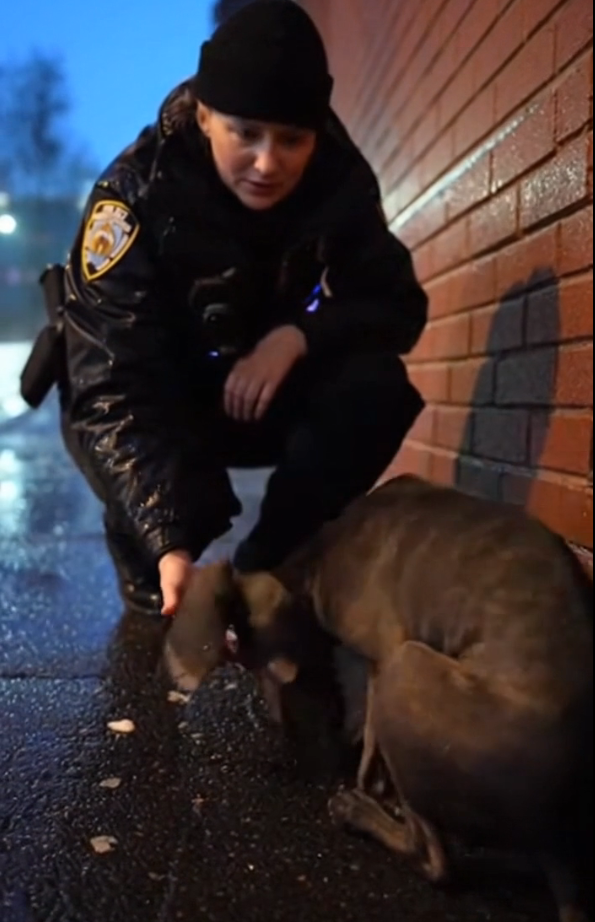
The dog screamed before anyone even touched him.
A sharp, broken sound tore through the quiet alley—raw, panicked, almost human. The kind of sound that made people stop mid-step, breath caught halfway in.
He wasn’t being attacked.
He wasn’t cornered.
No hand had reached him yet.
He was just being seen.
The dog— a young pit bull mix, barely three years old—pressed himself flat against the brick wall, body shaking so violently his legs slid out from under him. His ribs showed through short, patchy fur. One ear was torn at the edge. His eyes were wide, unfocused, darting from face to face like he was counting exits that didn’t exist.
A man in a reflective jacket stood frozen a few feet away. Early forties. Construction worker by the look of him. Dirt under his nails. Coffee breath. He lifted his hands slowly, palms open.
“Hey… hey… it’s okay,” he whispered.
The dog screamed again.
Not in anger.
In terror.
People gathered—two commuters, a woman walking her own dog, a police officer who had pulled over when he heard the noise. No one moved closer. No one spoke loudly. The alley felt like it had sealed itself shut.
Rainwater pooled around the dog’s paws. Old trash bags clung to the walls. A flickering streetlight painted everything in sickly yellow.
The officer crouched, voice low. “Has he been hit?”
“No,” someone said quietly. “He’s just… scared.”
The pit bull’s paws trembled uncontrollably. His chest heaved in short, frantic breaths. A thin rope was still knotted loosely around his neck—frayed, dirty, cut short, as if he’d chewed his way free.
When the officer reached one inch closer, the dog collapsed onto his side, curling inward, teeth chattering, tail locked stiff against his body.
Like he had already decided what was about to happen.
Like he had learned that humans only approached right before something bad.
The alley went silent again.
And in that silence, one horrifying question settled over everyone there:
What had been done to make a dog this afraid of being touched?
Because this wasn’t a stray reacting to surprise.
This was a dog reacting to memory.

They named him Ghost at the shelter.
Not because he was quiet—he wasn’t.
But because he moved like someone who didn’t believe he was allowed to exist.
Ghost flinched at footsteps.
At keys jingling.
At shadows shifting across the floor.
The intake room smelled of antiseptic and wet fur. Fluorescent lights hummed overhead. A volunteer wrapped a blanket around his shaking body, careful not to let her fingers brush his skin.
“It’s okay,” she said softly, though Ghost’s eyes never left the door.
The vet estimated his age at three. Maybe younger. Underweight. Dehydrated. Scar tissue along his ribs. Old bruising beneath the skin—not fresh enough to prosecute, but not old enough to forget.
He had no microchip.
No missing reports.
Just fear—deep, patterned, learned.
When a man raised his voice in another room, Ghost urinated on himself and froze. When a woman tried to offer him food from her hand, he backed into the corner until his spine pressed painfully against the wall.
They discovered something else on the third day.
Ghost didn’t react the same way to everyone.
Men in boots? Panic.
Loud voices? Shutdown.
Fast movements? Full collapse.
But when an older volunteer named Ellen entered—gray-haired, soft-spoken, moving slowly—Ghost didn’t scream.
He still trembled.
Still avoided eye contact.
But he stayed upright.
Ellen noticed it immediately.
“You’ve learned who hurts you,” she murmured. “Haven’t you, sweetheart?”
Ghost’s tail did not move.
But it didn’t tuck tighter either.
The shelter staff pieced together fragments. A neighbor’s anonymous tip about a backyard dog used for intimidation. A landlord complaint about yelling. A rope burn pattern too familiar to ignore.
Ghost hadn’t been trained.
He had been controlled.
And when he finally broke free—chewing through the rope, bolting down the street—every human face became a threat his body remembered even when his mind didn’t want to.
They tried rehabilitation.
Slow feeding.
No direct eye contact.
Sitting on the floor instead of standing.
Progress came in inches.
Ghost learned to eat when someone was in the room—if they faced away. Learned to sleep through the night without screaming. Learned that hands could exist without striking.
But one thing never changed.
His tail.
It never wagged.
Weeks turned into months. Other dogs came and went. Some were adopted. Some were returned.
Ghost stayed.
One afternoon, a volunteer sighed, watching him curl inward as footsteps passed.
“He might never be normal,” she said quietly.
Ellen shook her head. “Normal isn’t the goal.”
Then she added, barely audible,
“Trust is.”
The real change didn’t come from training.
It came from routine.
Every morning at 7:10, the same city bus stopped near the shelter. And every morning, the same driver—a woman in her late fifties, hair pulled back, voice calm from years of speaking to strangers—stepped inside to drop off a bag of old blankets.
She never tried to touch Ghost.
Never called his name.
She just sat on the bench near his kennel and said, the same way, every time:
“Good morning. I’m back.”
The first week, Ghost hid.
The second, he watched.
The third, he stayed visible.
And one morning—so small it almost went unnoticed—his tail twitched.
Just once.
Uncontrolled.
Unplanned.
Like a muscle remembering something his heart had forgotten.
Then he froze.
As if terrified of what that movement might cost him.
The woman smiled softly, tears threatening her eyes.
“I saw that,” she whispered. “You’re doing better than you think.”
Ghost did not wag again that day.
But something irreversible had begun.
Because for the first time since he learned to fear humans—
His body had betrayed his fear.
The day Ghost almost lost his life didn’t begin with drama.
It began with snow.
Heavy, wet snow falling sideways, clinging to street signs and piling against the shelter’s back fence. The kind of cold that numbed fingers in minutes and made even routine tasks feel urgent.
That morning, Ghost refused to eat.
He stood rigid in the corner of his kennel, body tight, eyes fixed on something no one else could see. His breathing grew shallow. His legs trembled—not from fear this time, but from exhaustion.
Ellen noticed first.
“He’s not okay,” she said, already kneeling, already counting breaths.
The vet arrived within minutes. Pale. Focused. Quiet.
“His heart rate’s unstable,” she murmured. “We need to move. Now.”
They wrapped Ghost in blankets. His body felt frighteningly light. Too light for a dog who had already survived so much.
The room smelled of antiseptic and damp wool. Fluorescent lights blurred overhead as they carried him through the hallway. Someone dropped a clipboard. It clattered loudly.
Ghost flinched.
Even now.
Even here.
As they loaded him into the transport van, snow melting into mud beneath their boots, a familiar figure appeared at the gate.
The bus driver.
Late fifties. Gray streaks in her hair. Coat pulled tight against the cold. Her name was Marianne—though Ghost had never known it.
She stopped when she saw him.
“What happened?” she asked, voice tight.
“He collapsed,” Ellen said. “We don’t know yet.”
Marianne didn’t hesitate.
“I’ll ride with him.”
Inside the van, Ghost stirred. His eyes fluttered open. The world felt wrong—too loud, too fast, too close.
He tried to pull away.
Marianne sat on the floor beside him, careful not to touch.
“It’s me,” she said softly. “I’m here. Same as always.”
Her voice was steady. Familiar.
Something in Ghost’s chest loosened—just enough to breathe.
At the clinic, everything blurred.
Cold metal table.
White walls.
The sharp smell of medicine.
Hands moved quickly, but gently. Monitors beeped in a steady rhythm. Ghost whimpered once, a broken sound that made everyone pause.
Marianne stood in the corner, hands shaking now, tears slipping down her cheeks.
“You’re safe,” she whispered. “You don’t have to fight alone.”
The vet worked for nearly an hour.
Hypothermia. Severe stress response. Old trauma layered onto a body already pushed past its limits.
“He’s been surviving in emergency mode for too long,” the vet said quietly. “His system doesn’t know how to stand down.”
Marianne stepped closer.
“Can I… can I sit with him?”
The vet nodded.
Marianne sat on the floor, back against the wall, knees drawn up. She didn’t reach out. She didn’t force contact.
She just stayed.
Minutes passed.
Then something happened.
Ghost’s tail moved.
Not the tiny twitch from before.
It lifted.
And then—without warning—it began to wag.
Wild.
Uncoordinated.
Completely out of control.
Like a dam breaking.
The room froze.
The vet stared. Ellen covered her mouth. A nurse whispered, “Oh my God…”
Ghost’s body still trembled—but his tail did not stop.
It thumped against the blanket, against the floor, against the side of the table, as if making up for years of silence.
Marianne let out a sob she didn’t know she’d been holding.
“Hey,” she whispered. “There you are.”
Ghost’s eyes found her.
And for the first time in his life, he didn’t look away.
Healing didn’t happen all at once after that day.
It never does.
Ghost didn’t wake up fearless.
He didn’t suddenly love strangers.
He didn’t forget what had been done to him.
But something fundamental had shifted.
Fear was no longer the only thing his body remembered.
Marianne began visiting every afternoon after her bus route ended. She sat with Ghost. Read quietly. Sometimes hummed under her breath.
No commands.
No expectations.
Just presence.
When Ghost pulled away, she let him.
When he came closer, she stayed still.
Weeks passed.
Snow melted.
Spring crept in slowly.
Ghost gained weight. His coat filled in. His eyes softened—not always, not completely—but enough to notice.
And his tail?
It wagged now.
Not constantly.
Not for everyone.
But when Marianne walked through the door, it betrayed him every time.
One afternoon, Ellen watched from across the room as Ghost leaned—just slightly—into Marianne’s leg.
Not pressing.
Not clinging.
Choosing.
Ellen felt tears sting her eyes.
Some dogs learn tricks.
Others learn something harder.
They learn that not every human leaves.
That not every hand hurts.
That love doesn’t always come with a price.
Marianne eventually fostered Ghost. Then adopted him.
She didn’t call it “rescue.”
She called it showing up.
Ghost still startles at loud noises. Still flinches at sudden movement. Still carries scars no one can see.
But every morning, when Marianne reaches for her coat, Ghost’s tail starts wagging before she even turns around.
Uncontrolled.
Joyful.
Alive.
I think about Ghost often.
About how close he came to disappearing without ever knowing what safety felt like.
And I wonder how many others are still trembling in corners—waiting not for perfection, but for patience.
Because sometimes the most meaningful improvement isn’t loud.
It’s quiet.
It’s a tail that finally forgets to be still.
 What do you think saved Ghost more — rescue, or consistency? Would you have waited for a dog who couldn’t trust you yet?
Share your thoughts in the comments.
Someone reading might need that hope today.