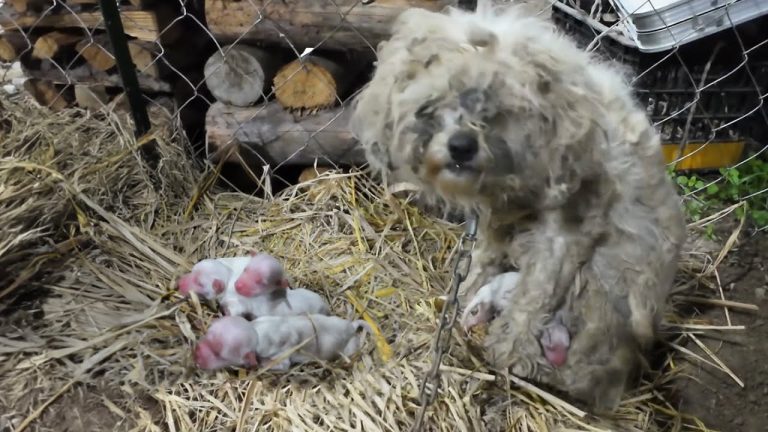
In a grim, abandoned sawmill on the outskirts of town, a heartbreaking scene quietly unfolded. Among rusted machinery and splintered wood, a mother dog lay heavily chained, her body weak from exhaustion. She could move only a few feet in any direction, the cold concrete beneath her offering no comfort. Just beside her, four newborn puppies—only hours old—struggled against freezing, sub-zero temperatures. Their tiny bodies trembled in the bitter air, utterly dependent on a mother who was herself barely surviving.
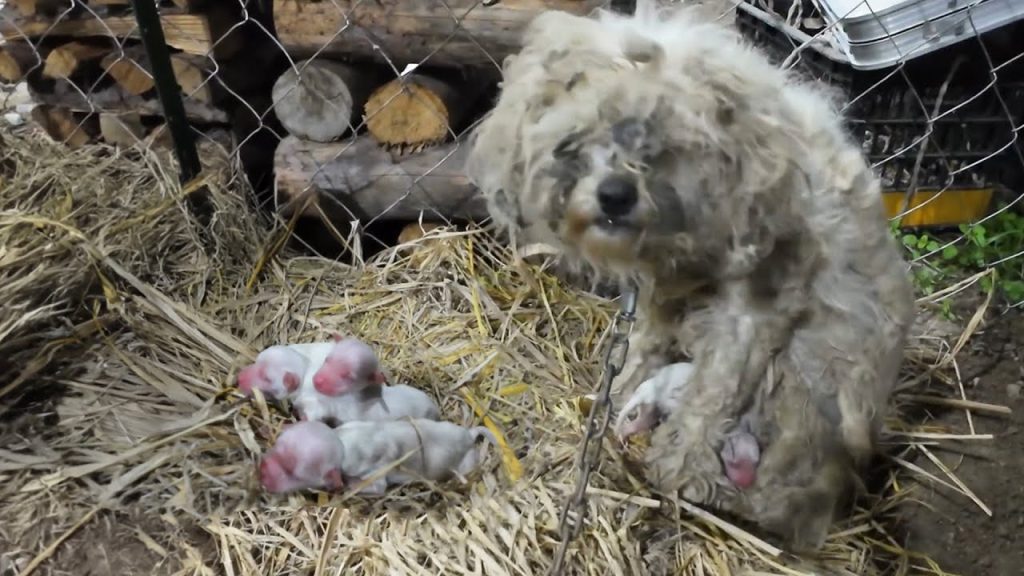
The sawmill had long been forgotten by people, but not by suffering. The wind slipped through broken boards and cracked windows, carrying with it the harsh chill of winter. There was no proper shelter, no insulation from the cold, no sign that anyone had intended to return. The chain around the mother’s neck was heavy and unforgiving, limiting her ability to curl fully around her babies. She tried her best to shield them, nudging them close, straining against the restraint as if sheer willpower could warm them.
It was a kind-hearted man who discovered them. He had no grand plan that day, no expectation of becoming part of their story. But when he saw the mother dog straining to comfort her newborns, something in him shifted. Without hesitation, he stepped forward. He understood immediately that time was critical. The puppies were fragile, their lives measured in hours, not days, if the cold continued unchecked.
He moved quickly, gathering straw to create a layer between the family and the frozen ground. He fashioned what shelter he could from the materials around him, blocking drafts and adding insulation wherever possible. Food was brought for the mother—simple nourishment, but desperately needed. She ate with cautious gratitude, her body too depleted to produce sufficient milk without support. Warmth, even in small increments, began to change the atmosphere. It was not comfort yet, but it was hope.
The man returned again and again, checking on them, adjusting the straw, bringing fresh food and water. He spent long hours there, determined not to let neglect claim another life. He understood that survival for newborn puppies in such extreme conditions is never guaranteed, even with intervention. Still, he refused to give up.
Despite his tireless efforts, the cold had already taken its toll. One by one, three of the four puppies succumbed to the harsh conditions they had endured in their earliest hours. It was a devastating turn, a reminder that even compassion cannot always undo what neglect has done. The mother dog mourned in her own quiet way, nudging the still bodies, confused by the silence that replaced their fragile cries.
Only one puppy survived.
Recognizing how precarious that small life remained, the man made a decisive choice. He brought the surviving pup into his own home. There, in the warmth of a safe space, he fed the little one every two hours, day and night. Sleep became secondary. Routine disappeared. His focus narrowed to a single purpose: keep this puppy alive. He measured formula carefully, monitored breathing, and kept the pup close to steady warmth. It was exhausting, but it was necessary.
Meanwhile, he could not forget the mother still chained at the sawmill. Though she had lost most of her litter, she remained vulnerable. Determined to create lasting change rather than temporary relief, the man made a remarkable decision. He purchased the old warehouse property itself. What had once been a place of abandonment would no longer serve as a backdrop for suffering.
With ownership secured, he began transforming the space. The chain was removed. A comfortable shelter was built—solid walls, proper bedding, protection from wind and rain. The mother dog, once confined and exposed, now had room to move freely within a secure environment. She no longer strained against restraint; instead, she explored cautiously, as if unsure whether this newfound freedom was real.
The surviving puppy grew stronger each day under careful feeding and steady care. Gradually, the danger that once hovered over his fragile body began to fade. His eyes opened fully to the world. His movements became more confident. Yet an emptiness remained in the space where his siblings had once lain. Loss leaves a quiet imprint, even in the animal world.
Then came an unexpected new chapter.
The same man learned of four more abandoned puppies in need of immediate help. Without hesitation, he brought them to the newly restored shelter and introduced them to the mother dog. There was a brief moment of uncertainty, as there always is when unfamiliar animals meet. But instinct runs deep. The mother dog approached gently, sniffing each small body, listening to their tentative whimpers.
Something shifted in her posture. The tension that had defined her early days in the sawmill softened. She lay down, allowing the orphaned puppies to nestle close. Within moments, she began caring for them as if they had always been hers. The void left by her lost litter did not disappear, but it was filled with purpose. She cleaned them, warmed them, and accepted them fully.
The surviving original puppy blended seamlessly with the newcomers, no longer alone. Together, they formed a new family—bound not by circumstance of birth, but by compassion and second chances. The man watched as the once-desolate warehouse became a sanctuary of movement and sound, where playful paws replaced the silence of abandonment.
By the sixty-fourth day, the transformation was undeniable. The mother and her adopted litter transitioned to a spacious, vibrant new home designed specifically for their well-being. There was room to run, grass beneath their feet instead of cold concrete. Sunlight streamed through open spaces, warming fur that had once known only frost. Laughter replaced worry.
What began as a scene of isolation and despair ended as a testament to persistence and mercy. A chained mother, newborns on the brink, and an abandoned building could have been forgotten. Instead, they became the center of a story defined by steady, practical compassion. The losses were real and deeply felt, but so was the renewal.
In the end, the sawmill no longer symbolized neglect. It stood as proof that even in the coldest places, kindness can build warmth strong enough to change the course of a life.