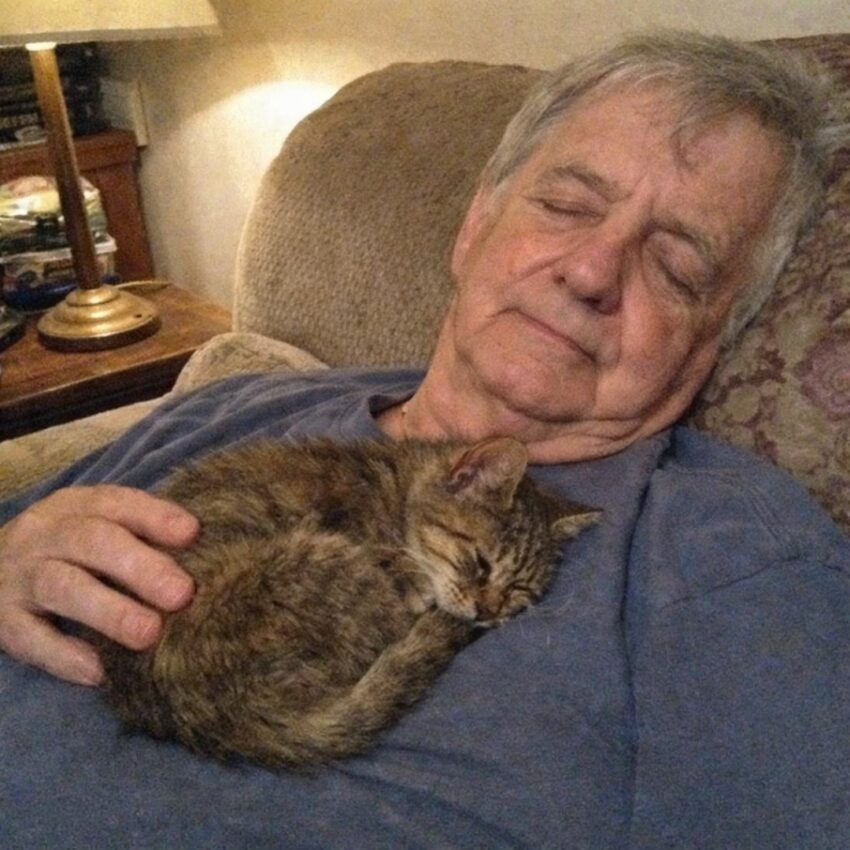
She had been sitting in the shelter for 204 days without a single serious inquiry. Most visitors wouldn’t even approach her kennel. Then one afternoon, a man who openly admitted he wasn’t a cat person walked in and said, “I’ll take the difficult one.”
We had first taken her in during the spring of 2019. Someone had abandoned her before sunrise, crammed inside a plastic crate and left outside the clinic. No note. No name. Her fur was tangled with dried blood, and her sharp yellow stare warned anyone not to come too close. She weighed barely five pounds. One ear was torn, patches of fur were missing, and her growl rumbled low and rough.
The staff jokingly called her Chaos. I started calling her Wednesday — the day I stopped trying to promote her for adoption. Cats like her rarely get chosen. People prefer wide – eyed kittens who purr on cue and look good in photos. They don’t line up for older, half-feral cats with scarred faces and a reputation for biting.
She hissed at nearly everyone. She wouldn’t eat if someone watched. She claimed the space under the laundry counter and reacted sharply to sudden movement. Yet she never missed the litter box. And at night, when the clinic went quiet, she would curl up on the exam bench where sunlight had warmed the cushion earlier in the day.
We shared her story online. We tried campaigns focused on overlooked animals. Nothing worked. Eventually, she simply became part of the building — a quiet, prickly presence we learned to live with. My team left extra food. I gave her access to the hallway after hours. When I stayed late finishing paperwork, she sometimes perched nearby—close enough that I could feel her warmth, but never close enough to touch. We respected each other’s boundaries.
Then Frank Donovan came in.
He was seventy-three, a retired machinist who had lost his wife to cancer the year before. His shoulders sagged under the weight of loneliness. He stopped by for flea medication, and we made small talk about everyday things. Then he surprised me by asking if we had any cats nobody wanted.
I asked why.
He said the house felt unbearably quiet. His dog had passed months earlier, and he couldn’t stand the silence.
I led him to the back room. Wednesday crouched beneath a cabinet, watching us carefully. Frank slowly knelt down and studied her.
“So you’re the troublemaker?” he said gently.
She growled.
He smiled. “That’s fine. I don’t trust anything that’s friendly too fast.”
She didn’t run. He didn’t push. After a quiet moment, he said he’d take her.
I warned him about her temperament and the possibility she might never soften. He waved off the concern. He wasn’t searching for a cuddly companion. He just wanted company.
During the first week, he phoned daily with updates. She hid in odd places. She knocked food off tables. She sat on his chest during naps and stared at him. After a few weeks, she had a new name — Marlene.
Six weeks later, he brought me a photo of her stretched in a beam of sunlight on his windowsill. He looked different too — lighter somehow.
Then one week, the calls stopped.
When he didn’t show up for his usual Saturday visit, worry settled in. I went to his home. The porch light was on. The car was still there. No answer at the door. When I stepped inside, I found him on the floor near his recliner, gone peacefully.
Curled against him was Marlene.
She glanced up at me once but didn’t hiss or move. She stayed pressed against him, as if guarding what little warmth remained.
A deputy later told me Frank had written my name on a slip of paper in his wallet with instructions to contact me if anything happened.
That’s how Marlene returned.
Back at the clinic, she refused food for three days. She didn’t hide or lash out. She just lay under the exam bench, staring into space. On the fourth day, I placed one of Frank’s flannel shirts beside her. She curled into it immediately, as if it anchored her to something familiar.
I never attempted to rehome her again. She had already fulfilled her purpose — giving an aging man companionship when he needed it most. That felt like enough.
She lived another year before passing quietly under a heat lamp one afternoon. I buried her behind the clinic beneath a tall poplar tree, wrapped in Frank’s flannel.
Some might question grieving a cat who offered more scratches than snuggles. But loss isn’t reserved for the easy ones. It’s about connection.
When people ask which case has stayed with me the longest, they expect dramatic rescues or life-saving surgeries. Instead, I think of Frank—and that tough old cat who finally allowed herself to belong.
Sometimes what we crave isn’t constant affection. It’s simple presence. Two wounded beings sharing the same quiet space, acknowledging each other without judgment.
For some of us, that is more than enough.