“They let that thing into school?” someone snorted.
I tightened my grip on the leash. My dog trembled beside me. Then a voice behind us said one name—and the hallway went silent.

Lockers slammed. Sneakers squeaked against polished floors. Morning light spilled through tall windows, pale and unforgiving. The air smelled like disinfectant and cafeteria toast.
I kept my eyes down.
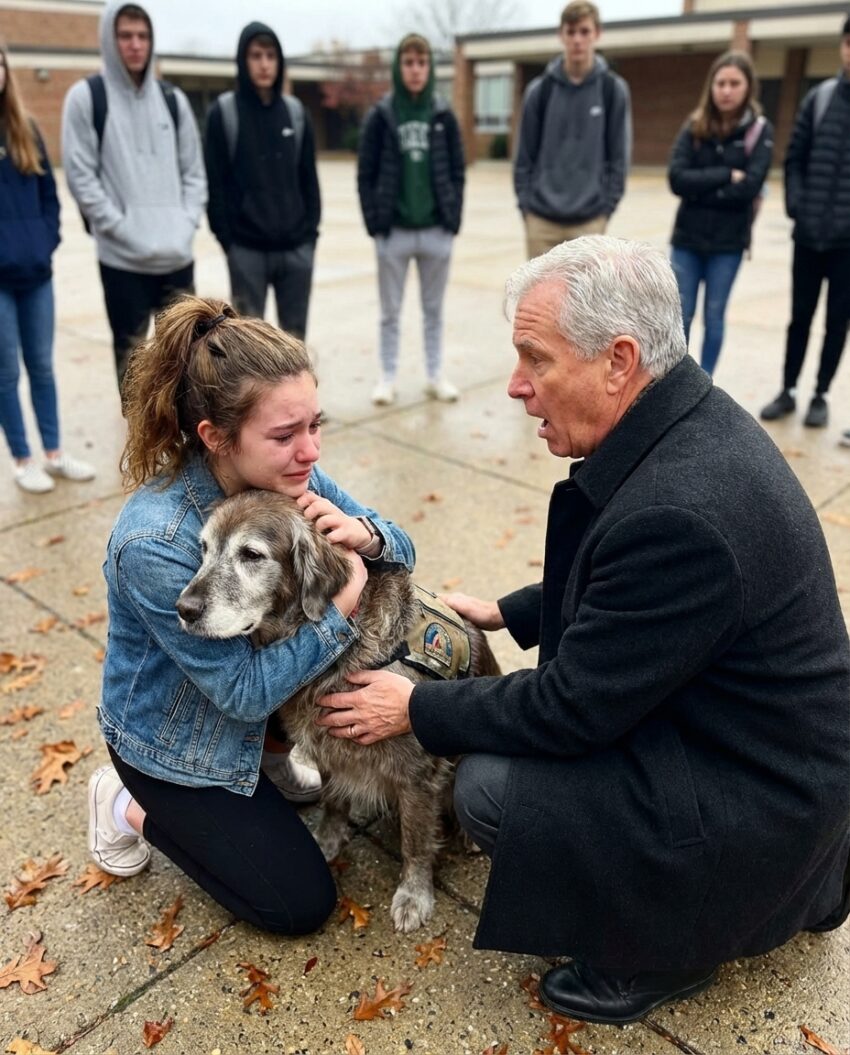
Beside my leg stood Buddy, my old Golden Retriever. His fur had thinned to uneven patches. White hairs clouded his muzzle. His back legs shook when he stood too long. A soft gray vest hung loosely around his narrow frame.
To them, he looked fragile. Broken. Almost gone.
To me, he was everything.
“Is that dog even alive?” a boy muttered loudly.
A ripple of laughter followed.
I felt heat crawl up my neck. My fingers tightened around the leash until my knuckles burned. Buddy leaned gently against my calf, steadying me the way he always did.
“It’s disgusting,” a girl whispered. “Why would she bring that here?”
My chest felt tight, like the hallway had shrunk.
Buddy’s breathing was slow but uneven. Each inhale carried a soft rasp. His eyes—cloudy with age—still searched my face every few seconds, checking if I was okay.
I knelt slightly and brushed my hand along his neck. His fur was warm. Familiar. Real.
“Easy, Bud,” I murmured.
Footsteps approached.
A teacher paused near us, uncertain. A security aide frowned. Students slowed, pretending not to stare but staring anyway.
The laughter grew sharper.
“Looks like it’s about to collapse.”
“Animal control should take it.”
Every word landed like small stones.
Buddy shifted his weight, paws trembling. His tag clinked softly. The sound was thin, metallic, lost in the noise.
Then someone behind me spoke.
Not loud.
Not angry.
Just firm.
“Let them pass.”
The tone cut clean through the chatter.
Conversations died mid-sentence. A locker door hung half-open. A phone lowered. Breath caught in throats.
I turned slowly.
A tall man stood near the entrance. Early sixties. Broad shoulders beneath a tailored charcoal coat. Silver hair trimmed with military precision. His posture carried quiet authority, the kind you don’t question.
His eyes weren’t on the students.
They were on Buddy.
And something in his expression shifted—recognition, sharp and personal.
The hallway felt suddenly weightless.
Buddy’s tail moved once.
Slow. Certain.
The man took one step forward.
And said a name I hadn’t heard in years.
“Sergeant.”
Everything stopped.
The word didn’t belong in a school hallway.
It belonged somewhere louder. Rougher. Far away.
But when he said it, Buddy reacted instantly.
His head lifted. Ears twitched. Tail moved again, a little stronger. A spark flickered behind his cloudy eyes.
The man approached slowly, as if crossing fragile ground.
Students parted without being told.
Teachers watched in confused silence.
I felt my pulse in my throat.
The man knelt carefully despite the stiffness in his knees. Close enough to see the faded stitching on Buddy’s vest. Close enough to read the worn metal tag I’d polished that morning.
His hand hovered before touching.
“Good boy,” he whispered.
Not a casual phrase.
A memory.
Buddy leaned forward, pressing his forehead gently into the man’s palm. A long breath left his body, almost a sigh.
I stared.
“You… know him?” I asked.
The man looked up at me, eyes bright in a way adults try to hide.
“I owe him my life.”
Silence deepened.
He sat back slowly on one heel.
“My name is Daniel Harper,” he said softly. “I’m your new principal.”
A murmur moved through the crowd.
But he kept looking at Buddy.
“Years ago,” he continued, voice steady but low, “I couldn’t sleep. Couldn’t stand crowds. Loud sounds made everything come back.”
His fingers traced the edge of Buddy’s vest.
“They paired me with a therapy dog. Said he’d help me find my way back.”
My breath caught.
Buddy shifted closer to him.
“His name was Sergeant.”
Students exchanged uncertain glances.
I felt my eyes sting.
“He stayed with me through the worst nights,” the principal said. “When the world felt too heavy. When I forgot how to breathe.”
His hand rested fully on Buddy now.
“He reminded me I was still here.”
The hallway lights hummed faintly above us.
No one laughed.
No one whispered.
“He wasn’t just a dog,” the principal said. “He was my partner in survival.”
My fingers loosened on the leash.
“I adopted him when he retired,” I said quietly. “After my uncle passed.”
The principal nodded slowly.
“That makes sense,” he murmured.
He looked at Buddy again, really looked.
“You kept him safe.”
I swallowed.
“He kept me safe too.”
A teacher wiped her eyes discreetly.
A student shifted uncomfortably.
The principal stood with care, joints stiff, dignity intact.
Then he faced the crowd.
“Kindness,” he said calmly, “isn’t optional in this building.”
No anger. Just truth.
“And respect isn’t reserved for the strong. It’s earned by those who endure.”
The words settled like dust in sunlight.
He turned back to me.
“Walk with me,” he said gently.
And just like that, the hallway made space.
We didn’t go to the office.
We went outside.
The principal held the door open, letting the late-morning air roll in. Cool. Bright. Honest. Buddy stepped carefully over the metal frame, paws slow but determined. I followed, still trying to steady the storm inside my chest.
The courtyard was quieter than the halls. A few students lingered near benches. Leaves scraped across brick in soft, restless circles. Somewhere, a lawn mower hummed like distant thunder.
“Sit with me,” Principal Harper said.
We lowered ourselves onto a wooden bench warmed by sunlight. Buddy eased down between us with a tired exhale, ribs rising gently beneath thinning fur. I could feel the heat of his body through my jeans. Familiar. Grounding.
The principal rested both palms on his knees. His breathing was measured, but I noticed the faint tremor in his fingers.
“Crowds still do this to me,” he admitted quietly.
I nodded. I understood.
Buddy shifted, pressing his shoulder against the man’s leg. The movement was small, but deliberate—like he was adjusting a weight only he could sense.
A group of students gathered at a distance. Curious. Careful. No laughter now. Just watchful silence.
One girl stepped closer. Red hair. Freckles. Backpack straps clenched tight.
“Is he okay?” she asked.
“He’s old,” I said. “But he’s strong.”
Buddy lifted his head at the sound of my voice. His eyes found mine, cloudy yet steady. His tail tapped once against the bench leg.
The principal reached into his coat pocket and pulled out a folded handkerchief. He wiped his eyes quickly, pretending it was the wind.
“Sergeant used to do that,” he murmured. “Lean in when my breathing changed.”
He placed a gentle hand over Buddy’s chest, feeling the slow rhythm.
A maintenance worker approached with hesitant steps. Middle-aged. Grease on his sleeves. Concern on his face.
“Sir… everything alright?”
The principal nodded.
“More than alright.”
Buddy suddenly coughed—a rough, hollow sound that tightened my spine. His body tensed. Legs struggled to push upright but faltered.
I dropped to my knees instantly.
“Buddy… hey… I’m here.”
My hands slid under his chest. His breath came faster now. Shallow. Fragile. I could feel the tremble through his bones.
“Call the nurse,” someone whispered.
Footsteps scattered. A door banged open. The world sharpened.
The principal crouched beside me despite the stiffness in his joints. His voice stayed calm.
“Easy, Sergeant. You’re okay.”
Buddy’s eyes flickered between us. Trust. Always trust.
A school nurse rushed out with a small medical kit. Her hands moved quickly but gently, checking pulse, lifting eyelids, listening to breath.
“He’s exhausted,” she said softly. “Dehydrated. But he’s fighting.”
I cradled Buddy’s head against my chest. My sleeve grew damp from his breath. Or my tears. I couldn’t tell.
“Stay with me,” I whispered.
The courtyard had gone completely still.
Students stood frozen. Teachers silent. Even the mower had stopped.
The principal removed his coat and folded it beneath Buddy’s side, cushioning him from the brick.
A simple gesture.
Heavy with meaning.
Buddy’s breathing slowly steadied. Each inhale deeper. Each exhale longer.
I felt the shift like sunrise after a long night.
The nurse smiled faintly. “He’s stabilizing.”
My shoulders dropped. I hadn’t realized how hard I’d been holding myself together.
The principal rested a hand on my back.
“You did well,” he said.
But I knew the truth.
Buddy had carried both of us again.
Just by staying.
Buddy didn’t come to school every day after that.
He didn’t need to.
People already knew.
Students who once laughed now waved quietly when they saw us walking near the gate. Some knelt to greet him with careful hands. Others just watched with softened eyes, learning something they couldn’t find in textbooks.
The principal started a new program that semester—therapy dogs on campus twice a week. Safe spaces for students who felt overwhelmed. Rooms where silence wasn’t awkward and breathing came easier.
He never said it was because of Buddy.
He didn’t have to.
I visited his office one afternoon. Sunlight filtered through half-closed blinds, drawing gentle lines across framed medals and old photographs. Buddy lay at my feet, asleep, paws twitching in soft dreams.
“Funny,” the principal said, gazing at the wall. “We spend years trying to look strong.”
He glanced down at Buddy.
“Then something fragile teaches us what strength really means.”
I smiled.
Because I had learned the same lesson.
Buddy grew slower with each season. Walks became shorter. Rests became longer. But his eyes never lost that quiet knowing. That steady presence that made heavy days lighter.
On his last evening, the sky turned gold like it was trying to hold the sun a little longer. I sat beside him on the porch, fingers buried gently in his fur.
His breathing was soft.
Unhurried.
Peaceful.
“Thank you,” I whispered.
For the courage.
For the comfort.
For staying.
He exhaled once more and rested.
Just like he always did.
People say dogs don’t understand the world the way we do.
I think they understand it better.
They know loyalty without conditions. Love without noise. Presence without performance.
Buddy didn’t need words to change lives.
He just showed up.
And sometimes, that’s enough to save someone.
If this story stayed with you, share your thoughts below.
And if you believe small kindness can change a life, follow the page for more stories that keep hearts warm.