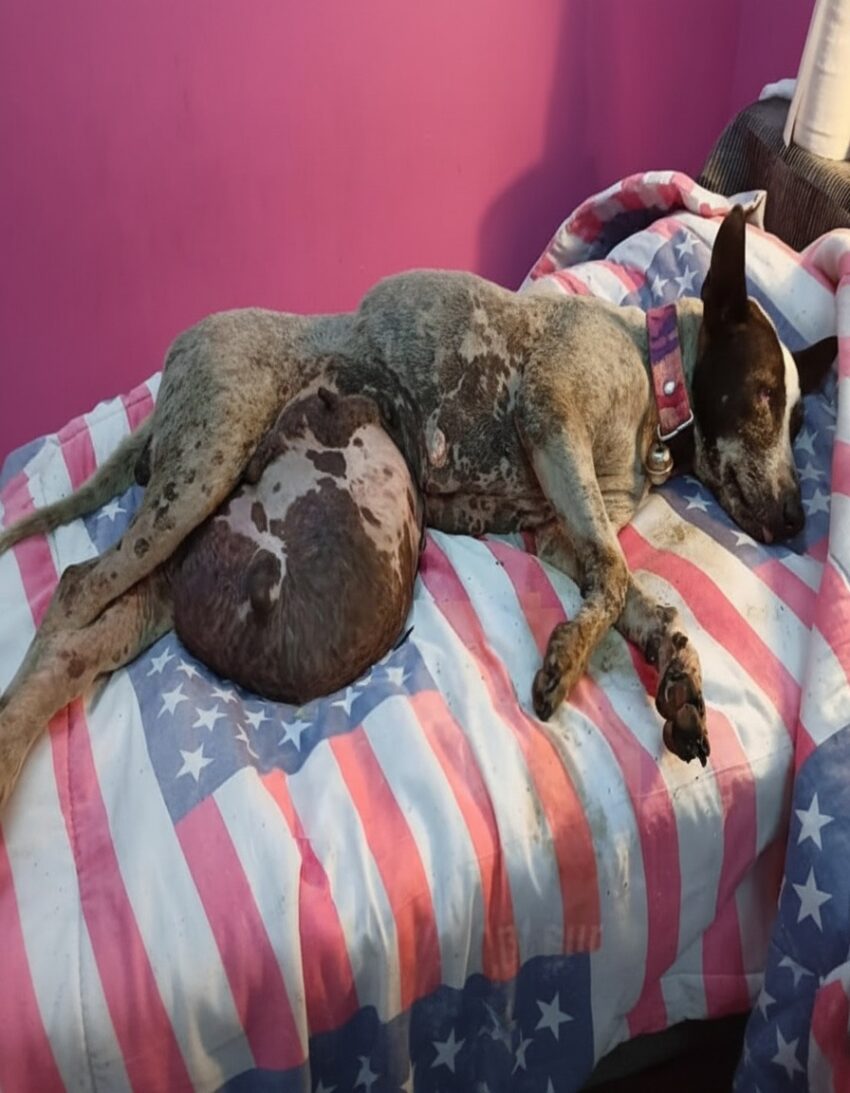
In the sweltering heat of a late summer afternoon in rural Queensland, Australia, on September 12, 2025, a routine drive along a dusty backroad turned into a heart-stopping rescue mission for local veterinarian Dr. Emily Hargrove. What began as a tip from a passing truck driver about “a dog that looked half-dead by the side of the highway” unfolded into one of the most harrowing animal welfare cases the region had seen in years. As Hargrove pulled her weathered Toyota Hilux onto the gravel shoulder near the small town of Charleville, she was unprepared for the sight that greeted her: a emaciated mother dog, her brindle coat marred by oozing sores and patches of raw, infected skin, lay sprawled in the dirt, too weak to lift her head. Tucked against her swollen underbelly were not one, but three tiny puppies—two still nursing faintly from her exposed teats, and a third, alarmingly still, wedged beneath her hind leg. The scene was a poignant tableau of maternal devotion amid utter devastation, and it would soon reveal layers of unexpected tragedy that captivated animal lovers worldwide.

Dr. Hargrove, a 38-year-old vet with over a decade of experience in outback animal care, initially mistook the dog for a stray cattle dog mix, common in the Australian bush. But as she approached cautiously, gloves on and a makeshift muzzle at the ready, she noticed the distinctive floppy ears and the mottled gray-and-brown fur that hinted at a Bluetick Coonhound lineage— a breed rarely seen wandering the arid plains of Queensland. “She didn’t even flinch when I touched her,” Hargrove later recounted in an interview with the ABC News Australia. “Her eyes were half-open, clouded with exhaustion, and her breathing was so shallow I thought she was already gone.” The mother dog, whom rescuers would name “Blue” for her breed’s signature coat, weighed barely 18 kilograms (40 pounds), a fraction of what a healthy adult Coonhound should. Her body was a map of suffering: deep lacerations along her flanks suggested repeated attacks by feral cats or dingoes, while the severe mange had eaten away at her skin, leaving crusty lesions that wept pus. Yet, in a miracle of instinct, she was still producing milk, her teats engorged and leaking as the surviving pups suckled with feeble determination.The urgency escalated when Hargrove gently lifted Blue to assess the puppies. The two nursing ones, later estimated at just four days old, were alive but hypothermic, their tiny bodies shivering against their mother’s warmth. The third pup, however, was cold and unresponsive—a heartbreaking casualty of the ordeal. As Hargrove wrapped them in her jacket and radioed for backup from the local RSPCA chapter, an unexpected detail emerged: Blue’s collar. Buried under layers of grime and matted fur was a faded pink leather band, adorned with a small silver bell and a rusted tag engraved with the name “Luna” and a phone number. The discovery turned the rescue from a typical stray intervention into a mystery. Hargrove dialed the number immediately, her hands trembling as she balanced the phone against her shoulder while stabilizing Blue in the truck bed.
The call connected to an elderly woman in Brisbane, 700 kilometers away, who gasped in recognition. “Luna? My Luna? She disappeared three months ago from my backyard!” Margaret Ellis, 72, explained through tears that Blue—whom she called Luna—had been her beloved pet for seven years, a gift from her late husband. Ellis, battling dementia, lived alone on a sprawling property where Luna roamed freely. One stormy night in June, the dog had vanished, presumed lost to the floods that had ravaged the area. What Ellis revealed next stunned the rescuers: Luna was not supposed to be pregnant. She had been spayed as a puppy at a low-cost clinic, a procedure Ellis had personally overseen. Veterinary records, hastily pulled from the clinic’s database, confirmed the surgery—yet here was undeniable evidence of motherhood. “How is that even possible?” Hargrove wondered aloud to her team as they loaded the dogs into an ambulance en route to the Charleville Veterinary Clinic.

At the clinic, the mysteries deepened. Blood tests revealed Blue’s pregnancy was not a medical anomaly but a case of rare “cryptic pregnancy” following an incomplete spay, where a small ovarian remnant had regenerated over time. More shockingly, X-rays showed she had delivered five puppies originally, not three—two had likely been stillborn on the street, their tiny remains scavenged by wildlife. The surviving pair, dubbed “Star” and “Comet” by the clinic staff, were fighting for life in an incubator, receiving round-the-clock care with tube feeding and antibiotics. Blue herself required emergency treatment: intravenous fluids to combat dehydration, a course of ivermectin for the demodectic mange, and surgical debridement of her infected wounds. “She had gravel embedded in her paws from dragging herself miles to find safety,” said clinic technician Liam Patel. “We found thorns and burrs in her tail, and even a chunk of rusted wire tangled in her collar— she must have crossed a barbed fence.”As news of the rescue spread via social media posts from the RSPCA Queensland branch, donations poured in from as far as the United States and Europe. By the end of the week, over AUD 25,000 had been raised for Blue’s care and that of her pups. But the story took another unforeseen turn when a local farmer came forward with dashcam footage from his property 50 kilometers from the discovery site. The grainy video, timestamped two days prior, showed Blue limping along a fence line at dusk, the three visible puppies trailing behind her before she collapsed. “She was teaching them to move, even when she could barely stand,” the farmer, Jack Reilly, told reporters. This footage, shared widely on platforms like Instagram and TikTok, amassed millions of views, transforming Blue into an overnight symbol of resilience.
Weeks later, Blue’s recovery has been nothing short of miraculous. Her skin is healing, new fur sprouting in soft patches, and her weight has climbed to 25 kilograms. The puppies, now a robust six weeks old, are playful bundles of energy—Star with a perfect star-shaped blaze on her forehead, and Comet sporting a tail that never stops wagging. Margaret Ellis, after a tearful reunion facilitated by Hargrove, has welcomed the entire family back into her home, now fortified with higher fences and 24-hour monitoring via new security cameras. “I thought I’d lost her forever,” Ellis said, cradling Comet. “Luna didn’t just survive; she brought new life with her.”
