
A small, frightened white puppy—barely three months old—stumbled down the pavement, completely alone. His tiny body trembled with every step, his legs wobbly and uneven. He couldn’t walk straight, couldn’t stay balanced. His constant cries pierced the air, the sound raw with fear and helplessness. Passersby noticed him, but it was the other street dogs who seemed most drawn to his pain. A few approached him cautiously, their tails lowered, ears back, trying to make sense of the little one’s suffering. But none could offer the help he so desperately needed.
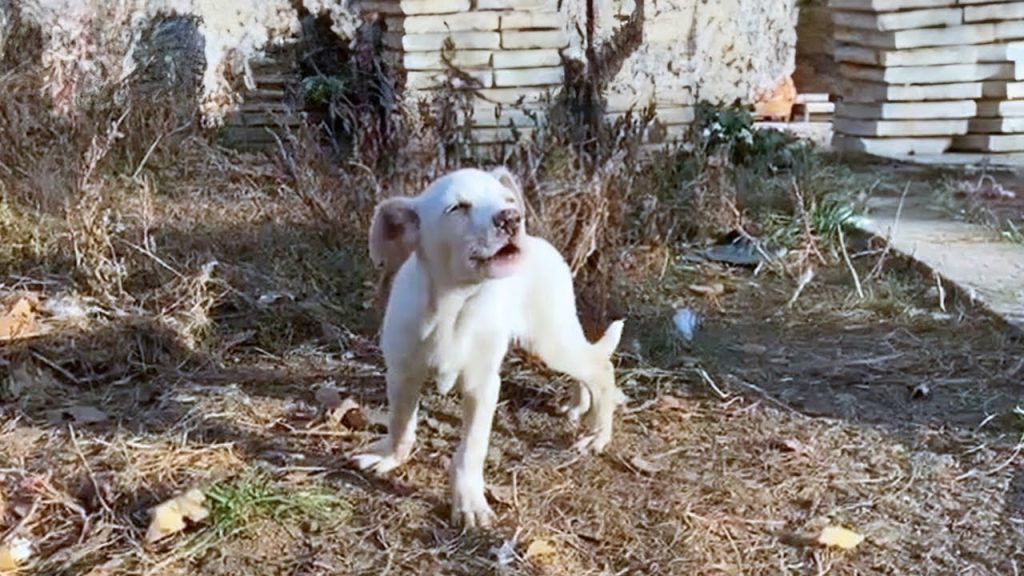
Eventually, someone stepped in. A local rescue team arrived and gently scooped him off the street. They named him Pluto. He was rushed to a nearby animal hospital, wrapped in soft blankets and cradled with great care. At first glance, his problems seemed mostly physical—he had difficulty eating, and his lower jaw appeared unusually short, forming what vets later identified as a severe underbite. But there was something even more heartbreaking about him. He didn’t react. He didn’t bark, whimper, or wag. That entire first morning at the clinic, Pluto was silent. He curled up into himself, eyes vacant, not recognizing anything around him.
Concerned by his unresponsiveness, the vets ordered deeper tests, including an MRI. What they found was devastating.
Pluto’s young life had been shaped by trauma—physical and neurological. The scans revealed he was suffering from external hydrocephalus, meaning fluid was collecting around his brain. He also had a subdural hematoma—bleeding near the brain’s surface—and worst of all, his cerebellum had significantly atrophied. This part of the brain controls movement and coordination, and its condition explained his unsteady gait and compulsive circling behavior. He wasn’t just walking in circles; he was trying to navigate a world completely cloaked in darkness. Pluto was blind. His movements were rooted in panic and confusion, not play.
Faced with these results, the rescue team and veterinarians had to make an agonizing decision. Brain surgery might offer hope—but at such a young age, and in such fragile health, the risks were overwhelming. Instead, they chose a conservative, long-term treatment plan focused on medication, supportive care, and consistent observation. It would take time, patience, and hope.
But slowly, the miracle began.
Each day brought small changes. At first, it was the slight flicker of recognition—Pluto began to tilt his head when someone spoke to him. Then came the wag of a tail, cautious but undeniably there. His appetite improved. His circling slowed. The light in his eyes, once dull and vacant, began to flicker with something new: awareness.
Then, something extraordinary happened. His vision started to return.
It was gradual, and no one dared celebrate too early. But over the next few weeks, Pluto transformed before their eyes. He began to play, nudging toys across his kennel floor. He recognized the voices of his caretakers and would run—albeit a little awkwardly—toward them. He snuggled into their laps, licking their hands with soft gratitude. He had gone from a silent, broken pup to a thriving young dog full of joy and affection.
Pluto found not just safety, but love. And with that love, he bloomed.
Today, Pluto is a bright, spirited dog with boundless energy and a heart as big as his journey. He adores his caretakers—his second family—and follows them around with unmistakable trust. He’s playful, curious, and just a little goofy. Though he still has moments where he circles, it’s no longer from fear. It’s simply a part of who he is now—a reminder of what he’s overcome.
His transformation stands as a powerful reminder of what care and compassion can do. Pluto was once a symbol of pain and neglect, but now, he’s living proof that no life is too broken to heal. His story resonates deeply, especially with those who understand the healing power of love, patience, and second chances.
For anyone who’s ever felt unseen or lost, Pluto’s journey reminds us that even in the darkest places, there is light to be found. It may come quietly, like the gentle hand of a rescuer or the slow return of sight. But it comes.
Pluto’s tale is one of resilience. Of medical science working hand in hand with heart. Of a dog who had every reason to give up—but didn’t. And of the people who saw him, not as a case, but as a soul worth saving.
There are still countless dogs out there like Pluto—fragile, frightened, and forgotten. But his story proves what’s possible. Every time he chases a ball, nuzzles into a lap, or simply greets a new day with his tail wagging, he’s a living, breathing testament to the power of compassion.
If there’s one thing Pluto teaches us, it’s this: healing doesn’t always happen overnight. Sometimes it takes weeks. Sometimes months. But with love, support, and care, even the most shattered spirits can mend. And when they do, the result is nothing short of beautiful.
From the trembling puppy on the pavement to the joyful dog he is today, Pluto’s journey is nothing less than remarkable. It’s a story that speaks to the heart, reminding us all that with enough love and kindness, even the most broken beginnings can lead to the brightest tomorrows.