
Some lives begin with comfort and certainty. Others begin in hardship, shaped by pain long before love ever enters the picture. Eva’s life belonged firmly to the latter. When I first encountered her, it was immediately clear that she had been carrying an invisible burden for far too long—one that had slowly worn down her body but never fully extinguished her spirit.
Eva looked impossibly fragile. Her frame was thin, her movements strained and hesitant, as though every shift of weight demanded effort and courage. Pain lingered in her posture, etched into the way she held herself, the way she breathed. And yet, despite everything her body had endured, her eyes told a different story. They were gentle, alert, and quietly defiant. In them flickered a spark of resilience—a refusal to give up—that stopped me in my tracks.
It was that spark that pulled me toward her.
I approached slowly, speaking in soft tones, careful not to frighten her. She did not recoil or grow defensive. Instead, she lifted her head just slightly, summoning what little strength she had left to acknowledge me. The trust she extended in that moment was fragile and tentative, but unmistakably real. It felt like an unspoken plea—and a responsibility I could not ignore.
When I carefully lifted her into my car, supporting her body so as not to cause additional pain, I made a quiet promise to her. I didn’t yet know what her future would look like, but I knew this much: she would not suffer alone anymore.

A Will to Survive Against the Odds
Even in those first hours, Eva revealed her extraordinary resilience. Her hind legs were limp, unable to support her, yet her spirit remained astonishingly intact. When food was offered, she ate eagerly. Each bite felt symbolic—proof that, despite everything, she still wanted to live.
For an animal in such a compromised state, appetite was more than nourishment; it was determination in its purest form. Eva’s calm demeanor further underscored her strength. She endured discomfort without complaint, responding to gentle touches by leaning in rather than pulling away. When I stroked her head, she closed her eyes briefly, as if allowing herself to believe—perhaps for the first time in a long while—that kindness was real.
That same day, we headed to a specialist. Eva deserved answers, and I needed to understand what had been done to her—or what life had taken away.
During the drive, she lay quietly on a blanket, her breathing steady though her body trembled occasionally with pain. I felt fear tighten in my chest, but I also felt hope. Whatever the outcome, she would finally be seen.

The Diagnosis That Changed Everything
The specialist examined Eva with careful precision, his compassion evident as he assessed her mobility and reviewed her medical imaging. When he finally spoke, his words brought clarity—and heartbreak.
X-rays revealed significant damage to two vertebrae in Eva’s spine. The injury was severe enough to cause paralysis in her hind legs, and it had likely been present for a long time. She had been living with chronic pain, limited mobility, and no relief.
The weight of that realization was crushing.
Imagining Eva navigating the world in silence—hurting, immobile, and vulnerable—was almost unbearable. Yet the diagnosis also offered direction. We finally knew what she was fighting against, and that knowledge opened the door to treatment, management, and comfort.
The specialist explained that while full mobility might never return, Eva could still live a rich, joyful life. With proper pain management, routine care, and emotional support, she could thrive. And if spirit alone could determine outcome, Eva was already winning.

Choosing Comfort, Choosing Dignity
From that moment forward, the goal became clear: restore Eva’s comfort and give her the dignity she had been denied.
She began a daily pain-management regimen designed to reduce inflammation and ease her discomfort. Every day, she accepted her medication with patience and trust. She never resisted. Never snapped. Never showed frustration.
Slowly, the changes began.

She held her head higher.
Her breathing eased.
Her eyes grew brighter.
Her appetite strengthened.
These were small victories, but they were everything.
Eva became more engaged with her surroundings, more responsive to affection. She delighted in gentle brushing, leaned eagerly into touch, and greeted familiar voices with soft, hopeful eyes. The heaviness that once dulled her gaze began to lift, replaced by curiosity and quiet joy.
It became clear that her healing was not only physical. It was emotional. Eva was learning that she was safe—that she mattered.

A Spirit Reclaimed
Eva’s progress was not linear. There were difficult days, moments of stiffness, periods of fatigue. But through it all, her gentleness never wavered. She trusted completely, even when vulnerable—a testament to her extraordinary nature.
Watching her transform reinforced a powerful truth: animals do not heal through medicine alone. They heal through connection, patience, and love.
Eva was not just recovering from an injury. She was rec

A Forever Home Across Borders
Eva’s journey soon reached a turning point that felt almost poetic.
A compassionate family in Canada learned her story and felt an immediate connection. They didn’t see a disabled dog. They saw a survivor. They saw a gentle soul who deserved safety and love without conditions.
Their home was ready for her. Their hearts were open.
Letting Eva go was emotional, but it was also filled with gratitude. She was stepping into a life defined not by pain, but by belonging.
In her new home, Eva flourished. Surrounded by routine, warmth, and affection, she healed in ways no scan could measure. She lived with peace, confidence, and the deep comfort of being cherished exactly as she was.
Eva did not just survive.
She triumphed.

A Lake, a Crate, and a Life Hanging by a Thread
While Eva’s story unfolded through quiet resilience, another life was saved through sudden courage.
On a cold November afternoon in Illinois, middle school science teacher Bryant Fritz headed to Kaufman Lake for a simple fishing trip. The air was sharp with winter’s approach, the water dark and still.
Then he saw something that didn’t belong.
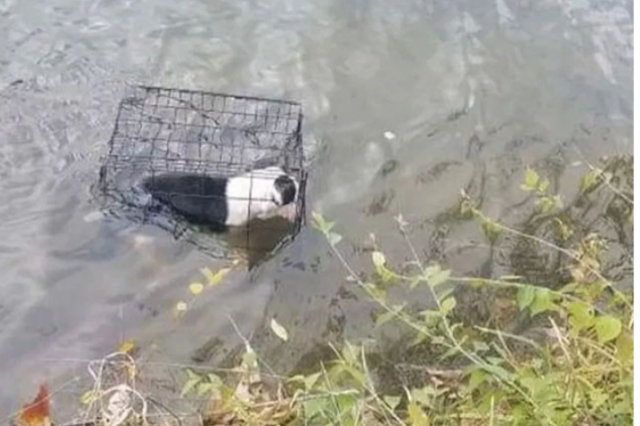
Floating in the lake was a partially submerged dog crate. Inside it, barely above the waterline, was a tiny black-and-white puppy fighting to stay alive.
Her head bobbed weakly above the freezing water. Exhaustion was overtaking her. Time was running out.
A Decision Without Hesitation
Bryant didn’t think. He acted.
He stripped down and entered the icy lake, wading 15 to 20 yards toward the crate. The cold seized his body, numbing his legs and stealing his breath, but he pushed forward.
When he reached the crate, he freed the trembling puppy and carried her back to shore.
Her body was shockingly cold. Blood stained her fur. Patches of hair were missing. Her paw pads were raw and torn. She was barely conscious.
Without intervention, she would have died.

Fighting for Dory’s Life
Bryant wrapped the puppy in blankets, sharing his body heat, then rushed her to the University of Illinois Veterinary Teaching Hospital. There, veterinarians treated her for severe hypothermia, wounds, and trauma.
Against all odds, she responded.
As Bryant filled out paperwork, he felt something shift inside him. This wasn’t just a rescue. This was the beginning of something lasting.
He named her Dory—a tribute to perseverance and refusal to quit.
Love Born from Courage
As Dory recovered, Bryant made it clear he hoped to adopt her once allowed. The bond forged in freezing water was undeniable.
Her story shocked the community, but it also inspired it. Dory became a symbol of both cruelty and compassion—of how one act of bravery can rewrite a life.
Two Stories, One Truth
Eva.
Dory.
Different paths.
Same ending.
Both lives were saved because someone chose compassion over convenience, courage over comfort, love over indifference.
Their journeys remind us that healing is possible—even after unimaginable suffering—when kindness enters the story.
Because sometimes, saving an animal doesn’t just change their life.
It changes ours forever.