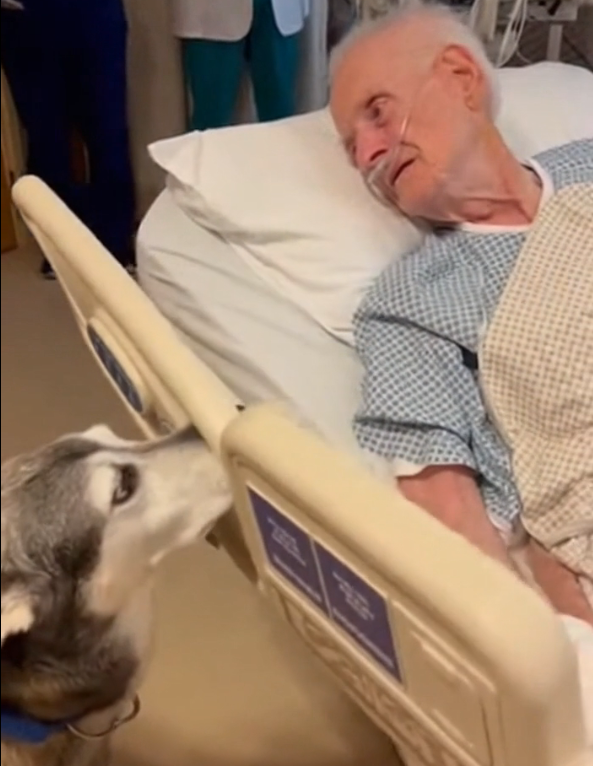
The dog refused to leave.
For three days, he sat in the same spot outside the intensive care unit, his body pressed against the cold wall, eyes fixed on the closed doors that hissed open and shut for everyone except him.
Nurses whispered.
Doctors slowed their steps.
Families stopped talking when they passed.
Something about the stillness felt wrong.
The dog was old—at least ten. A large mixed-breed with graying fur around the muzzle and tired eyes that had seen too much. His ribs showed slightly beneath his coat. One ear drooped, permanently bent from some old injury. A faded collar hung loosely around his neck.
He didn’t bark.
He didn’t pace.
He just waited.
On the third night, the hallway lights dimmed to their soft yellow glow. The smell of antiseptic mixed with old coffee and quiet grief. A nurse noticed the dog’s legs trembling—not from fear, but from exhaustion.
“He hasn’t eaten,” she whispered to a colleague.
“He won’t move,” the other replied.
Inside the ICU room lay an elderly man, unconscious, tubes and wires mapping his fragile body. His hand rested open on the bed, trembling slightly. A worn military cap sat on the chair beside him, folded carefully as if it still mattered how it looked.
No visitors were allowed.
Rules were rules.
But the dog didn’t understand rules. He only understood one thing:
His person hadn’t come back yet.
When a doctor finally stopped in front of him and crouched down, the dog lifted his head for the first time in hours. Their eyes met.
And in that moment, the question became unavoidable:
What kind of bond keeps a creature waiting like this…
even when hope feels thin?

The man’s name was Henry Collins.
Seventy-six years old. Widower. Retired mechanic. Vietnam veteran. He lived alone in a small house at the edge of town, the kind with creaking floors and a porch that sagged just enough to remind you time was winning.
The dog’s name was Rusty.
Henry found him eight years earlier, tied to a fence behind a closed grocery store. No note. No explanation. Just a thin dog and a frayed rope.
Henry cut the rope without hesitation.
“You and me, pal,” he’d said. “Looks like we’re both leftovers.”
From that day on, they were inseparable.
Rusty followed Henry everywhere—into the garage, onto the porch, down the quiet streets in the early mornings. When Henry’s hands shook from age, Rusty learned to wait patiently. When Henry’s nightmares came, Rusty learned to wake him gently, placing his head on Henry’s chest until the breathing slowed.
After Henry’s wife died, Rusty became the reason Henry got out of bed.
Neighbors said the dog knew Henry’s moods better than any person ever could.
So when Henry collapsed at home, Rusty knew something was wrong immediately.
He barked until a neighbor came.
He blocked the door when paramedics tried to leave without explaining.
He followed the ambulance until the doors closed.
At the hospital, Rusty was told to wait.
And so he did.
Here came the first twist:
Henry had no family nearby. No children. No one listed as an emergency contact except “Rusty” scribbled half-jokingly on an old form.
The second twist came quietly, spoken in a low voice by a nurse to the attending physician:
“He hasn’t responded to stimulation in two days.
But his vitals spike every time the dog whines outside.”
The room went quiet.
On the morning of the fourth day, Henry’s condition worsened.
His breathing became shallow.
His pulse irregular.
Monitors beeped softly, steadily—too steadily.
The doctor stood at the foot of the bed, jaw tight.
“We’re running out of options,” he said quietly.
Outside, Rusty lifted his head as if he felt it.
His tail thumped weakly against the floor once. Then stopped.
A young nurse—new to the job, still believing rules could bend—looked down the hallway. She looked at the dog. Then back at the ICU doors.
“Five minutes,” she said. “That’s all I’m asking.”
The doctor hesitated.
Then nodded.
They wiped Rusty’s paws. Slipped a disposable gown loosely around his body. Opened the door.
Rusty walked in slowly, as if afraid this might disappear if he moved too fast.
The ICU room felt colder than the hallway. White walls. White sheets. White light that made everything look fragile.
Rusty approached the bed.
Henry lay motionless. His face was thinner now. His hand still open, trembling faintly.
Rusty sniffed once.
Then gently, carefully, he placed his head on Henry’s hand.
The reaction was immediate.
Henry’s fingers curled.
Just slightly.
But enough.
A tear slid from the corner of Henry’s eye.
His chest hitched.
Rusty stayed perfectly still, breathing warm air onto Henry’s skin, his tail making slow, hopeful arcs against the bed.
“I’m here,” Henry whispered. His voice was barely sound. “Good boy… I knew you’d wait.”
Nurses cried openly.
The monitor steadied.
It wasn’t a miracle.
But it was something.
Rusty stayed for five minutes.
Then ten.
No one stopped him.
Henry survived.
Not quickly.
Not easily.
But he survived.
Weeks later, he left the hospital thinner, slower, but smiling. Rusty walked beside him, leash loose, head high.
They returned home together.
Life didn’t become perfect after that. Henry still moved carefully. Rusty still slept lightly. But something had shifted.
The porch saw more sunrises.
The garage smelled of oil again.
And the house no longer felt empty.
Sometimes, people at the hospital still talk about the dog who waited.
The one who didn’t bark.
Didn’t beg.
Just believed.
Because sometimes, love isn’t loud.
Sometimes, it’s a tired dog sitting on a cold floor, trusting that the door will open.
What part of this story stayed with you the most?
Share your thoughts in the comments—we’d love to hear them.