
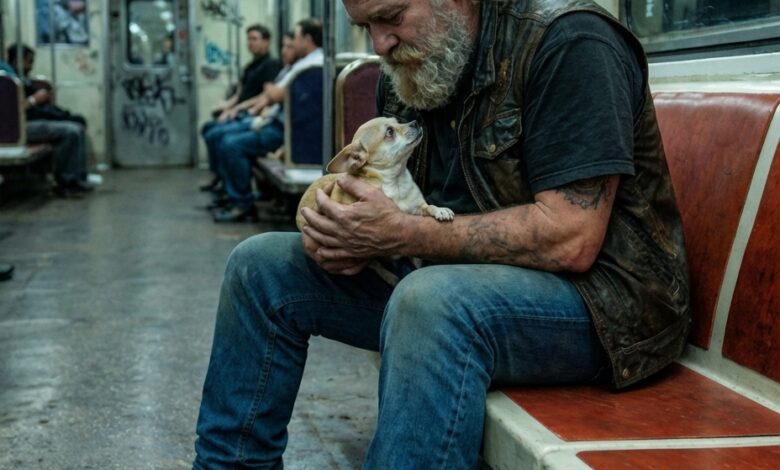
The subway car was thick with the usual midday tension of New York City—a cacophony of screeching metal, flickering fluorescent lights, and the guarded silence of commuters determined to ignore one another. However, as the train pulled out of the Atlantic Avenue station, a different kind of stillness took hold. It was the heavy, uncomfortable quiet that occurs when people are collectively unnerved. The source of the unease was a man who seemed to occupy more space than the bench allowed. He was a biker, broad-shouldered and encased in weathered black leather, his arms a roadmap of dark tattoos that disappeared into his collar. But it wasn’t his size or his attire that made people recoil; it was the fact that he was weeping.
He sat with his head bowed, great heaving sobs shaking his frame, while his massive, calloused hands cradled a small, scruffy terrier wrapped in a frayed wool blanket. One by one, passengers began to perform the subtle choreography of avoidance. They shifted to the far ends of the car, clutching their bags tighter and whispering behind their hands. In their eyes, a large man displaying such raw, unbridled emotion was a wild card—something unpredictable and therefore dangerous. To them, his grief looked like a threat.
I stayed where I was. I couldn’t look away, not because of the spectacle, but because of the way he was holding that dog. He wasn’t just carrying the animal; he was sheltering it. His touch was so light, so achingly tender, that it contradicted every stereotype his appearance suggested. It was a private, devastating goodbye unfolding in the most public and sterile of places.
The dog was clearly in its final hours. Its breathing was a series of shallow, ragged hitches, and its fur was dull with the gray of great age. Occasionally, a weak, almost imperceptible thump of its tail would hit the biker’s leather sleeve, a final vestige of a lifelong devotion. When a man a few seats down muttered loudly about calling transit security, the biker didn’t even flinch. He was locked in a world of two, whispering soft, rhythmic reassurances into the dog’s ear, promising over and over that he wouldn’t let go.
The gap between the biker and the rest of the passengers felt like a physical chasm, a vacuum created by fear and judgment. Something about that void felt wrong. Driven by an impulse I couldn’t quite name, I stood up, crossed the rattling floor, and sat down directly beside him. He didn’t look up at first, but his weeping softened into a jagged breath.
“He looks like a good friend,” I said quietly, my voice barely audible over the roar of the tunnel.
The biker finally raised his head. His eyes were bloodshot and rimmed with a profound, weary exhaustion. “The best,” he rasped. “Cancer. The vet said it was time, but I couldn’t do it. Not in that room with the white tiles and the smell of chemicals. He deserves better than a needle in a fluorescent office.”
He told me the dog’s name was Buster. He explained that they were headed to Coney Island—the end of the line. It was the place where, twelve years earlier, he had found Buster shivering under the boardwalk on a cold October morning. At the time, the man was a veteran who had recently returned home, struggling with the invisible architecture of a war that wouldn’t leave his mind. He was isolated, angry, and drifting toward a darkness he couldn’t name. Buster had been the anchor. The dog didn’t care about the tattoos or the scars; he only cared about the man’s presence. For over a decade, that scruffy terrier had been the reason he got out of bed, the reason he stayed sober, and the reason he learned to trust the world again.
As the train rolled south toward the coast, the atmosphere in the car began to shift. The other passengers, who had been watching from the periphery, were no longer looking at a “dangerous biker.” They were looking at a man losing his soulmate. The whispers died down. The woman who had been clutching her purse let it go. One by one, the invisible barriers of the subway car began to dissolve.
A teenager in an oversized hoodie took off his headphones and sat a few seats away, watching with a somber, respectful gaze. An older woman reached into her bag, pulled out a clean tissue, and wordlessly handed it to the man. No one gave a speech; no one offered hollow advice. Their presence simply moved closer, forming a protective circle of human empathy around a dying animal and the man who loved him.
By the time the train slowed for the final stop at Stillwell Avenue, a strange thing happened. When the biker stood up, his legs slightly unsteady, several strangers rose with him. We walked out onto the platform in a quiet procession. We followed him across the concrete and onto the wooden planks of the boardwalk, the air turning salt-heavy and sharp with the scent of the Atlantic.
The beach was nearly empty, the winter tide pulling back from the shore in long, rhythmic sighs. The biker walked down to the edge of the water, where the sand was damp and firm. He knelt, unwrapping the blanket just enough so Buster could feel the ocean breeze on his face one last time. We stood back, a dozen strangers from a dozen different lives, unified by a moment of shared humanity. We watched as the man let his dog watch the horizon, the sun catching the white caps of the waves.
The goodbye was heartbreaking, a quiet surrender to the inevitable, but it was also filled with an incredible dignity. In the middle of a city often accused of being heartless and cold, a small community had spontaneously formed to witness the end of a beautiful life.
As we eventually dispersed, walking back toward the station or into the streets of Brooklyn, I realized that the morning had changed more than just the biker’s journey. A carload of people had boarded that train with their defenses up, conditioned to fear what they didn’t understand and to turn away from the messiness of grief. But because one person chose to sit down instead of move away, they had all remembered how to be human.
We learned that compassion doesn’t always wear a gentle face, and that the most intimidating exteriors can hide the softest hearts. Fear is a powerful force, but it is fragile; it disappears the moment we choose to move closer. The biker left the beach alone that day, but he didn’t leave unsupported. He walked away with the knowledge that his grief was seen and respected, and we walked away with the reminder that we are never more alive than when we are willing to carry a small piece of someone else’s burden.