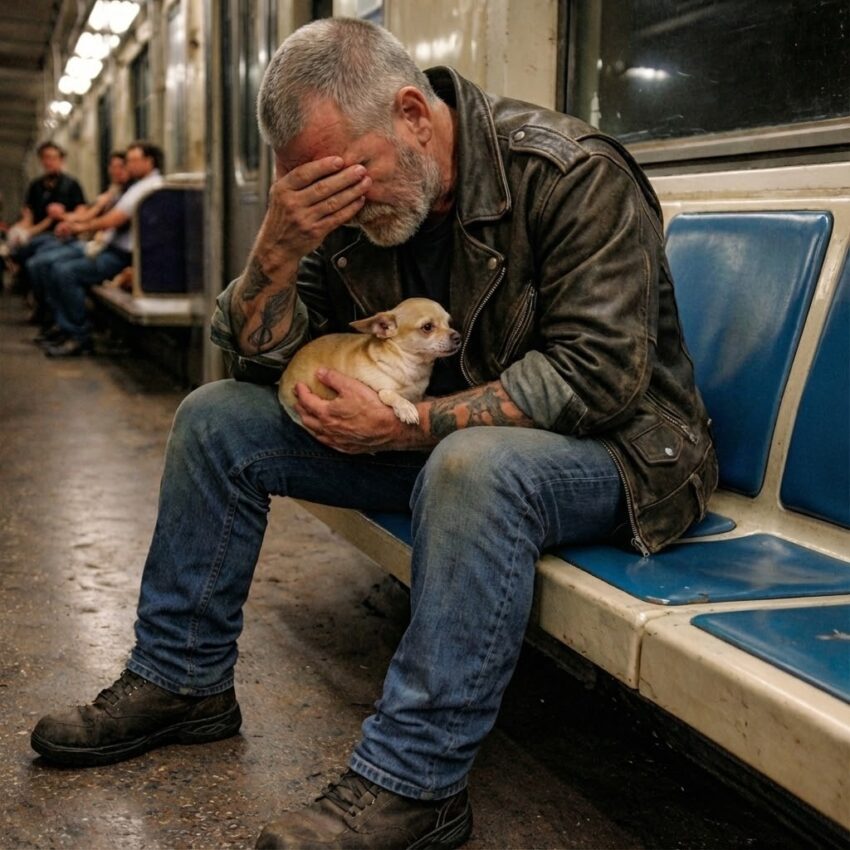
The subway car felt colder than usual that morning, not because of the weather, but because of the silence people created as they moved away from him. He was enormous, wrapped in leather and ink, shoulders hunched inward as if trying to disappear. In his arms lay a small terrier mix, gray around the muzzle, bundled in a worn blanket. The dog’s breathing was shallow, every rise of its chest a quiet struggle. Passengers stared, whispered, then shuffled down the car, choosing distance over discomfort. I stayed where I was, watching a man who looked frightening to everyone else cry with the helpless grief of someone about to lose family.
The closer I looked, the harder it became to look away. His hands were gentle, trembling as they stroked the dog’s head, his voice barely louder than the rattle of the tracks. He spoke to the dog as if nothing else existed, promising he was there, promising he would not leave. When I finally crossed the space between us and sat down, he looked up with swollen eyes full of shock, as if kindness was the last thing he expected. He told me the dog’s name was Sergeant, a companion he had found years earlier when life was rough and lonely, a presence that had given him structure, routine, and a reason to keep moving forward when everything else felt unstable.
As the train rolled on, something changed. An older woman sat nearby, then a teenager, then a mother with her children. No one spoke much. They did not need to. Grief has a language that does not require words. When the train reached the final stop near the ocean, we all followed him without discussion, a quiet procession of strangers who understood that this moment mattered. On the beach, under pale sunlight and sharp wind, he knelt in the sand and held Sergeant toward the water, letting him feel the breeze and hear the waves one last time. There was no drama, only love, gratitude, and the deep ache of goodbye.
When Sergeant passed, the sound the biker made was raw and unguarded, the sound of a heart breaking without shame. Hands reached out instinctively, resting on his shoulders, his back, reminding him he was not alone. Later, offers came, not out of obligation but humanity, help with arrangements, gentle support, shared stories of love and loss. What stayed with me most was not the sadness, but the transformation. A subway car that had recoiled in fear became a small community because one person chose to move closer instead of away. That day taught me that pain often hides behind the faces we judge fastest, and sometimes all it takes to restore a piece of our shared humanity is the courage to sit down and care.