When the Robinson family decided to leave their small rented apartment and move to a quiet rural property, they believed the biggest changes ahead would be learning how to manage land, space, and a slower pace of life. They were expecting their second child, and with a six-year-old son already bursting with energy, the idea of fresh air, open fields, and a future farm felt like the right next step. What they did not know was that one decision—made almost as an afterthought—would one day stand between life and death.
For years, the Robinsons had wanted a dog. Their apartment lease forbade pets, and finances were tight, so the idea stayed a wish rather than a plan. But once they closed on their new home, the conversation resurfaced almost immediately. They didn’t want a puppy from a breeder. They wanted to adopt. They wanted to give a dog a second chance.
They visited several shelters, listening to volunteers recount stories of abandonment, neglect, and bad luck. Many of the dogs barked loudly from behind kennel doors. Others cowered in corners. Then they came to a quiet enclosure where a stocky, gray Pit Bull sat with his head lowered, eyes avoiding contact.
His name was Benson.
Benson’s history was not an easy one. He had been used for fighting, discarded when he was no longer profitable, and left on the streets. By the time animal control found him, he was physically scarred and emotionally shut down. Trust was something he no longer offered freely. At the shelter, he barely reacted to people. Volunteers worried he might never be adopted.
A family had tried once. They brought him home, hoping love would fix everything. Two weeks later, they returned him, saying he was “too distant” and “not friendly enough.” The rejection only deepened his withdrawal.
When Mrs. Robinson heard this, she felt something settle in her chest. She didn’t see an aggressive dog. She saw one that had been broken by humans and then punished for not healing fast enough. Against common advice and without romantic illusions about an instant transformation, the Robinsons adopted Benson.
The first weeks were slow and careful. Benson didn’t bark. He didn’t wag his tail. He watched everything. Loud noises made him flinch. Sudden movements froze him in place. The family respected his space, especially their son, Mathias, who was taught to sit quietly near Benson and let the dog decide if he wanted contact.
One afternoon, Benson approached Mathias on his own. He sniffed the boy’s hand, then sat beside him. That was all it took. From that day forward, Benson followed Mathias everywhere, not possessively, but attentively, as if learning what it meant to belong.
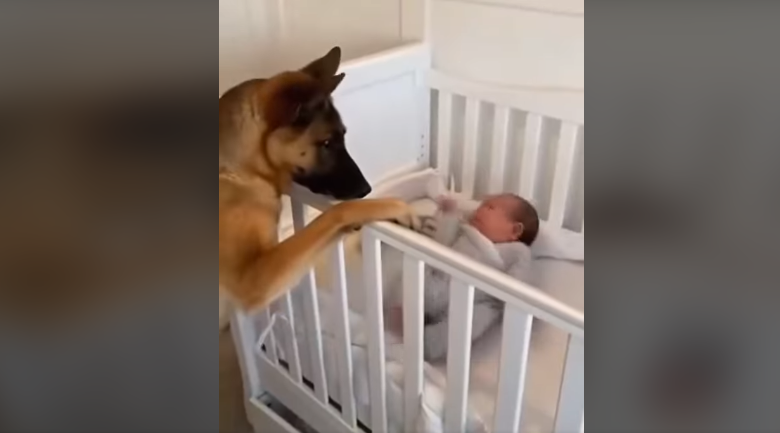
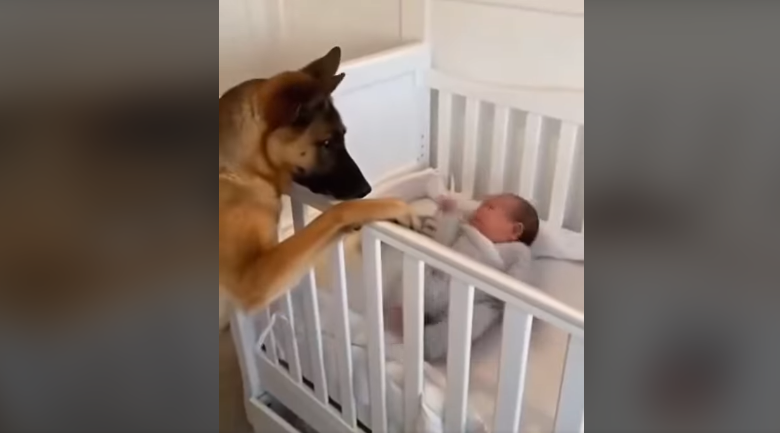
When the baby arrived—a little girl—the family watched Benson closely. They worried his past trauma might surface. Instead, he surprised them again. He lay near the crib. He rested his head on the floor during feedings. He seemed to understand that this tiny human was fragile.
Weeks passed. Life settled into sleepless nights and soft routines.
Then came the night that changed everything.
It was well past midnight when the silence broke. Not with a cry, but with barking—deep, urgent, relentless. Benson was barking from the baby’s room. Not once or twice, but continuously, louder than the family had ever heard him.
Startled awake, the Robinsons ran down the hallway, fear already gripping them. When they reached the nursery, the sight stopped them cold. Benson had his mouth around the wooden slats of the crib, pulling and biting at them with desperate force.
For a split second, panic took over. Their first thought was that something had gone terribly wrong—that the dog had snapped.
Then they saw the baby.
She was motionless.
Her chest wasn’t rising.
Benson wasn’t trying to hurt her. He was trying to reach her.
Mrs. Robinson grabbed her daughter and screamed for her husband. They rushed to the car and drove to the emergency room, Benson’s frantic barking still echoing in their ears.
Doctors worked quickly. The diagnosis came soon after: the baby had stopped breathing. Had it gone unnoticed for much longer, she would not have survived.
One doctor said it plainly. “If your dog hadn’t alerted you when he did, you wouldn’t be holding her right now.”
The weight of that truth didn’t fully register until later, when the baby was stable and sleeping peacefully under hospital lights. The dog they had rescued—the one no one else wanted—the one deemed too broken, had saved their child’s life.
Benson had not been trained for this. No one taught him to recognize danger or sound an alarm. He acted on instinct, on attachment, on something deeply ingrained that humans had nearly destroyed but never fully erased.
When the family brought the baby home days later, Benson never left her side. He slept near her crib, alert but calm. The house felt different now. Not just fuller—but safer.
The Robinsons often say that when they adopted Benson, they believed they were saving him. What they didn’t realize was that he was quietly saving them too, long before that night ever came. He was learning trust. Learning family. Learning what it meant to protect rather than be used.
Benson’s past didn’t disappear. He still startled at loud sounds. He still avoided strangers. But within his family, he was steady, loyal, and gentle. He had found his purpose—not as a fighter, not as a discarded animal—but as a guardian.
The story spread, as stories like this do. Some people were surprised. Others weren’t. Those who work with animals understand that trauma doesn’t erase instinct, and love doesn’t always announce itself loudly. Sometimes it waits quietly, until it’s needed most.
Benson never knew he was a hero. He only knew that the smallest member of his pack was in danger, and that abandoning her was not an option.
And for the Robinson family, that night became a permanent reminder: second chances are not acts of charity. They are acts of faith. And sometimes, they come back to you in ways you could never have imagined.