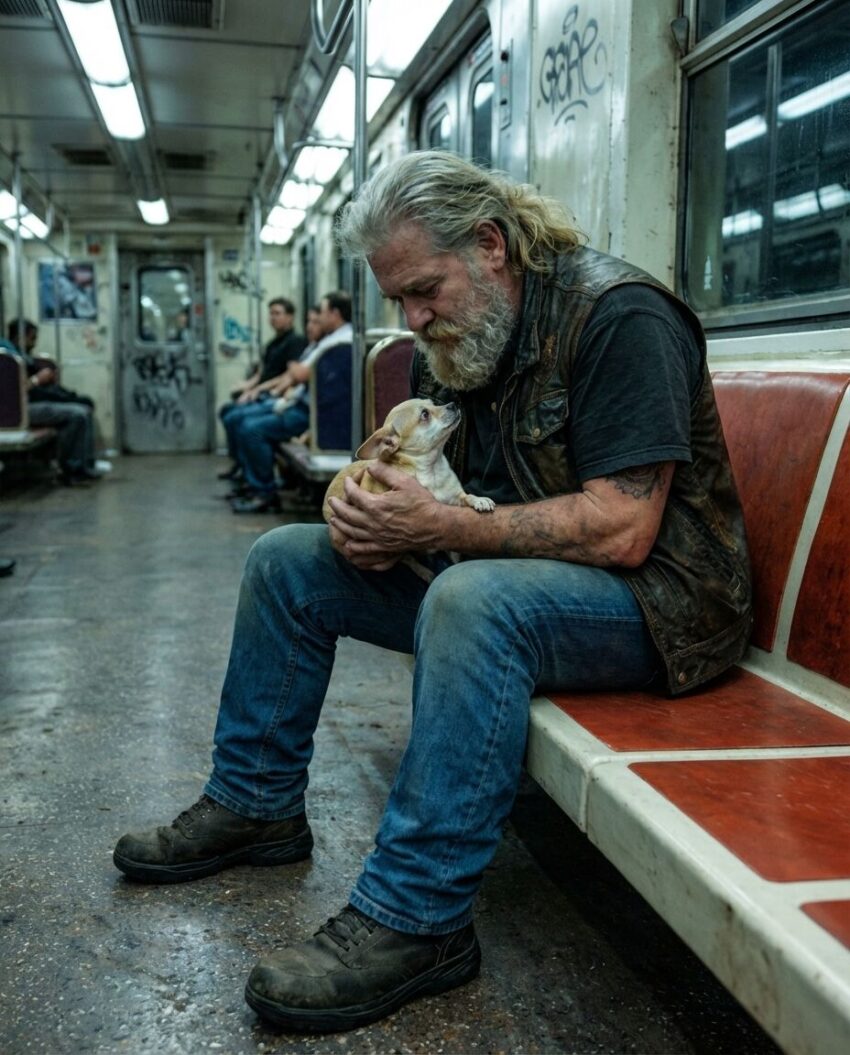
The subway car felt tense the moment he boarded, a heavy quiet settling under the flickering lights as commuters subtly shifted away. He was big, tattooed, wrapped in worn black leather, the kind of man people instinctively read as dangerous. But what unsettled them wasn’t his size. It was the fact that he was crying. Not quietly, not politely, but with the kind of grief that shakes the body. In his arms, he cradled a small, aging terrier bundled in a frayed blanket, holding it as if the world depended on his grip. People tightened their bags, avoided eye contact, and retreated to the edges of the car, afraid not of violence, but of raw, unfiltered sorrow displayed so openly in a public place.
I stayed where I was, unable to look away—not because of fear, but because of the tenderness in his hands. He wasn’t just holding the dog; he was sheltering it. The animal’s breathing was shallow, uneven, its gray-flecked fur dulled by age and illness. Every so often, its tail gave the faintest tap against his sleeve, a last reflex of loyalty. Someone muttered about calling security, but the biker didn’t react. He leaned close, whispering promises he clearly couldn’t keep, except one—that he wouldn’t let go. The space around him felt wrong, hollowed out by judgment, and without fully understanding why, I stood up and sat beside him.
“He looks like a good friend,” I said softly. The man finally lifted his eyes, red and exhausted. “The best,” he replied. He told me the dog’s name was Buster, that cancer had taken over, and that he refused to say goodbye in a sterile clinic. They were going to Coney Island instead. Years earlier, he had found Buster shivering under the boardwalk after returning from war, broken and angry, barely holding himself together. That scruffy little dog hadn’t cared about his past, his scars, or his demons. He had simply stayed. Buster had given him a reason to wake up, to stay sober, to believe again.
As the train rattled toward the coast, something shifted. The fear drained from the car. A teenager removed his headphones and watched quietly. An older woman passed forward a tissue without a word. When the biker stood at the final stop, a few of us stood too, following him onto the platform and then the boardwalk. The beach was nearly empty, the air sharp with salt. He knelt by the water, letting Buster feel the sea breeze one last time as waves sighed against the shore. Strangers stood together in silence, bearing witness. When we finally dispersed, the city felt different. We had boarded guarded and distant, but left reminded that compassion dissolves fear the moment someone chooses to step closer instead of away.