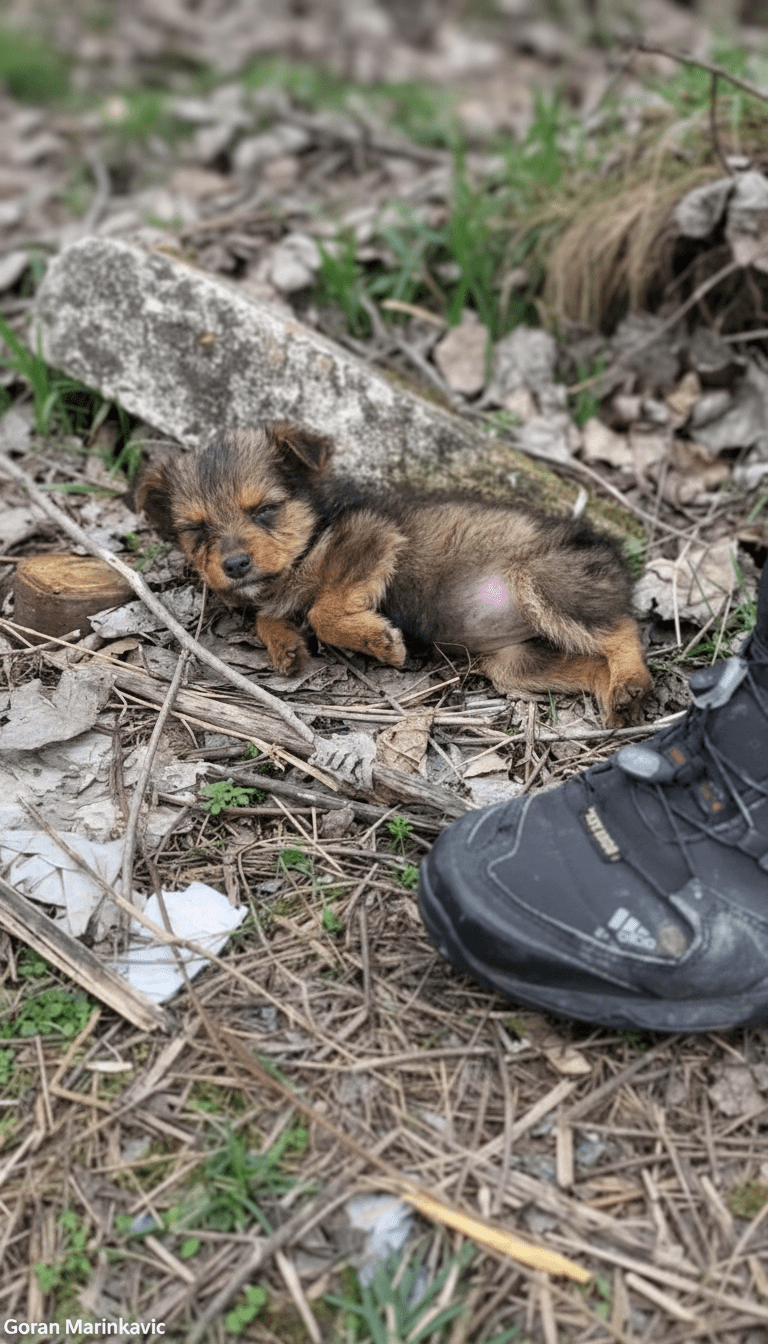
In the damp, leaf-strewn forests of rural Slovenia, on a chilly April morning in 2024, 42-year-old Goran Marinkovic set out for what he expected to be an ordinary solo hike. He had no idea that a single step would change multiple lives across three continents.
Goran, a part-time carpenter and avid nature photographer, noticed something small and dark lying motionless among the fallen leaves near the trail. At first he thought it was a discarded piece of clothing or a dead animal. Then he saw the tiny ribcage rise and fall—shallow, labored breaths. It was a puppy, no more than six weeks old, curled into a tight ball. What stopped Goran cold was the sight of the pup’s lower abdomen: a gaping, raw wound where skin and muscle had been torn away, exposing glistening pink intestines that moved faintly with each breath.

The little dog, a scruffy brown-and-black terrier mix, didn’t even have the strength to lift its head. Its eyes were half-closed, crusted with discharge. Next to the puppy lay a small, flat stone—someone had clearly placed it there, perhaps as a makeshift pillow. Goran later said the scene looked almost deliberate, as if the person who left the puppy wanted it to be found.
Rather than panic, Goran did what few would have the stomach to do: he gently scooped the dying puppy into his jacket, cradling the exposed organs against his chest to keep them warm and protected, and ran three kilometers back to his car. Every bump in the forest path made him wince, terrified he would cause more damage.
The nearest veterinary clinic in Maribor was 45 minutes away. Goran called ahead while driving, voice shaking, begging them to stay open. When he arrived, the entire staff froze at the sight of the tiny patient. The lead veterinarian, Dr. Ana Kovač, later admitted she gave the puppy less than a 5% chance of survival. The intestines had been exposed to the elements for at least 24 hours; infection was already raging.
Against all odds, the surgical team operated that same night. They flushed the abdominal cavity, repaired what tissue they could, and closed the enormous defect with a combination of grafts and meticulous suturing. For the first 72 hours, the puppy—now named “Kamen” (Slovenian for “stone,” in memory of the rock beside him)—hovered between life and death. Twice his heart stopped. Twice the team brought him back.
Word of the “miracle puppy” spread quickly across Slovenia. Local news stations ran the story, and animal lovers from neighboring countries began donating to the clinic’s emergency fund. But the real twists were only beginning.
Two weeks later, while Kamen was still in intensive care, a woman named Elena Petrović walked into the clinic with tears streaming down her face. She was 28, unemployed, and visibly pregnant. She confessed that Kamen was hers—or had been. She explained that she had found the puppy abandoned in a cardboard box on the side of a highway near Ljubljana three weeks earlier. She took him home, named him Bambi, and tried to care for him. But she lived in a tiny apartment with no heat, no money for food, and no experience raising a dog. When Bambi began vomiting and became listless, Elena panicked. She thought he was dying anyway.
In a moment of desperation, she carried the weakening puppy into the forest, laid him on the ground next to a stone, and walked away, hoping someone kinder would find him. She never expected him to still be alive.
The confession shocked the veterinary staff and animal control officers. Elena faced possible animal cruelty charges, but the prosecutor’s office, moved by her obvious remorse and difficult circumstances, offered her a plea deal: community service at an animal shelter and mandatory parenting and pet-care classes. Elena accepted immediately.
Meanwhile, Kamen continued to defy expectations. By week six he was eating solid food, wagging his tail, and attempting to play despite the massive scar across his belly. Photos of the little survivor hugging a stuffed hedgehog went viral across Europe.
That’s when the story crossed the Atlantic.

In Portland, Oregon, 31-year-old veterinary technician Mia Delgado saw Kamen’s picture on a rescue group’s Instagram page. Mia had lost her own terrier-mix puppy, Milo, to parvovirus two years earlier and had been unable to adopt again—until now. She contacted the Slovenian clinic, offered to cover all remaining medical costs, and asked if Kamen could be rehomed to the United States.
After months of paperwork, international health certificates, and a heartbreaking goodbye from the Maribor veterinary team, Kamen boarded a plane in Frankfurt bound for Portland. He arrived on August 12, 2024, wearing a tiny sweater that read “Miracle Boy.”
Mia renamed him Milo II. The bond was instant. Milo II slept curled against Mia’s neck every night, as if he still feared being left alone. Within weeks he was running in the backyard, chasing tennis balls, and charming every neighbor on the block.
But the story wasn’t over.
In early 2025, Elena gave birth to a healthy baby girl. She named her Kamenka—in honor of the puppy she had once abandoned. Through a translator, Elena began exchanging messages with Mia. They sent photos back and forth: Milo II playing in Oregon snow, Kamenka giggling next to a framed picture of the puppy she had saved from death.
In a final, astonishing twist, Elena used the compensation money from a small GoFundMe campaign (originally intended for her legal fees) to start a small dog-walking and pet-sitting business in Ljubljana. She now specializes in helping low-income families keep their pets rather than surrender them. Her first client? A young mother who had found a stray kitten and didn’t know how to care for it.
Today, Milo II is a healthy, energetic two-year-old with a thick scar across his belly—the only visible reminder of the day he was left to die. He has a favorite squeaky hedgehog, a sunny spot by the window, and a human mom who still cries every time she tells his story.
Across the ocean, in Slovenia, Elena keeps a photo of Milo II on her phone. She shows it to every new client and tells them the same thing: “This little dog taught me that second chances are real—even when you don’t deserve them.”
From a cold forest floor in Slovenia to a warm home in Oregon, and from an act of abandonment to acts of redemption, Milo II’s journey reminds us that sometimes the smallest, most broken creatures can become the greatest bridges between strangers, cultures, and second chances.
