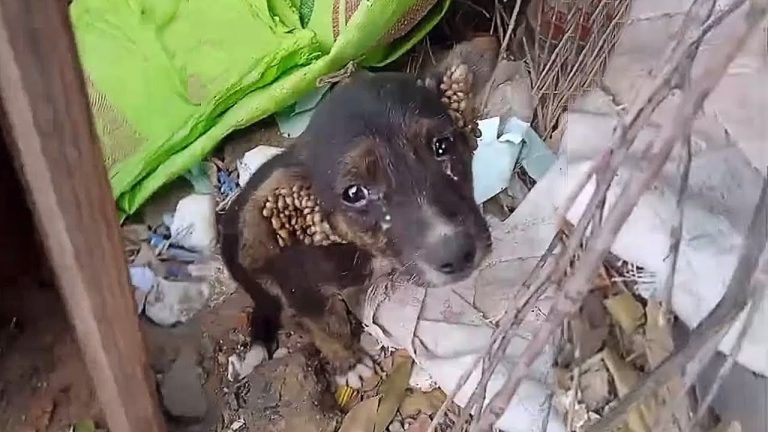
Heartbreaking yet deeply inspiring, this story follows the rescue of an orphaned puppy who was barely clinging to life under the weight of a massive parasite infestation. When he was first discovered, he was so weak he could hardly lift his head. His tiny body was covered in thousands of ticks, clustering heavily around his ears and along the delicate folds of his skin. The infestation had drained him of so much blood that he had become severely anemic. His gums were nearly white, a quiet but urgent signal that his body was running out of strength.
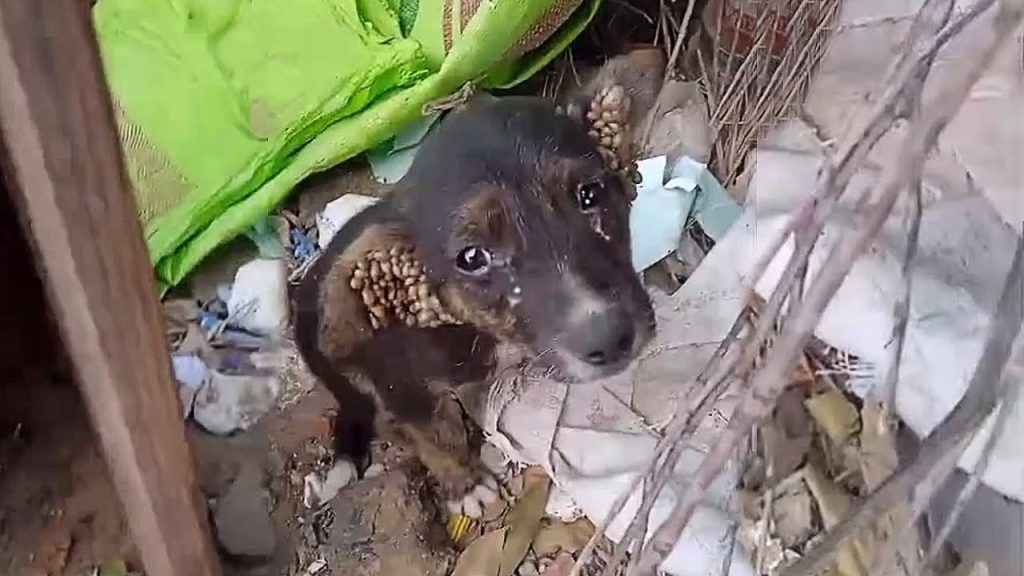
He had no mother to protect him, no shelter to shield him from the elements, and no relief from the relentless parasites feeding on him day and night. For anyone who has ever loved a dog, the sight was almost unbearable. Yet even in his fragile state, there was something in his eyes—a faint flicker of will—that suggested he had not given up.
The rescuers understood immediately that time was critical. They wrapped him gently and rushed him straight to a veterinary clinic, knowing that without swift medical intervention, he might not survive. At the clinic, the veterinary team moved with calm precision. Before beginning treatment, they carefully checked his temperature and weighed his small frame to assess just how much the infestation had compromised his health. Every detail mattered. A puppy this weak could not tolerate aggressive procedures. His body needed stabilization before anything else.
Ticks are more than just a nuisance; in large numbers, they can be life-threatening. They consume blood, spread disease, and leave behind painful irritation that can quickly become infected. In this case, manually pulling thousands of ticks from his fragile skin would have caused additional trauma and significant pain. The medical team chose a different approach—one that balanced effectiveness with compassion. Instead of forcefully removing each parasite, they applied a specialized medicated spray designed to kill the ticks safely.
This method required patience. The medication would cause the parasites to die and detach naturally, sparing the puppy unnecessary suffering. For an animal already on the edge of collapse, minimizing stress was just as important as eliminating the infestation itself. The team monitored him closely, ensuring that his breathing remained steady and that his body responded well to the treatment.
In the hours that followed, something remarkable began to happen. The ticks gradually loosened their grip and fell away. As the parasites died off, the puppy’s skin was spared further injury. It was a quiet transformation—one that unfolded not with dramatic gestures, but with careful medical judgment and steady hands.
Within twenty-four hours, the improvement was visible. The most striking change was in his gums. What had once been a pale, alarming white slowly shifted toward a soft, healthy pink. That subtle change spoke volumes. It meant his body was beginning to rebuild the blood it had lost. It meant oxygen was circulating properly again. It meant hope.
By the next morning, the puppy lifted his head with more awareness. His eyes were brighter. He accepted solid food eagerly, something he had likely not done in days. Eating is one of the clearest signs that an animal feels safe enough to begin healing. For the first time since he had been found, he seemed present, engaged, and curious about the world around him.
Beyond the medical progress, there was another powerful shift taking place. He was no longer alone. Gentle voices replaced silence. Warm blankets replaced cold ground. Compassion replaced neglect. For an orphaned animal, these changes are just as life-saving as any medication. The experience of being handled with care, spoken to softly, and protected from harm can restore trust that might otherwise be lost.
Stories like this remind us of the extraordinary resilience built into animals. Despite severe weakness and overwhelming odds, this small puppy responded quickly once given proper care. His body had been pushed to its limits, yet it had not surrendered. With targeted treatment, nourishment, and rest, he began reclaiming his strength at a pace that astonished everyone involved.
For those of us who have spent decades witnessing both the fragility and the endurance of life, there is something deeply moving in such recoveries. They reinforce a simple but profound truth: timely, appropriate medical care can make the difference between tragedy and renewal. They also highlight the responsibility we share as a community to intervene when we see suffering.
This rescue was not about dramatic heroics. It was about informed decisions, measured treatment, and unwavering compassion. It was about choosing a method that protected delicate skin rather than causing further harm. It was about monitoring vital signs carefully and recognizing subtle improvements that signaled recovery. Above all, it was about refusing to look away.
By the time the puppy stood on steadier legs and ate with enthusiasm, he had already defied expectations. The transformation from a severely anemic, parasite-covered stray to an alert, recovering young dog unfolded in just days—but it represented far more than physical healing. It symbolized the power of patience, knowledge, and kindness working together.
His story serves as a reminder that even the smallest life carries immense worth. When compassion meets expertise, survival becomes possible. And sometimes, in the span of a single day, a future that once seemed uncertain can begin to shine with promise.
In the end, what lingers is not the memory of infestation or weakness, but the image of a puppy finally experiencing comfort, nourishment, and safety. That shift—from suffering to stability—is the true heart of this rescue. It stands as quiet proof that with proper medical intervention and genuine care, even the most vulnerable among us can find their way back to strength.