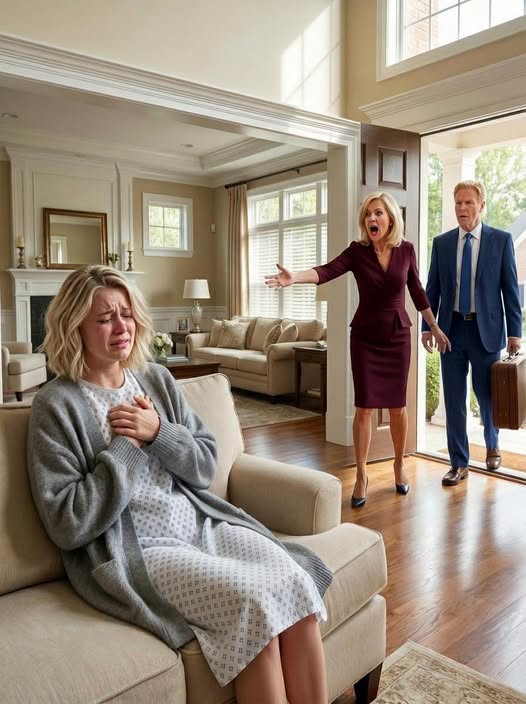
I still had the hospital wristband on when my mother signed me out against medical advice. The nurse stood between us and the elevator, one hand lifted as if she could physically hold the moment in place. She kept repeating the same thing in different ways: my oxygen levels were unstable, I needed another night of observation, leaving now could send me straight back to the emergency room.
My mother never even looked at her.
“She’s coming home,” she said, with the kind of finality she had used my entire life. Not as a question. Not even as an argument. Just a decision already made.
Two days earlier, I had collapsed at work in Columbus after a respiratory infection turned into something much worse. I remember flashes of it more than a sequence—the siren, the fluorescent lights, the mask forcing air into my lungs, the doctor leaning over me and saying very clearly, “You are not safe to leave yet.”
But my family had already rewritten the situation into something smaller.
To them, I wasn’t seriously ill. I was inconvenient.
My parents and younger brother had a beach trip to Florida scheduled for that week, and in their version of reality, my hospitalization was just terrible timing. The doctors were being dramatic. The hospital was trying to inflate the bill. I was, as usual, “making things harder than they needed to be.”
By the time I could sit up without shaking, my mother was already standing beside the bed with my clothes folded over one arm.
I told her I could barely walk to the bathroom by myself.
She said I would feel better once I was home.
I told her the doctor said my breathing still wasn’t stable.
She leaned in, her face hard and cold, and hissed that I was embarrassing the family and wasting everyone’s time.
My father stood by the window during all of this, not saying a word, scrolling through flight confirmations on his phone as if he were waiting for a delayed boarding group instead of watching his daughter being pulled out of a hospital too soon.
I thought they were taking me back to my apartment.
They didn’t.
They drove me to my parents’ house outside the city instead. Somewhere along the highway, I asked my mother for my debit card because I wanted to order medication and groceries once I got settled. She kept her eyes on the road and said, almost casually, “We used your account for the rental car and hotel. We’ll pay you back.”
I remember the exact feeling that went through my chest when she said it—not just fear, not just disbelief, but a sharp, tearing shock that made it hard to breathe for an entirely different reason.
I had less than two hundred dollars left after rent. They knew that. They also knew I had already missed work and had no idea how long I’d be out. When I checked my phone, I watched the charges stack up in real time: airline upgrade, beachfront resort deposit, restaurant prepayment.
My money was funding their vacation while I sat in the passenger seat trying not to black out.
When we reached the house, they helped me inside with the detached efficiency of people moving something fragile they didn’t particularly value. My mother set a glass of water on the kitchen table and pointed to a paper bag filled with crackers, canned soup, and cold medicine.
“Just rest,” she said. “We’ll be back in four days.”
At first I thought she was joking.
Then I saw the suitcases by the door.
I told them I couldn’t be left alone. I said I got dizzy every time I stood up. I said if something went wrong, I might not even make it to the front door, let alone drive anywhere. My brother shrugged and said I could always call 911 if I was “that bad,” then carried his suitcase out without looking at me again.
They left before sunrise the next morning.
I woke to the sound of the front door closing, tires crunching over gravel, and then silence. Not peaceful silence. Not morning quiet. A silence so complete it felt like something had been torn out of the house.
My phone battery was at nine percent. My inhaler was almost empty. The refrigerator held beer, condiments, and fruit gone soft and brown. I tried to stand and nearly collapsed.
Around noon, I ended up on the kitchen floor, breathing in short, careful pulls, staring at the family calendar still hanging on the wall.
Across that week, in thick blue marker, my mother had written one cheerful word:
VACATION.
For the first hour, I kept telling myself I could manage.
I dragged a chair across the kitchen so I could pull myself from counter to table to sink without falling. I found a charger in a junk drawer, plugged in my phone, and sat on the floor waiting for it to come alive. My hands shook so badly I dropped it twice.
My first call was to my mother. Straight to voicemail.
My second was to my father. He actually answered, sounding annoyed, airport noise rumbling in the background. When I told him I was worse, he told me to take the cold medicine my mother had left.
I said I needed help, not cough syrup.
He lowered his voice, like I was the one causing a scene, and told me not to ruin the trip over panic.
Then I called my brother.
He laughed. Not because anything was funny, but because that was always his reflex when someone else was in pain and he wanted distance from it. He said they had already boarded, there was nothing they could do now, and I needed to start “acting like an adult.”
Then he hung up.
I stared at the dead screen in my hand and felt something in me shift.
I knew one neighbor well enough to ask for help—Mrs. Delaney across the street—but I still waited.
That is the part that embarrasses me most now.
Not because I should have been stronger. Because I had been trained so thoroughly to protect my family’s image that even half-sick and alone on a kitchen floor, I was still thinking about how it would look if the neighbors found out.
Shame is powerful. It can keep you loyal to people who are actively harming you.
But pain is more powerful eventually.
When I finally texted her, the message was broken and uneven: Can you help? Trouble breathing. Alone.
She was at my door in less than ten minutes.
I heard the knocking first, then my name, then the change in her voice when she realized I was trying to crawl toward the entryway. She came in through the garage using the code my mother had once given her for package deliveries, took one look at me, and said, “We are not debating this.”
She called 911 while kneeling beside me with one hand on my shoulder.
The paramedics arrived fast. They asked who had discharged me. I said my family took me out. One of them glanced at the other in a way that told me everything I needed to know: this was bad. Worse than I had let myself admit.
At the hospital, the same doctor who had warned me not to leave recognized me immediately.
He didn’t scold me. That somehow would have been easier.
He just looked at my chart, then at me, with a kind of stunned disappointment that felt almost unbearable. My oxygen saturation was lower than when I had first been discharged. I was dehydrated, under-medicated, and edging toward another major complication.
That evening, once I had stabilized enough to think clearly again, a social worker came into my room and sat down.
She asked careful questions.
Did I feel safe going back with my family?
Had they ever controlled my finances before?
Had they ever interfered with my medical care?
I wanted to say no. I wanted to explain it away. I wanted to soften everything, because naming it honestly would mean admitting that what had happened wasn’t cruel by accident. It was part of something larger. A pattern. A structure.
So I told her the truth.
About the debit card. About the pressure. About the insults. About the way every crisis in my life somehow became an inconvenience to them. About my mother’s control, my father’s silence, my brother’s cruelty.
I told her I had never called it abuse because no one had ever hit me.
She didn’t blink.
She helped me freeze the card, document what happened, and contact my manager at work. Then she said something no one in my family had ever said to me before.
“What happened to you was not your fault. And you do not have to go back.”
I stayed in the hospital three more days.
For the first time since getting sick, I started getting better.
It’s amazing what proper oxygen, medication, fluids, and actual care can do. Amazing what happens when people listen the first time you say you are weak.
The family calls finally came, but not because they were worried.
Their resort payment had been declined after the bank flagged the card.
My mother left two voicemails calling me selfish. My father texted, You’ve made this into something it didn’t need to be. My brother wrote, Hope the drama was worth it.
I saved every message.
The hospital connected me with legal aid and an advocate. Because I was an adult and fully competent, the situation was complicated—but not hopeless. They helped me file a police report for the financial theft, dispute the charges, and document the timeline of my discharge.
At work, I braced for disappointment and got the opposite. My manager listened, asked only what I needed, arranged emergency leave, and sent a coworker to my apartment with clean clothes and a charger.
That kind of kindness can be almost unbearable when you’ve lived without it for too long.
When I was discharged the second time, I did not go back to my parents’ house.
Mrs. Delaney drove me to my apartment, carried in groceries, and wrote her number on a notepad in thick black marker beside my couch. Legal aid helped me open a new bank account. I changed every password I had.
My mother came once, pounding on my door, demanding that I stop humiliating the family.
I didn’t open it.
I stood on the other side and told her if she didn’t leave, I would call the police.
She shouted that after everything they had done for me, I was choosing strangers over blood.
That was when I finally understood something I should have known years earlier.
Blood was never the bond for them.
It was the excuse.
The bank eventually restored most of the money, though not before I spent a frightening month selling furniture, accepting help, and learning just how expensive freedom can feel in the beginning.
I started therapy that fall. In one session, I described waking up to their car leaving for Florida while I lay too sick to stand. My therapist told me abandonment often becomes clear only after survival loosens its grip. At the time, I was just trying to breathe. Later, I had the space to understand the full shape of what they had done.
My family never apologized.
Instead, they told relatives I was unstable, dramatic, manipulated by outsiders. Some believed them. Some didn’t. Eventually, I stopped trying to manage the story for everyone else.
The truth had already cost me enough.
What remains now is simple and hard-earned.
They left me sick and alone on a kitchen floor and flew to the beach using my money.
I survived anyway.
Not beautifully. Not all at once. Not with some triumphant speech waiting at the end of it.
I survived by inches, by help I almost didn’t ask for, by strangers who treated me with more care than blood ever had.
And once I stood up again, I didn’t go back.