I’m Lainey Beckwith. I’m twenty-eight. I’m a feature reporter at a small weekly paper in central Pennsylvania called the Sayre Gazette. Population of our town: about five thousand.
What I am telling you, I am telling you in pieces — pieces from Henry, pieces from his neighbor Marlene, pieces from a shelter manager named Pete Salvatori who has been at Bradford County Humane Society for twenty-one years, pieces from Daniel in Seattle who I called on a Wednesday afternoon in February, and pieces from a small notebook Henry keeps on his workbench that he reluctantly let me photograph.
I will tell it in order.
The first time Henry walked into the Bradford County Humane Society shelter with a tiny white doghouse in his hands, Pete Salvatori thought he was a salesman.
Pete told me, in his small office that smells like wet dog and burnt coffee, “Lainey. He came in with this thing under his arm. About a foot and a half tall. White. Beautiful work. Pitched roof. The name BISCUIT carved into the front. I figured he was selling them or trying to do a craft fair partnership.”
Henry set the doghouse on Pete’s desk.
He said, “This is for one of your dogs.”
Pete said, “Sir, we don’t really — we have kennels, the dogs sleep in kennels.”
Henry said, “I know. I’d like to put it in a kennel. With one of your dogs. The one you think needs a name.”
Pete said, “Sir, all the dogs have names.”
Henry said, “Then the one you think needs the name BISCUIT.”
Pete looked at him for a long moment.
He said, “Are you asking to give us a doghouse?”
Henry said, “Yes.”
Pete said, “Just for the kennel? While the dog is here?”
Henry said, “Yes.”
Pete said, “Okay.”
That afternoon, the doghouse called BISCUIT went into the kennel of a beagle mix who had been at the shelter eleven weeks. The volunteer who set it up posted a photo on the shelter’s Facebook page that night with a caption that said Look what a kind man brought us today.
The beagle mix was adopted four days later. The adopter said, in the comments under that photo, “We are bringing the doghouse home with him.”
Pete called Henry that Sunday.
Pete said, “Henry. We need another one.”
Henry said, “Already?”
Pete said, “Henry. You have no idea what just happened on Facebook.”
For the next six years, Henry built tiny white doghouses.
He built one a week, sometimes two. He cut every board himself on his band saw. He sanded every surface by hand. He painted every house with the same brand of exterior white he had used on the rocking chair he made for Ruth in 1971. He carved a different name on the front of every house in small block letters: SAGE. JUNIPER. WHISKEY. BUTTERS. TRUMAN. POPPY. GUSTAV. NESSIE. APRIL. CHARLIE. SCOUT. DUNCAN. He kept a list in a small green notebook on his workbench so he wouldn’t repeat himself.
He drove every single house to the Bradford County Humane Society and presented it to Pete.
Pete put each house in the kennel of the dog he thought needed it most — the dog who had been there longest, or the shyest, or the one who had been returned. The houses traveled with the dogs to their adoptive homes. Pete told the adopters, every single time, “This is from a man named Henry. The doghouse is yours to keep.”
The shelter started getting calls from other shelters. Shelters in Lycoming County. Shelters in Tioga County. Shelters across the state line in upstate New York.
Pete asked Henry if he was willing to make houses for them too.
Henry said, “How many do you need.”
Pete said, “I don’t know. As many as you can make.”
Henry said, “Okay.”
By year three, he had built one hundred and ninety-two houses. By year five, two hundred and ninety-one. He turned eighty in February of last year. By the time I drove out to interview him in March, he had built three hundred and forty-seven.
He had never accepted a single dollar.
He had refused, gently and firmly, every single offer of payment from every single shelter and every single adopter and every single person who heard about what he was doing through a friend of a friend on Facebook.
He had built every house from his own savings on materials. He had used wood from his retirement project pile that he had bought twenty years earlier and never used. He had bought the white paint at the Lowe’s in Towanda with his pension card.
When I asked him in his workshop, on a Wednesday afternoon in early March, why he didn’t sell them — why he didn’t at least let people pay for materials — he set down his sander and looked at me through his reading glasses.
He said, “Honey. If I sold them, they’d be product. They aren’t product. They’re houses.”
He said, “Houses are something you give someone.”
I had been at his workshop for about an hour when I noticed it.
He had a finished doghouse on his workbench — newly painted, drying. The name CLOVER was carved on the front. Pete had told him over the phone the day before that there was a black lab puppy at the shelter who needed a name and the volunteers had wanted CLOVER.
I picked up the house to look at it. It was beautifully made. Light. Hollow. The roof had a cross-shaped peak.
I tilted it up to look inside.
There was something carved into the underside of the roof.
Small block letters. Pencil-traced first, then carved. Carved deep enough that the letters were filled with a soft pencil residue Henry had clearly rubbed in to make them readable.
The letters said:
GRANDPA WISHES YOU NEVER GET COLD AGAIN.
I looked up at Henry.
He was watching me with the steady, careful expression of a man who had been waiting for me to find it.
I said, “Henry. What is — “
He said, “Look at the others.”
I went to a shelf along the back wall. There were nine more houses on it, finished, waiting for delivery to a shelter in Tioga County the following Saturday.
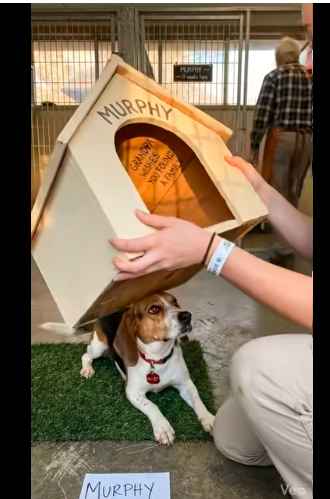
I tilted up the first one. The name on the outside was MURPHY. Inside the roof, in small carved letters, it said:
GRANDPA WISHES YOU FOUND A FAMILY.
The second house, ROSIE: GRANDPA WISHES SOMEBODY HOLDS YOU.
The third, FENWICK: GRANDPA WISHES YOU WERE NOT AFRAID OF ANYTHING ANYMORE.
The fourth, HAZEL: GRANDPA WISHES YOU HAD A GOOD MORNING TODAY.
The fifth, OTIS: GRANDPA WISHES SOMEBODY SAYS GOOD BOY OUT LOUD.
The sixth, MITTENS: GRANDPA WISHES YOU SLEPT INSIDE TONIGHT.
The seventh, BARNABY: GRANDPA WISHES YOU HAD A NAME SOMEBODY KNOWS.
The eighth, DOTTIE: GRANDPA WISHES YOU WERE LOVED BY SOMEBODY OLD ENOUGH TO STAY.
The ninth, COOPER: GRANDPA WISHES YOU WERE NOT ALONE WHEN IT GOT DARK.
I set the last one back on the shelf.
I sat down on the small wooden stool by his workbench.
I did not pick up my pen for almost a full minute.
Henry watched me from across his workshop.
When I could finally talk, I said, “Henry. There’s a sentence inside every one of them.”
He said, “Yes, ma’am.”
I said, “All three hundred and forty-seven.”
He said, “Three hundred and forty-six. The first one — Biscuit — was just a doghouse. I started carving them inside the roof on the second one.”
He said, “It seemed like the right place.”
He said, “Where they could see it if they looked up.”
I said, “Henry. Why are they all from grandpa?”
He took off his reading glasses.
He polished them slowly with a corner of his flannel shirt.
He said, “Honey. I’ll tell you. But you have to wait until I’m done polishing my glasses. I haven’t told anybody this before. I need a minute.”
I waited.
When he put his glasses back on, his pale blue eyes were very tired.
He said, “Ruth and I had three pregnancies. Daniel was the only one who made it. Daniel never had children. He doesn’t want them. That’s his right and I love him.”
He said, “I never got to be a grandfather.”
He said, “When Ruth got sick — at the end — she said to me one night, ‘Henry. I’m sorry we never made it to grandparents.’ I told her it was okay. She said, ‘But you would have been so good at it.’”
He said, “She died eleven days later.”
He paused.
He said, “I have not said the words ‘I love you’ or ‘be safe’ or ‘I’m proud of you’ or ‘sleep well, honey’ to anybody in eleven years. Daniel’s a grown man in Seattle. Marlene is a friend, not family. Ruth is gone.”
He said, “But the dogs. Every week there’s a new one. They never tell me to stop. They never say ‘thanks Dad, that’s enough.’ They never get tired of being told nice things.”
He said, “So I tell them. Every house. A different sentence. Every dog.”
He said, “It’s not a lot. But it’s mine. And I get to give it.”
I sat in Henry’s workshop for another hour after he told me that.
I asked him, eventually, if I could photograph the small green notebook where he kept his list of names.
He said yes.
I opened it on his workbench. The first page was dated June 19, 2015. The first name was BISCUIT. Under it, in Henry’s careful block printing, he had written: No carving. Started carving on next one.
The second name was MURPHY (a different Murphy, from 2015). Under MURPHY he had written, in small letters: Grandpa wishes you found a family.
I turned the pages. Every page was a name and a sentence. Some of the sentences repeated — Henry had used GRANDPA WISHES YOU FOUND A FAMILY twenty-three different times across the six years, because, he said, that was the one he most often needed to say.
But most were different.
GRANDPA WISHES YOU GET A BLANKET ON A COLD DAY.
GRANDPA WISHES SOMEBODY IS HAPPY TO SEE YOU AT 3 P.M.
GRANDPA WISHES YOU HAVE A GOOD KNEE TO LIE ON.
GRANDPA WISHES YOU NEVER HAVE TO ASK FOR FOOD AGAIN.
GRANDPA WISHES YOU SEE THE SAME PERSON EVERY MORNING WHEN YOU WAKE UP.
GRANDPA WISHES SOMEBODY KNOWS WHICH SIDE YOU LIKE TO BE PETTED ON.
I read them for thirty minutes.
I cried twice. Quietly. Henry pretended not to notice.
When I finally closed the notebook, I asked him one last question.
I said, “Henry. Have you ever told Daniel?”
He said, “Told Daniel what.”
I said, “About the houses. About the sentences.”
He said, “I send him a photo when I finish a particularly nice one. He says, ‘Looks great, Dad.’”
He paused.
He said, “He doesn’t know about the inside of the roofs.”
He looked at me.
He said, “I’d rather it be the dogs.”
My feature ran in the Sayre Gazette on the third Sunday of March.
It went viral within two days. The Associated Press picked it up. A reporter from the Today show called Pete at the shelter on Tuesday morning and Pete called Henry and asked him if he wanted to talk to her. Henry said no.
Pete said, “Henry. They’re going to call you anyway.”
Henry said, “Tell them I said no.”
Henry never spoke to a national reporter. He spoke only to me. He did the second interview in his workshop in late April, on a Saturday, after I asked his permission.
Daniel saw the original article on his phone in Seattle on the Sunday it ran.
He read it twice.
He flew home on Wednesday.
I was there in the workshop when Daniel walked in. I had come back to drop off a copy of the paper in case Henry hadn’t seen it, and Daniel’s car was already in the driveway. Henry had not told me Daniel was coming.
Daniel was fifty-two years old, in a North Face jacket, slightly grayer than the last photo on Henry’s refrigerator. He was holding the newspaper.
He walked into the workshop. Henry looked up from the doghouse he was painting.
Daniel walked across the concrete floor and put both arms around his father, and he did not let go for a long time.
Henry kept one paint-spattered hand on Daniel’s back.
Daniel said into his father’s shoulder, “Dad. I read it.”
Henry said, “I know, son.”
Daniel said, “Why didn’t you tell me.”
Henry said, “I figured you had your own things.”
Daniel said, “Dad. Read me one.”
Henry walked, slowly, to the shelf along the back wall. He picked up the doghouse marked HAZEL — the one for the shelter delivery the next morning. He tilted it up.
He read aloud, in his quiet steady voice:
“Grandpa wishes you had a good morning today.”
Daniel sat down on the small wooden stool by the workbench and cried.
Henry stood next to him. He put one large hand on the top of his son’s head. He left it there.
Daniel comes home now four times a year.
Henry is eighty-one. He still builds the houses. He has slowed to about one a week, sometimes one every ten days. The list in the green notebook is at four hundred and four. The sentences are still all different.
Daniel has started bringing his husband Marcus, whom Henry had only met once before, to the workshop on visits. Marcus has been helping sand the houses.
Marcus told me on his last visit, while Henry was inside making sandwiches: “Lainey. I have been with Daniel for twenty-one years. The last time he cried in front of me was when his mother died. He cried in this workshop in April for forty-five minutes.”
I asked Marcus if Daniel had asked Henry to add a different ending to the sentences. The sentences are still all Grandpa wishes.
Marcus said, “No. I asked him about that. Daniel said he wouldn’t change a word.”
Marcus said, “Daniel told me he’d been waiting his whole life to read those sentences.”