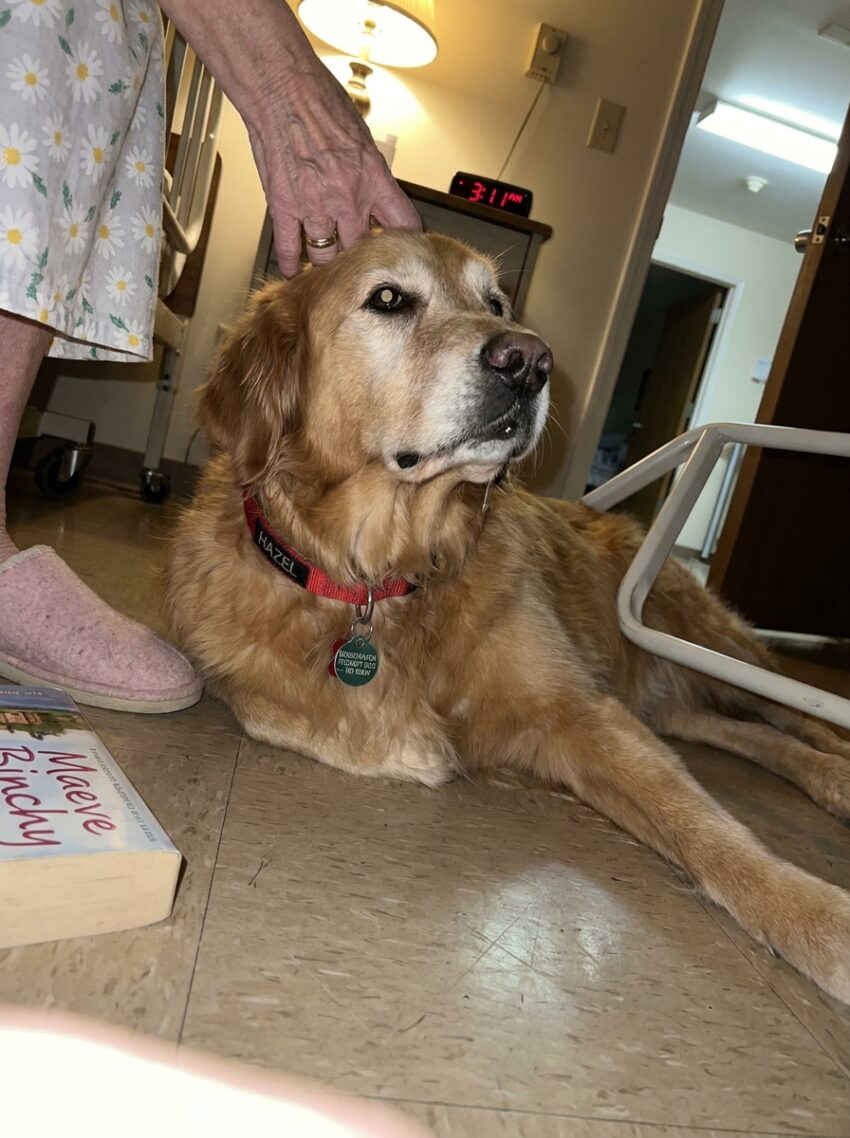
The first night was Tuesday, October 22nd.
I had clocked her out at 7:58 p.m. as I always do. I had said good night to the on-shift nurses — a woman named Beverly, fifty-eight, who had been at Brookhaven for nineteen years and who I knew well, and a younger nurse on her third week named Devin. I had clipped Hazel’s leash to her collar in the lobby. I had walked toward the front door.
Hazel had not walked.
She had sat down on the lobby tile.
I had looked back at her. She was looking at me with her tea-colored eyes. Her tail thumped the tile twice.
I said, “Hazey. Honey. Time to go.”
She did not get up.
I walked back to her. I crouched. I scratched behind her ear. I said, “Buddy. Come on. It’s eight.”
She did not move.
I tugged the leash. She stood up reluctantly. She walked, slowly, with her shoulders low, the way Goldens walk when they are doing something they do not want to do.
I got her to my car.
She sat in the back seat the whole drive home. She did not lay down. She watched out the window the way dogs watch when they are listening for something.
I thought she was tired.
I thought, Dogs have moods.
I went home.
She slept on the foot of my bed.
Wednesday, October 23rd, 8:00 p.m.
Same thing.
I clipped her leash on. I walked toward the front door. She sat down on the lobby tile and looked at me.
This time she did not even get up when I tugged the leash. I had to bend down and physically encourage her — gentle hand under her chest, gentle voice — to stand up and walk out with me.
Beverly, who had been at the front desk, said, “Tom. She’s not herself tonight.”
I said, “I know. Second night in a row.”
Beverly said, “Maybe she needs a vet check.”
I said, “I’ll call her vet tomorrow.”
I drove her home. She sat upright in the back seat the whole way. She did not lie down on her bed at home. She slept on the floor by my bedroom door, facing it, with her ears alert.
I called her vet — Dr. Pang at Cumberland Veterinary — Thursday morning. I described what was happening. Dr. Pang said, “Tom. She’s nine. She might be feeling a little anxious. Goldens can develop separation issues at her age. Bring her in next week. In the meantime — pay attention. Dogs are usually right about what’s bothering them, even when we don’t know what it is.”
I said, “Thanks, Doc. I will.”
I did not pay attention.
I picked her up Thursday afternoon for her shift. She did her work — visited Mrs. Crenshaw, visited the men in the East wing, sat for her therapy hours.
Thursday night, October 24th, 8:00 p.m.
She sat down on the lobby tile. She looked at me. This time she added a small whine.
It was the first time she had whined at me in four years.
I should have stopped.
I bent down. I told her, “Hazey. I know, sweet girl. I’ll bring you in early tomorrow. Come on.”
I picked her up. I carried her to the car. Sixty-three pounds of unhappy Golden Retriever.
She slept by my front door that night.
She did not eat her breakfast Friday morning.
Friday night, October 25th, 7:55 p.m.
I clocked her out at the front desk. Beverly was on shift again. Beverly took one look at Hazel as I clipped on her leash and said, “Tom. She doesn’t want to go.”
I said, “Beverly. I know.”
Beverly said, “Tom. I have been a nurse for thirty-six years. I have seen this before. Dogs know things.”
I said, “Beverly. I called her vet. Dr. Pang said she might have separation anxiety.”
Beverly said, “Tom. Look at her face. That isn’t separation anxiety.”
I looked at Hazel.
Hazel was looking up at me.
She was not anxious. She was not sad. She was alert. Her ears were forward. Her eyes were focused. She was standing now — not sitting — but she was standing in a way that said she was not going to move toward the door.
She was telling me something.
I said, “Beverly. What do I do?”
Beverly said, “Tom. Leave her here tonight. We have a quiet room. I’ll set her up a bed. The third-shift handlers can drop her at your house in the morning. Or we’ll keep her till you come back.”
I said, “Bev. I’m not supposed to leave her here.”
Beverly said, “Tom. I’ll write the note. I’ll take responsibility.”
I looked at Hazel.
Hazel’s tail thumped the lobby tile twice.
I unclipped her leash.
I said, “Hazey. Stay.”
She stood up. She walked across the lobby. She walked down the hallway.
She walked, without hesitation, to the doorway of Room 217.
She lay down across the threshold.
Beverly and I followed her at a distance. We watched.
Mrs. Crenshaw was reading a Maeve Binchy paperback in her bed. Beverly knocked.
Mrs. Crenshaw looked up.
Beverly said, “Mrs. Crenshaw. Hazel wants to stay with you tonight, if that’s okay.”
Mrs. Crenshaw lowered her glasses. She looked at Hazel on the floor. She looked at Beverly. She looked at me in the hallway.
She said, “Beverly. Honey. I would love that. Come here, Hazel.”
Hazel did not come into the room. She stayed at the threshold. She looked at Mrs. Crenshaw. She looked at the bed.
Mrs. Crenshaw said, “Hazel, sweetheart. Come up here.”
Hazel walked into the room. She walked over to the bed. She did not jump up. She lay down on the floor next to the right side of the bed.
Right where the bed rail was.
She put her chin on her paws.
She did not close her eyes.
I drove home Friday night for the first time in four years without Hazel in my back seat.
I did not sleep well.
At 3:14 a.m. my phone rang.
It was Beverly.
She said, “Tom. Hazel saved Ruth Crenshaw’s life forty minutes ago. I need to tell you what happened. Are you sitting down?”
I sat down.
She said, “Mrs. Crenshaw must have shifted in her sleep. The right-side bed rail dropped — turns out it had a mechanical failure none of us had reported because none of us had noticed it dropping over the course of nights, only over multiple nights. She slid out of the bed. Hazel was lying on the floor right where she went. Hazel broke her fall.”
She said, “Hazel started barking. Hazel does not bark, Tom. You know this. She has not barked on shift in six years. She started barking at 3:09 a.m. and did not stop.”
She said, “Devin and I were at the front desk. Devin ran. She got there in about forty seconds. Mrs. Crenshaw was on the floor. She had hit the carpet, not the bed-frame, because Hazel was between her and the frame. Hazel was lying on her side with Mrs. Crenshaw partially on top of her.”
She said, “Mrs. Crenshaw is bruised but not broken. The doctor’s been by. She’s awake. She’s okay. She’s furious about her glasses.”
Beverly paused.
She said, “Tom. We checked the camera in 217. The bedside rail had been dropping over the course of every night for at least the last week. Maybe longer. We had not caught it because we don’t watch every camera every night. Mrs. Crenshaw weighs eighty-nine pounds. The fall would have likely broken her hip. At her age and weight, with her existing osteoporosis, that fall is fatal in the next ninety days for one out of three patients.”
She said, “Tom. Hazel knew.”
She said, “I want you to listen to me.”
She said, “I think she knew on Tuesday. I think she knew on Wednesday and Thursday. I think that is why she would not get into your car.”
I sat on the edge of my bed in my dark bedroom and I cried.
I said, “Beverly. I made her go home with me.”
Beverly said, “Tom. Honey. Listen to me. You are not allowed to take this on. You did what every night handler at this nursing home would have done. We have a system. The system says she goes home. You followed the system.”
She said, “But Tom — listen to me — the system was wrong. She was telling us. She tried for three nights. We heard her on the fourth.”
She said, “Tom. We are going to talk about that at our staff meeting. We are going to change the system.”
I said, “Bev. I’m sorry.”
She said, “Don’t be sorry. Be early. We need you here at six. Mrs. Crenshaw wants to see you. She wants to see Hazel. Hazel has not left her side. She is on the floor by her chair right now. She has been there for three hours.”
I drove to Brookhaven at 5:30 a.m.
I walked into Mrs. Crenshaw’s room. She was in her recliner near the window with a small ice pack on her left elbow and an enormous bruise on her right cheek. Hazel was lying on the floor at her feet. Mrs. Crenshaw was wearing her glasses — a different pair, an older pair — and reading her Maeve Binchy paperback again.
She looked up when I came in.
She said, “Tom. Honey. Come sit.”
I sat in the chair across from her.
I said, “Mrs. Crenshaw, I am so sorry.”
She said, “Tom. Why?”
I said, “I should have left her with you on Tuesday.”
She said, “Tom. Honey. None of us knew. The bed didn’t know. The rail didn’t know. The night staff didn’t know. I didn’t know. The only person in this building who knew was the dog.”
She said, “And she tried to tell you.”
I said, “Mrs. Crenshaw.”
She said, “Tom. I want to tell you something. I am ninety-two years old. I do not have endless time. I have something I have been waiting to say to somebody.”
She said, “I have spent ninety-two years on this earth. I have raised three children. I have buried two husbands. I have been a postmaster of a small town for thirty-seven years. I have learned a few things.”
She said, “The first thing I learned is that animals know things human beings have stopped paying attention to. I had a horse in 1958 who would not let my husband Burton walk into a particular pasture three days running. We thought she was being stubborn. On the fourth day my brother walked in to fetch her and was bitten by a copperhead in tall grass. The horse had smelled it three days before.”
She said, “Animals know. They tell us. We have to be willing to listen.”
She said, “Tom. You did not do anything wrong. You listened on the fourth night. Most people never listen. Most people would have made it five. Most people would have made it ten.”
She said, “Hazel was telling you. You heard her. You brought her to me. She caught me when I fell.”
She paused.
She said, “Honey. I would not have survived a broken hip at ninety-two pounds and ninety-two years.”
She said, “She gave me the rest of my life.”
She put her hand down on Hazel’s head.
Hazel thumped her tail twice on the floor.
Mrs. Crenshaw said, “Now sit with me a minute. We have been having a very nice morning.”
I sat with her for an hour. I cried twice. She did not let me apologize again.
Brookhaven changed its system that week.
The staff meeting on Monday adopted, with full corporate approval — they had no choice — a new policy. If our therapy dog refuses to leave the building at the end of her shift on more than one consecutive evening, the night-shift handler is required to consult with the on-duty nurse and consider whether to leave her overnight. If the dog is showing distress or behavioral change for two evenings in a row, the default becomes she stays until evaluated.
The policy is now part of the handler training packet. I helped Beverly write it.
The mechanical failure on Mrs. Crenshaw’s bed rail was identified and replaced within twenty-four hours. Brookhaven also commissioned an independent engineer to review every adjustable bed rail in the facility. Three more had similar developing failures. They were all replaced.
A small framed photograph hangs above the desk in the front lobby of Brookhaven now.
It is a photograph of Hazel, asleep on the floor in Room 217, with one of her front paws resting against the right-side bed rail of Mrs. Crenshaw’s hospital bed.
The photograph was taken at 4:07 a.m. on Saturday October 26th — about an hour after the fall — by Devin, the third-shift nurse, with Mrs. Crenshaw’s permission.
The photograph has a small brass plaque under it.
The plaque reads: Hazel was telling us for three nights. We listened on the fourth. We are going to listen earlier next time.
It has been seven months.
Hazel still works at Brookhaven. She still rides home with me on most weeknights. She is, the staff and I have all agreed, allowed to stay overnight whenever she chooses to.
She has chosen to stay overnight nine times in seven months. Each time, it has been with a different resident. Each time, the resident has had something quiet going wrong — not always something dangerous, sometimes just something hard.
She stayed with a man named Ed in February for the four nights of his daughter’s funeral. She stayed with a woman named Marjory in March for the night she was admitted to the memory wing for the first time and was frightened. She stayed with Mrs. Crenshaw twice more — once in November when Mrs. Crenshaw had a chest cold, and once in February when Mrs. Crenshaw simply asked if Hazel could stay because she was lonely.
The night-shift staff now knows, in the words Beverly used at our staff meeting last winter: Hazel is the senior member of the staff who has the most accurate sense of who needs us tonight. Listen to her first.
Mrs. Ruth Crenshaw is ninety-three years old this June.
She told me last week, on a Wednesday afternoon when I came to visit her with Hazel, “Tom. I am eighteen months past the night that should have ended me. I have read forty-one books. I have learned to play hearts with my granddaughter on Sunday afternoons. I have written four letters to people I have been meaning to write to for twenty years. I have been on this earth a year and a half longer than I had any right to.”
She said, “I owe Hazel for that.”
She said, “And I am paying her back the only way I can.”
She said, “I tell every new resident on my hall about her. I tell every visitor. I tell my own children. I tell my granddaughter.”
She said, “I tell them — Listen to the dog. The dog hears things you do not. The dog will tell you things you do not yet know. Listen the first time.“
She said, “If you do not listen the first time, listen the second.“
She said, “If you do not listen the second time, then God help you — listen the third.“
She said, “And if you do not listen the third time — pray that the people around you are still listening, because by the fourth time it is the fourth time, and not everybody gets a fourth.“
Hazel, on the carpet at her feet, thumped her tail twice.