I’m going to tell this slow. The slow part is the whole story.
The Whitmore-Calloways pulled into our gravel parking lot at 10:14 a.m. on Saturday, September 7th, 2024, exactly 96 hours after they had taken Winston home. They were driving a silver Subaru Outback with a wire crate in the back.
I was at the front desk that morning. It was a clear cool September Saturday. Our shelter had been open since 9. We had two adoption appointments scheduled for that afternoon.
I saw the Outback pull in. I saw Mrs. Whitmore-Calloway get out of the passenger seat. I saw Mr. Whitmore-Calloway get out of the driver’s seat. I saw them open the back hatch and look at the wire crate inside.
I did not yet know what was in the crate.
I did know, by the body language — by the way Mrs. Whitmore-Calloway was standing with her arms crossed, by the way Mr. Whitmore-Calloway was already reaching into his pocket for paperwork — that this was a return.
I have been doing this for 13 years. I know what a return looks like before it walks through the door.
I went to the front door and I opened it. I smiled. I made my voice gentle.
I said, “Anders. Larkin. Good morning. Is everything okay?”
Mr. Whitmore-Calloway said, “Hazel. We need to talk to you.”
I said, “Of course. Come in.”
I want to tell you what happened in our front office over the next twenty-two minutes, because the twenty-two minutes contains the entire emotional shape of what happens when a return goes wrong.
They brought Winston inside in the wire crate. Winston was lying flat on the floor of the crate. He was wearing a small new red collar that had a tag with a phone number on it — a tag Mr. Whitmore-Calloway peeled off before he handed the crate over to me. He was not making a sound. His ears were back. His cataract-clouded eyes were watching me through the wire of the crate door.
He recognized me.
I had seen this dog four days ago. I had hugged him goodbye at our front door. He had wagged his tail. He had thumped my hand with his small front paw before they put him in the car.
He recognized me now.
Mrs. Whitmore-Calloway said, “Hazel. I’m so sorry. We thought we could do this. We can’t. The vet bills are — they were more than we were expecting. We went to our regular vet on Wednesday for the meds refill and the heart check, and they wanted to add an ultrasound to be safe, and the total was $480 just for that one visit. We — Anders runs a small contracting business. The shih tzu before Winston, she was healthy until the very end. We didn’t realize the difference. We just — Hazel, we cannot afford this. And he’s already declining. Our vet said the kidney values are not good. We just — we don’t want to fall in love with him and then lose him in six months. It’s too much. I’m sorry.”
Mr. Whitmore-Calloway slid a paper across the counter. It was our return form, filled out in advance. Under “Reason for Return” he had written: Too many medical issues. Vet bills higher than expected. Not what we were prepared for.
He also slid across a brown paper grocery bag containing six prescription bottles, two ointment tubes, a partial container of his prescription kidney diet kibble, and his soft blue collar with his name tag on it — the original one Mrs. Vance-Pickering’s son had brought when he surrendered him.
I looked at the paperwork. I looked at the bag. I looked at Winston in the crate.
Winston was looking at me.
He had figured out what was happening.
I want to be honest with you. I have been a veterinary social worker. I have been a shelter director for 13 years. I have managed many, many returns. I have a strict policy of professional neutrality at returns. I do not lecture. I do not shame. I do not push back. The shelter relies on adopters being willing to return dogs to us instead of dumping them or rehoming them informally to people who will not be able to handle them. Returns are the system working as intended. They are not failures.
But.
I sat down on the stool behind our front counter. I took a slow breath.
I said, “Anders. Larkin. I want to say a few things. I am not going to lecture you. I am going to ask you to listen for one minute. Then I will sign the paperwork and you can go.”
They nodded.
I said, “The first thing. We told you on Tuesday that Winston had multiple medical issues. We gave you a written care plan. We gave you the monthly cost estimate of $140 in maintenance care. We told you he had 18 to 36 months left in him. You signed an acknowledgment of those things. You took him home with full information.”
They nodded.
I said, “The second thing. You went to your regular vet on Wednesday — the day after you adopted him. Your vet recommended an additional ultrasound. You agreed to it. The $480 was for the visit plus an optional ultrasound. The maintenance monthly is $140. Those are not the same number. An ultrasound is not a monthly expense. Winston was not going to cost $480 a month. He was going to cost $140 a month, plus occasional larger expenses when warranted.”
They looked down.
I said, “The third thing. And I am saying this because I have a son who is 26 and a daughter who is 23 and I have done end-of-life work with about 2,400 families in my career, and I am going to be honest with you because I am 51 years old and I am tired. You are returning a 13-year-old dog after 96 hours because he is going to cost you money and time and grief. That is your choice. It is legal. The form is filled out. But you are returning him to a kennel where he is now going to have to live with strangers for whatever time he has left. He has just lost his owner of 13 years. He has just lost you. He is small and old and confused. He has done absolutely nothing wrong. I want to ask you, before I sign this paperwork — are you sure?”
Mrs. Whitmore-Calloway said, very quietly, “Hazel. Yes. We’re sure. We can’t do this.”
Mr. Whitmore-Calloway nodded.
I picked up my pen. I signed the return paperwork.
I said, “Okay. Thank you for being honest. Thank you for bringing him back instead of rehoming him on Craigslist. The system worked. Drive safely. Goodbye.”
I did not stand up to shake their hands. I did not walk them to the door. I did not say I was sorry. I sat at the counter with my hand on the wire of Winston’s crate and I looked at them until they left.
They left.
I sat at the counter alone for about ten minutes with Winston in his crate at my feet.
Then I picked up the crate and I walked him back to kennel 11.
I sat down on the concrete floor of kennel 11 with him for an hour and I cried.
He let me put my hand on his back.
He did not wag his tail.
I want to tell you about the next six days.
Winston was placed back on our medical-monitoring rotation. He had his medications administered on schedule by our staff. He had his ears cleaned twice. He had his prescription diet kibble offered to him three times a day.
He stopped eating on day two — Monday, September 9th.
By day three, he was drinking water but refusing all food. Including the cooked chicken breast that I personally brought from my own home on the morning of day four. Including the small piece of cheese my staff vet Dr. Saoirse Knowlton-Park, 38 years old, offered him on the morning of day five from her personal lunch bag.
Dr. Knowlton-Park called me into her office on the afternoon of day six — Friday, September 13th, 2024. Yes. The day was a Friday the 13th. I noticed.
She closed the door.
She said, “Hazel. I need to talk to you about Winston.”
I sat down.
She said, “Hazel. He has stopped eating. He has been declining the high-value treats. His weight is down about two pounds from intake. His heart sounds are slightly worse this morning. I do not think he is going to make it through the weekend if we cannot get him eating. I want to talk to you about hospice care. I want to talk to you about whether — Hazel, I want to talk to you about whether the kindest thing we can do is to plan for him to pass at the shelter with our staff who already know him, rather than in the back of someone’s car or in a strange new home.”
I sat in her office for a long moment.
I said, “Saoirse. You’re saying we should plan for him to die here.”
She said, “Hazel. I am saying he might be deciding to die anyway. I am saying we should be ready.”
I went home that Friday night and I cried at my kitchen table while my 14-year-old Lab Tully laid his head on my knee.
I did not sleep well.
The next morning, Saturday, September 14th, 2024, at approximately 9:12 a.m., I was at the front desk of our shelter doing intake paperwork for two surrender cases that had been brought in overnight. The shelter doors were open. The bell on our front door rang.
I looked up.
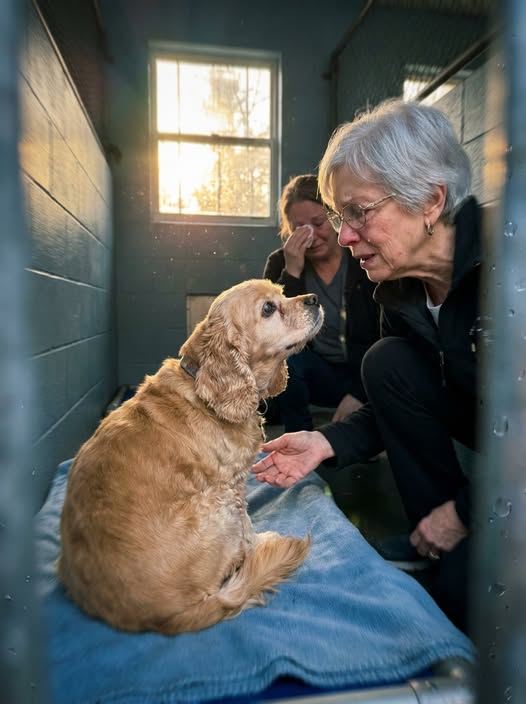
A small, dignified-looking older woman walked in. She was about 5’4″. She had short white hair cut in a careful pixie style. She wore round black-framed glasses. She was wearing a charcoal-gray cardigan over a white turtleneck, gray wool slacks, and small black leather walking shoes. She had a thermos of coffee in one hand and a small leather notebook in the other. She had the upright posture and quiet professionalism of a woman who had spent her career being respected.
She came up to the counter.
She said, “Good morning. My name is Dr. Adelaide Ferncliffe-Bohannon. I am a retired small-animal veterinarian. I practiced for 39 years at the Burlington Veterinary Medical Group. I retired in 2019. I am here because I received an email yesterday morning from the Vermont Veterinary Medical Association’s email list, which a colleague of mine still receives, about a 13-year-old cocker spaniel named Winston who is at your shelter, who has multiple medical needs, and who has been refusing to eat. I would like to meet him. May I?”
I stood up.
I said, “Dr. Ferncliffe-Bohannon. Yes. Please. Come with me.”
I walked her back to the kennel hallway. She walked at my left side, slowly. I noticed she had a very slight limp in her right knee. I did not mention it.
We stopped in front of kennel 11.
Winston was lying on his bed in the corner. He was facing the wall. He had been facing the wall for almost five days.
Dr. Ferncliffe-Bohannon knelt down on the concrete floor.
I want to tell you that I had to look away when she knelt down because she had to brace herself on the chain-link of the kennel and lower herself slowly because of her right knee. She did not ask for help. She made it down. She sat with her legs folded to one side on the concrete.
She looked at Winston through the chain-link.
She did not speak.
For three minutes she did not say a word.
Winston, on day seven of refusing food and on day six of facing the wall, slowly turned his head and looked over his shoulder at her.
His cataract-clouded eyes did not focus well at distance. He could see her shape. He could probably smell her. He held her gaze for about twelve seconds.
He turned back to the wall.
Dr. Ferncliffe-Bohannon stood up.
She turned to me.
She said, very quietly: “Hazel. I don’t need him to live long. I just need him loved.”
I sat down on the cold concrete of our kennel hallway.
I cried for almost twenty minutes.
Dr. Ferncliffe-Bohannon — 71 years old, with a bad right knee — got back down on the floor next to me. She did not say anything. She did not try to comfort me. She just sat next to me on the concrete with her hand on top of my hand and she waited.
When I could speak, I said, “Dr. Ferncliffe-Bohannon. He has not eaten in six days. He is — Saoirse, our staff vet, told me last night that we should plan for him to pass at the shelter. He has — Dr. Ferncliffe-Bohannon, he has 18 to 36 months left under optimal conditions, but right now he is — he is deciding he is done. I cannot let him go home with someone if there is a real chance he passes in their car on the way.”
She said, “Hazel. Let me put a couple of things on the table.”
She pulled her leather notebook out of her cardigan pocket.
She opened it.
She read from notes she had clearly made in advance.
She said, “Hazel. First — financially. I am 71. I retired with a paid-off mortgage and a substantial professional pension. I have no children. My husband passed in 2017. I have approximately $1.4 million in savings, of which about $40,000 a year currently goes unused. The cost of Winston’s medical maintenance is, to me, statistically zero. I will not require any subsidy from your shelter for his care.”
She turned the page.
She said, “Second — medically. I am a board-certified small-animal veterinarian. I will be administering his medications myself. I have access, through my professional license, to in-home palliative care equipment including oxygen support, subcutaneous fluid administration, pain management protocols, and end-of-life euthanasia services. Winston will not have to travel to a clinic for end-of-life care. I will provide that for him in my own home, in his own bed, when the time comes.”
She turned another page.
She said, “Third — emotionally. I live alone. I have lived alone for seven years. I have time. I have nothing else to do. I will be with him 24 hours a day except when I go to the grocery store. He will not be alone. I have a fenced quarter-acre yard that is fully shaded. I have a heated dog bed I bought in 2018 and never used because my previous dog passed before I could give it to her. I have a recliner I can lift him into. I have a memory-foam pad for the side of my bed where he can sleep next to me on the floor — or on the bed, if he prefers.”
She closed the notebook.
She said, “Hazel. I want to take him home today. I want to take him into hospice care in my home. I am not asking him to live long for me. I am asking him to let me love him for the time he has left. If he wants to keep declining and pass quietly in two weeks, I will hold him through that. If he rallies and lives 18 months, I will love him for 18 months. If he lives 36 months, I will love him for 36 months. The amount of time he gives me is not the variable. The variable is that he gets the time loved.”
She paused.
She said, “Hazel. I do not need him to live long. I just need him loved.”
It was the second time in fifteen minutes she had said those eleven words.
I picked up the phone at our front desk. I called Dr. Saoirse Knowlton-Park, my staff vet, in her office down the hall.
I said, “Saoirse. Get to the front. Please bring Winston’s full chart. I have someone here I want you to meet.”
I want to tell you what happened between Dr. Ferncliffe-Bohannon and Dr. Knowlton-Park in our small conference room over the next 45 minutes.
I want to tell you that the two women, who had never met, recognized each other within the first three minutes.
Dr. Saoirse Knowlton-Park was 38 years old. She had graduated from the Cornell University College of Veterinary Medicine in 2012. She had done her clinical rotations in Burlington, Vermont, in the spring of 2011. Her preceptor at the Burlington Veterinary Medical Group during those rotations had been Dr. Adelaide Ferncliffe-Bohannon.
Dr. Ferncliffe-Bohannon had been Dr. Knowlton-Park’s first mentor.
They had not seen each other in 13 years.
When Dr. Ferncliffe-Bohannon walked into our conference room and looked up, Dr. Knowlton-Park dropped Winston’s chart on the table and put her hand over her mouth and said, “Mom.”
She did not literally mean her biological mother. She meant the woman who had been her veterinary mother during the most formative rotation of her training.
Dr. Ferncliffe-Bohannon said, very softly, “Saoirse. Hello, sweetheart. I had no idea you were here. Hazel did not tell me her staff vet’s name. Oh, sweetheart. Look at you. You are a real doctor now.”
They hugged for a long time.
I sat at the conference table with Winston’s chart between them and I cried again.
Dr. Ferncliffe-Bohannon and Dr. Knowlton-Park went through Winston’s chart together for about 40 minutes. They reviewed his medications. They discussed dosage adjustments for his current refusal to eat — they agreed to switch his anti-inflammatory to an injectable form temporarily. They discussed how to introduce food slowly. They discussed kidney values and what to monitor. They discussed end-of-life criteria — what signs would tell Dr. Ferncliffe-Bohannon that it was time.
They wrote down everything in Dr. Ferncliffe-Bohannon’s leather notebook.
When they were done, Dr. Knowlton-Park stood up.
She said, “Adelaide. He is yours. I trust you completely. I will do his check-ups at our clinic at no charge — please bring him every six weeks. I want to take care of him for you for as long as he has.”
Dr. Ferncliffe-Bohannon said, “Saoirse. Yes. Thank you, sweetheart.”
I processed the adoption paperwork at the front counter.
We waived the $85 senior adoption fee.
Dr. Ferncliffe-Bohannon insisted on writing us a check for $2,000 anyway, as a donation to our shelter’s senior medical fund.
She wrote the check in careful, careful handwriting.
She handed it to me.
I took it.
I walked back to kennel 11.
I unlocked kennel 11 at 11:47 a.m. on Saturday, September 14th, 2024.
Dr. Ferncliffe-Bohannon was standing in the doorway. She had a soft blue blanket folded over her arm — the same shade of blue as Winston’s original collar from Mrs. Vance-Pickering’s house. She had brought it from her car. She had been carrying it since she had read the email about him the morning before.
I knelt down by Winston’s bed.
I said, “Winston. Winston, sweetheart. There’s somebody here for you. She is going to take you home with her.”
Winston did not turn.
Dr. Ferncliffe-Bohannon knelt down on the concrete next to me. I noticed her wince at her right knee. She did not complain.
She put the soft blue blanket on the concrete floor about three feet from Winston’s nose.
She said, very quietly, “Winston. My boy. My name is Adelaide. I am 71. I am alone. I have a recliner and a fenced yard and a heated dog bed and a refrigerator full of food. I have nothing else to do for the rest of my life except love you. I will not ask you to live for me. I will love you for whatever time you have. If you want to come with me, you can stand up and step onto this blanket. If you do not want to come, I will leave. I will not be hurt. You have already done so much. You do not owe anyone anything. The choice is yours.”
She stopped speaking.
She waited.
Winston was still facing the wall.
For about two minutes, nothing happened.
Then Winston’s left ear moved.
Then his nose lifted.
Then — very slowly — he turned his head.
He looked at the blue blanket.
He looked at Dr. Ferncliffe-Bohannon.
His cataract-clouded eyes held her gaze for what felt like a long time. It was probably about eight seconds.
He stood up.
His back legs were shaky. He had not stood up on his own in three days. He took two careful steps across the concrete.
He stepped onto the blue blanket.
He sat down on it.
He looked up at Dr. Ferncliffe-Bohannon.
She wrapped him in the blanket. She lifted him in her arms — all 22 pounds of him. Her right knee buckled and she almost went down, and I caught her elbow, and she steadied. She did not let go of Winston.
She carried him out of kennel 11.
She carried him through our lobby.
She carried him to her car — a 2018 Volvo XC60 in deep green — and she set him on the passenger seat on a small dog booster I had not noticed her arriving with. She had also brought that with her in the trunk that morning. She had come prepared, knowing what she was going to ask for.
She buckled his harness into the seat belt.
She closed the door very gently.
She came back to me at the front of our shelter.
She hugged me. She said, “Hazel. Thank you.”
I said, “Adelaide. Please call me. Please tell me how he is.”
She said, “I will call you on Tuesday.”
She drove away.
I sat down on the front step of our shelter and I watched the green Volvo disappear down our gravel drive.
She called me on Tuesday, September 17th, 2024, at 6:30 p.m.
I want to tell you what she said. It is going to be more painful than I expected to write.
She said, “Hazel. Hello, dear. I am sitting in my recliner. Winston is on my lap. He has had a very small dinner of cooked chicken and rice. He ate it. It is the first food he has eaten in eight days.”
I started crying at my kitchen table.
She said, “Hazel. He started eating yesterday evening, very small portions. By this morning he was up to half a cup. By tonight he is at almost a full cup. He has been sitting on my lap for almost two hours. He let me give him his ear drops without fussing. He let me clean around his eyes. He let me brush him. He let me trim the long hair around his paws.”
She paused.
She said, “Hazel. He has not stopped looking at me. Whenever I walk to the kitchen, he watches the doorway until I come back. He has decided to stay alive. I want you to know that. He has decided.”
I cried at my kitchen table for almost twenty minutes.
When I could speak, I said, “Adelaide. I will call you on Saturday.”
She said, “Hazel. Please do. I will tell you about the progress.”
I want to tell you about the next fourteen months.
Winston lived for fourteen months and three days in the home of Dr. Adelaide Ferncliffe-Bohannon at her small Cape Cod-style house on Pinegrove Lane outside Burlington, Vermont.
He gained back the two pounds he had lost. He gained another two pounds beyond that.
His coat got shinier.
His ears stopped getting infections — Dr. Ferncliffe-Bohannon’s twice-weekly cleaning was clinical-grade.
His arthritis improved with gentle daily walks — two slow loops around her backyard, holding onto her arm when his back legs got tired.
He learned to ride in her car.
He went to her grandniece’s third birthday party in February of 2025. The little girl — a 3-year-old named Ophelia Ferncliffe-Bohannon-Castle — fell asleep with her head on Winston’s belly on the couch. Dr. Ferncliffe-Bohannon took a photograph. It is one of the most-shared photographs I have ever posted on our shelter’s Facebook page. It got 412,000 likes.
He met Dr. Knowlton-Park every six weeks for his check-ups.
His kidney values stabilized. They never got better, but they did not get worse.
His heart held.
He started rotating between three different favorite napping spots: Dr. Ferncliffe-Bohannon’s recliner, a small heated bed by the kitchen sink where she could see him while she made tea, and the foot of her bed at night where he slept on the memory-foam pad she had bought in 2018 for a dog who had passed before she could give it to her.
He had — by every measurable standard — the best fourteen months of his thirteen-and-a-half-year life.
About three weeks after Winston went home with Dr. Ferncliffe-Bohannon, she called me on a Tuesday evening.
She had been going through Mrs. Vance-Pickering’s information that I had transferred to her — Winston’s medical history, prior vet records, vaccination schedule.
She had found a small handwritten note clipped to the back of his pre-shelter medical chart from his lifetime vet.
The note was from Mrs. Vance-Pickering.
It said:
“To whoever takes Winston after I am gone — Please know that Winston was the only thing that got me through losing my husband Albert in 2011. I adopted him at 8 weeks old, three months after Albert passed. He has slept on the foot of my bed for thirteen years. He likes cheese, but only sharp cheddar. He is afraid of vacuum cleaners. He cries if you leave him alone too long. He is everything to me. I have nothing else to give him. Please love him. He has been my husband and my child and my best friend. — Ellsworth Vance-Pickering, Schoolteacher, Williamstown, VT, retired 2003.”
Dr. Ferncliffe-Bohannon read the note to me on the phone.
She paused.
She said, “Hazel. I want to tell you something. Ellsworth Vance-Pickering was my fourth-grade teacher in Williamstown, Vermont, in 1962. She was 26 years old. I was nine years old. She taught me how to read. She taught me how to write. She told me, when I was 12 and she was teaching seventh-grade science, that I should be a veterinarian. I owe her my entire career.”
She was quiet for a long moment.
She said, “Hazel. I did not adopt Winston because of her. I had not yet made the connection when I read the email. I adopted him because he was a 13-year-old dog who had been returned in 96 hours and was refusing to eat. But the universe arranged it. Ellsworth’s dog was returned, and a small statewide email got forwarded, and I happened to read it on a morning when I had nothing else to do, and I drove to your shelter, and I took home the dog of the woman who taught me how to read sixty-two years ago. I have spent the last three weeks not knowing how to tell you this. I am telling you now.”
I sat at my kitchen table in silence.
She said, “Hazel. I called the memory care facility yesterday. Ellsworth is still alive. She is in moderate decline but she has good days. They told me I could visit her on Saturdays. I drove down on Saturday with Winston in his car booster. They had me sign visitor paperwork and they brought her out to the sun room in a wheelchair. She did not recognize me. But she saw Winston. She — Hazel, she lifted her hand toward him. I lifted him into her lap.”
She was crying as she told me this.
She said, “He pressed his head against her hand. She said his name. She said, ‘Winston. My Winston.’ Twice. She held him for almost an hour. The nurse said it was the most present she had been in weeks. We are going every Saturday. I am taking him to see his old mother every single Saturday until she is gone.”
I wept at my kitchen table for a long time after that phone call.
Mrs. Ellsworth Vance-Pickering passed away peacefully on March 8th, 2025, in her sleep at the memory care facility. Winston had been to see her every Saturday for 24 weeks. The facility staff told Dr. Ferncliffe-Bohannon that Winston’s visits had been the longest sustained moments of recognition and joy Mrs. Vance-Pickering had experienced in her final six months of life.
Her son in Boston flew up for the funeral. He met Dr. Ferncliffe-Bohannon for the first time at the small graveside service in Williamstown. He cried in her arms for a long time. He had not known that the woman who adopted his mother’s dog had been his mother’s student in 1962. He did not know how to process it. Neither did Dr. Ferncliffe-Bohannon. Neither did I.
I went to that funeral. I sat in the back row.
Dr. Ferncliffe-Bohannon brought Winston in his car booster. He sat at her feet in the funeral home. When the eulogy was given by Mrs. Vance-Pickering’s son, Winston laid his head on the toe of Dr. Ferncliffe-Bohannon’s black leather shoe and he closed his eyes.
He knew.
He absolutely knew.
Winston himself passed away fourteen months and three days after he went home with Dr. Ferncliffe-Bohannon.
He passed on the afternoon of November 17th, 2025 — three weeks before I am writing this post.
Dr. Ferncliffe-Bohannon called me at 4:42 p.m. that afternoon. He had been declining for about two weeks. His kidneys had started to fail in late October. Dr. Knowlton-Park and Dr. Ferncliffe-Bohannon had agreed, after their last check-up on November 4th, that it was time to begin hospice protocols at home.
He passed in his sleep on her recliner, with her hand on his chest, in front of a fireplace she had lit because the November afternoon had been cold.
She told me on the phone: “Hazel. He waited until I was awake. He waited until I had eaten lunch. He waited until I had told him I loved him. Then he went. He did not struggle. He did not cry. He just stopped breathing. Hazel — he gave me fourteen months. I gave him fourteen months. It was enough.”
We held his small funeral on Saturday, November 22nd, 2025, at her small Cape Cod-style house.
I drove up. Dr. Knowlton-Park came. Mrs. Vance-Pickering’s son flew up from Boston. Mrs. Vance-Pickering’s grandniece Ophelia, now almost 4 years old, came with her parents. A few of Dr. Ferncliffe-Bohannon’s neighbors came. About 15 people in total stood in her small back yard around a small flat stone we had brought from the shelter’s memorial garden.
Dr. Ferncliffe-Bohannon spoke.
She said:
“Friends. I want to say a few things. Winston was 14 and a half years old when he died. He was returned to a shelter at 13 in 96 hours because he was too much trouble. He came to me. He gave me 14 months. He gave me companionship through my own grief. He brought me back to my old teacher Ellsworth in the last 24 weeks of her life. He let her hold him every Saturday. He let her remember herself. He let me say goodbye to her in a way I had not known I needed.
Winston was small. He was old. He had many medical needs. He had 18 to 36 months left under optimal conditions and he gave me almost all of them. I did not need him to live long. I just needed him loved. He let me love him. That is the only thing I asked of him.
If there is one thing I want everyone here to take away from Winston’s life, it is this. The dogs nobody wants are sometimes the dogs we need the most. The senior dogs in the shelter system are not failures. They are not problems. They are not too much trouble. They are someone’s whole life, returned. They are waiting for one more person who will sit on the floor in front of their kennel and not ask them to live long. Just love them. That is all.
Goodbye, Winston. Thank you for letting me be your last person.”
She placed her hand on the small flat stone.
The stone had been engraved by my own staff at the shelter, paid for out of our memorial fund, and presented to her at the start of the service.
The stone said:
WINSTON VANCE-PICKERING-FERNCLIFFE-BOHANNON 2011 — 2025 LOVED FOR FOURTEEN MONTHS. ENOUGH.
She placed the stone in the corner of her back yard under a small Japanese maple tree.
She stood up.
She turned to me.
She said, “Hazel. I want to come work for you. Volunteer. I want to be the senior-dog hospice coordinator at your shelter. I want to find homes for every senior dog you have ever had returned. I want to spend the rest of my life doing this.”
I said, “Adelaide. Yes.”
I want to write down a few things before I finish.
The first thing. Dr. Adelaide Ferncliffe-Bohannon started as a volunteer Senior Dog Hospice Coordinator at our shelter on December 1st, 2025 — two weeks before I am writing this post. She works three days a week, unpaid. She has, in her first two weeks, personally placed three senior dogs aged 11, 12, and 14 in hospice-style homes she has carefully screened. She is funding the first six months of medical care for all three out of her own savings. I have stopped trying to argue with her about it. She tells me, every time I try, “Hazel. I do not need them to live long. I just need them loved.”
The second thing. The Whitmore-Calloways — the couple who returned Winston in 96 hours — have not adopted from us again. I believe they did not adopt from anyone else either, at least not in Vermont. I do not hold a grudge against them. They were honest about their limits. The system worked. They returned him instead of dumping him. I tell my staff regularly: returns are not failures. Returns are part of how the system protects the animals. I mean that. I will mean that until the day I retire.
The third thing. Mr. Vance-Pickering — Mrs. Ellsworth’s son in Boston — has stayed in touch with Dr. Ferncliffe-Bohannon and with me. He sends a donation to our senior medical fund on his mother’s birthday every March. Last year he sent $5,000. He told us, in his Christmas card to me, that he has decided to take a leave from his job and start a small nonprofit in Massachusetts dedicated to placement of senior dogs whose owners have been admitted to memory care. He is calling it the Vance-Pickering Fund. It will be operational by spring of 2026.
The fourth thing. Our shelter, the Green Mountain Companion Animal Sanctuary, has implemented a new policy as of November 1st, 2025, two weeks before Winston passed. The policy is called the Ferncliffe Protocol. It states: Senior dogs (defined as age 10+) that are surrendered or returned to this shelter will be prioritized for placement with hospice-style adopters, with full medical-cost coverage provided by the shelter for the first six months if needed. Adopters of senior dogs must complete a 90-minute orientation that emphasizes that the goal of senior adoption is not to extend life, but to honor it. The policy has been adopted, voluntarily, by three other shelters in central Vermont. It is being reviewed by the New England Shelter Network for possible regional adoption.
The fifth thing. Dr. Saoirse Knowlton-Park, our staff vet, married her long-term partner in May of 2025. Dr. Adelaide Ferncliffe-Bohannon was her honorary maternal escort at the wedding. She walked Saoirse down the aisle in place of Saoirse’s late mother, who had passed in 2019. Winston was the ring bearer. Saoirse had specifically asked, in writing, six months in advance. Adelaide brought him in his car booster. He wore a small navy bow tie. The rings were tied to his collar. He carried them down the aisle next to Adelaide, who walked Saoirse to the altar with one hand on her arm and the other on Winston’s leash.
I cried at that wedding.
I have cried, by my own count, fourteen separate times in the writing of this post.
I want to end with one more thing.
I want to tell you what I said to Dr. Ferncliffe-Bohannon at the shelter on her first day of work as our Senior Dog Hospice Coordinator on December 1st, 2025.
She came in at 9 a.m. She had brought her own coffee in a thermos. She wore the same charcoal-gray cardigan she had worn the morning she met Winston. She had her leather notebook in her hand.
I had set up a small desk for her in the corner of my office.
I had bought her a name plate from an engraver in town.
The name plate said:
DR. ADELAIDE FERNCLIFFE-BOHANNON SENIOR DOG HOSPICE COORDINATOR “I don’t need them to live long. I just need them loved.”
She read the name plate.
She turned to me.
She said, “Hazel. You did not have to do that.”
I said, “Adelaide. Yes I did. It is the only thing on this plate that needs to be said about what you do.”
She placed the name plate on her new desk.
She sat down. She pulled a small framed photograph out of her bag. It was the photograph of Winston with little Ophelia asleep on his belly from her grandniece’s third birthday party. She placed it next to the name plate.
She opened her leather notebook.
She said, “Hazel. Who do we have today.”
I handed her a list of four senior dogs.
She started working.
She is still working.
I think she will work for as long as her right knee will let her get down to the floor of a kennel.
If this story moved you, follow the page — there are more like Winston and Adelaide and Ellsworth and Saoirse I haven’t told yet.