Part 2 – The First Free Steps
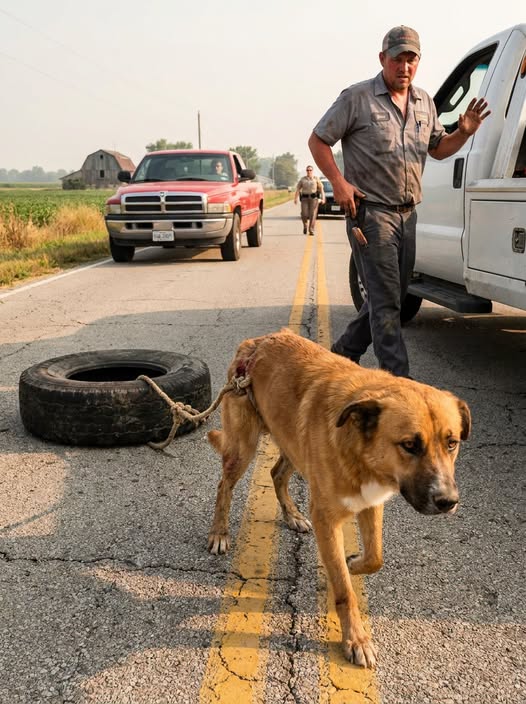
The dog stared at the tire as if it might follow him.
That detail stayed with me longer than the rope, longer than the knot, longer than the heat rising from the asphalt. He had taken three steps without dragging anything, but instead of running away, he turned to face the tire. His ears pinned back. His tail tucked low. One paw lifted from the road, uncertain, as if he was waiting for the weight to come snapping back around his body.
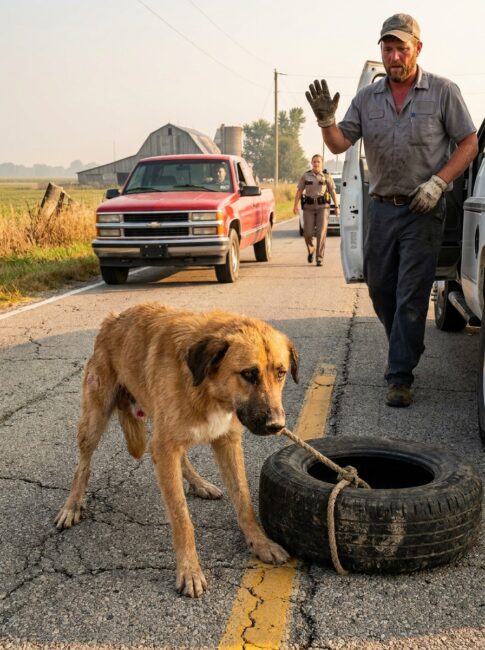
Freedom had arrived too suddenly for him to trust it.
I slipped the knife into my pocket and stayed crouched.
“You’re loose,” I said. “You hear me? It’s off.”
He looked at me, then at the tire again.
The rope still hung from his side in a cut length, loose now but frightening to him. I reached for it slowly. He flinched, then held still. When my fingers touched the rope, his skin twitched under the fur. I cut the last section away and dropped it beside the tire.
He watched it fall.
Then he looked back at me.
For a few seconds, neither of us moved.
A car came over the hill too fast. I stood and waved both arms until the driver slowed. He gave an annoyed little honk, then saw the tire, the dog, and the tow truck blocking half the lane. His expression changed. He rolled down his window.
“Need help?”
“Call the sheriff’s office,” I said. “Tell them there’s animal cruelty on County Road 17. Dog was tied to a tire.”
The man swallowed. “Someone did that?”
“Yes.”
He pulled onto the shoulder and made the call.
I turned back to the dog.
He had not run.
Instead, he had walked to the edge of the road and stopped in the gravel, legs shaking, chest heaving. His ribs showed faintly under his golden-brown coat. Not starved to the edge, but neglected enough that meals had clearly been inconsistent. His paws were dusty and raw in spots from trying to drag the tire. His body had the defeated curve of an animal that had spent too long learning effort did not change anything.
I opened the side box of my tow truck and pulled out a clean moving blanket, a bottle of water, and the paper tray from a convenience-store sandwich I had not finished. I poured water into the tray and set it down several feet away.
He looked at it.
Then at me.
Then at the water.
“Go on,” I said. “It’s yours.”
He stepped closer, but stopped before reaching it. His eyes moved from my boots to my hands. He was asking a question I had heard from scared animals before.
What is the cost?
“There’s no cost,” I said, though of course he did not know the words. “Just drink.”
He lowered his head and lapped once. Then again. Then faster, until I had to gently pull the tray back and refill it slowly. Dogs who have been thirsty will drink like the water might vanish. People do that too, with kindness.
A county deputy arrived fifteen minutes later. Her name was Deputy Mae Simmons, a thirty-three-year-old Black American woman with dark brown skin, short natural hair tucked under a tan sheriff’s hat, and a steady voice that made even hard moments feel organized. She stepped out of her cruiser, looked at the tire and the cut rope, then looked at the dog.
Her face went still.
“Tell me that wasn’t attached to him.”
“It was.”
She walked closer, took photographs, then crouched near the tire without touching the dog. “Somebody wanted him slowed down.”
“Not slowed,” I said. “Stopped.”
The dog heard our voices and stepped behind my leg.
I looked down.
His shoulder pressed against my jeans.
That tiny lean, from a dog who had every reason to fear humans, hit me harder than I expected. He had known me less than twenty minutes. I had carried a knife near his body. I smelled like diesel, coffee, and old metal. Yet he chose my leg as the closest thing to safety available.
Deputy Simmons noticed too.
“He trust you?”
“I don’t know,” I said.
The dog lifted his head, looked at me, and touched his tongue to the back of my hand.
One quick lick.
Then he lowered his eyes, as if even that small gratitude had taken courage.
Deputy Simmons turned away for a second and pretended to photograph the tire again.
“I’ll call animal control,” she said. “But if he lets you handle him, you may be the best person to get him into a vehicle.”
I nodded.
The dog’s nose brushed my hand once more.
The tire sat in the road behind him, black, heavy, useless now.
But I could still feel the shadow of it.
Because some weights stay on a life after the rope is cut.
Part 3 – Naming the Weight
Animal control was forty minutes out.
That was not anyone’s fault. Rural counties stretch thin, especially on weekday mornings when one officer might be covering calls from loose cattle to injured hawks to dogs left where no living creature should be left. Deputy Simmons moved the tire to the roadside after photographing it from every angle. The driver who had called stayed long enough to give a statement, then drove away quietly, looking ashamed that he had almost kept going too.
I understood that shame.
Most people are not cruel.
But many people are busy.
Busy can look very similar to cruel when something helpless is waiting for someone to stop.
The dog stayed near me. When I stepped toward my truck, he followed. When I bent to set more water down, he lowered himself carefully beside my boot. The rope marks around his waist made me angry every time I saw them. They were not deep wounds, but they were proof. A line of rubbed fur. A line of fear. A line between the life someone tried to take from him and the life that had not arrived yet.
“What should we call him for the report?” Deputy Simmons asked.
I looked at the tire.
Then at the dog.
The wrong names came first. Lucky. Chance. Roadie. None fit. They sounded too cute for what he had carried. He needed a name that did not ignore the weight, but did not let the weight own him either.
“Atlas,” I said.
Deputy Simmons lifted her eyebrows. “Like carrying the world?”
“Yeah,” I said. “Except he’s done carrying it.”
The dog looked up when I said Atlas. Maybe it was my tone. Maybe the sound. Maybe he simply felt my attention turn toward him. His ears moved.
“Atlas,” I repeated.
His tail gave one careful sweep through the dust.
That was enough for me.
By the time Carla Ortiz arrived from Jasper County Animal Care, the morning had turned hot. Carla was a forty-two-year-old Latina American animal control officer with tan skin, dark hair in a braid, khaki pants, a navy field shirt, and hands so calm the dog noticed before any of us did. She did not rush. She did not grab. She sat on the road shoulder with a slip lead beside her and let Atlas look at her.
“You poor boy,” she said softly. “Somebody tried to make the whole world heavier than you.”
Atlas leaned harder against my leg.
Carla looked at me. “You cut him loose?”
“Yes.”
“Did he try to bite?”
“No.”
“Growl?”
“No.”
“Run?”
“No.”
She studied him for a moment. “That tells me a lot.”
I helped her guide him onto the moving blanket. He stepped on it, then froze when the fabric shifted under his feet. His whole body tensed. I thought of the tire scraping behind him and realized even harmless movement might feel like a trap now.
“Easy,” I said. “Nothing is tied to you.”
Carla glanced at me, and something in her face softened.
“That’s going to be his lesson for a while,” she said.
We loaded him into the back of her van with the blanket under him. He did not want to leave my side. When Carla closed the crate door, Atlas lifted his paw and pressed it against the metal bars. Not scratching. Not panicking. Just reaching toward the person who had cut the rope.
I put my fingers against the bars.
“I’ll check on you,” I said.
Deputy Simmons asked if I would come to the station later for a fuller statement. I said yes. Carla told me Atlas would be examined at Four Rivers Veterinary Clinic and held while they searched for an owner or identified the person who abandoned him.
“Owner?” I repeated.
She understood my tone.
“Legal language,” she said. “Not moral truth.”
I followed the van anyway.
I told myself I was only making sure the dog arrived safely. But I knew, even then, that something had already shifted. I had cut hundreds of cars free from ditches, mud, snowbanks, and guardrails. I had pulled vehicles back onto roads and watched their owners drive away.
Atlas was different.
I had not pulled him back to a road.
I had pulled a road off him.
At the clinic, Dr. Hannah Whitaker, a white American veterinarian in her fifties with silver-blond hair and kind tired eyes, examined him while I stood near the doorway. She found dehydration, paw abrasions, rope burns, muscle strain, and exhaustion. No broken bones. No internal injury that she could feel. His heart sounded strong, though fast. His spirit, she said, was guarded but present.
“He should recover physically,” she told Carla.
Then she looked at me.
“The emotional part is slower.”
Atlas lifted his head from the exam table.
His eyes found mine.
I nodded as if he had asked me a question.
“I know,” I said.
But I did not know.
Not yet.
Part 4 – The Dog Who Feared Dragging Sounds
The first night after the rescue, I went home to a house that felt louder than usual.
My place sat at the edge of Joplin, a small brick house with a gravel driveway, a detached garage, and a back porch that looked over a field. It had been mine since the divorce seven years earlier, though for a long time it felt less like a home and more like a place where I parked myself between shifts. The rooms were clean. The fridge worked. The bills got paid. But there was a kind of silence in that house that always waited for me after dark.
That night, the silence had a shape.
A tire in the road.
A dog turning around after his first free steps.
A tongue touching my hand.
I called the clinic before closing. Carla answered because she was still there.
“How is he?”
“Resting. He ate a little. He keeps watching the door.”
“Is that bad?”
“No,” she said. “It means he knows someone came.”
That sentence kept me awake.
The next morning, after towing a wrecked sedan from a ditch, I stopped at Four Rivers. Atlas was in a recovery kennel on a thick towel. When I walked in, he lifted his head so fast the vet tech beside him laughed.
“Well,” she said, “there’s your person.”
“I’m not his person,” I said automatically.
Atlas stood, wobbled, and placed one paw against the kennel door.
The vet tech gave me a look.
“Sure.”
His recovery began in small details. He drank slowly if someone stayed nearby. He ate better when the bowl did not slide on the floor. He flinched at ropes, chains, and anything dragged across concrete. The first time a technician pulled a rolling stool behind her, Atlas flattened himself so quickly Dr. Whitaker stopped the entire room.
“Dragging sounds,” she said quietly. “Make a note.”
Dragging sounds became part of his file.
So did rope fear.
So did strong attachment to finder.
I hated that last phrase because I knew what it was doing to me.
Each day, I visited. Each day, Atlas stood a little faster. His paw pads healed. The swelling around the rope marks faded. His appetite improved. Carla told me no microchip had been found. No one had reported a dog missing. Deputy Simmons checked nearby properties and old complaints, but the trail was thin. A blurry camera from a farm stand showed a dark SUV near County Road 17 before dawn, but not enough to identify the driver. The tire had no useful markings. The rope was common.
Cruelty had covered its tracks well enough to avoid immediate justice.
But not well enough to finish what it started.
On the sixth day, Dr. Whitaker asked if I wanted to take Atlas for a short walk behind the clinic. He wore a soft harness instead of a collar because no one wanted anything tight against his body. I held the leash lightly, almost afraid the word leash itself would hurt him.
He stepped onto the grass and froze.
The leash trailed behind him.
Not pulling.
Just touching the ground.
Still, he looked back in panic.
“Atlas,” I said. “Nothing is attached to you except me.”
He stared.
I lifted the leash slightly so it did not drag.
Only then did he move.
One step.
Then two.
By the fence, he found a patch of sunlight and stood in it with his eyes closed. The wind moved through his golden-brown fur. For a moment, he looked almost like any other dog, tired but alive, bruised but not beaten, standing in grass instead of asphalt.
Then a janitor inside the clinic dragged a trash can across the back hall.
Atlas dropped to the ground.
His body shook.
I knelt beside him and placed my hand flat on the grass, not touching him until he chose it.
“It’s not the tire,” I said. “It’s just a sound.”
He crawled toward me and pressed his chest against my knee.
I stayed there until he could breathe normally again.
After that, I stopped pretending adoption was a question for later.
It had already begun.
Not with paperwork.
With a dog deciding my knee was safer than fear.
Carla knew before I said it. Deputy Simmons knew. Dr. Whitaker definitely knew. The whole clinic seemed to know. I was the last person trying to act surprised.
On the tenth day, when the stray hold and cruelty hold allowed a foster-to-adopt placement, Carla handed me a stack of forms and said, “You should read these carefully.”
I did.
Twice.
Then I signed my name under Ryan Walker, foster adopter.
Under dog’s name, Carla had written Atlas.
Under special needs, she had written:
Fear of restraint, dragging sounds, abandonment trauma, needs patient home.
I looked through the glass at Atlas sleeping with his paw over his nose.
Patient home.
I had a home.
Maybe patience was something we could learn together.
Part 5 – A House Without Weight
Atlas came home on a Friday afternoon.
I had spent two days preparing the house and still felt unprepared. I bought dog beds for the living room and bedroom, then added a third near the back door because the woman at the pet store said dogs like choices. I bought bowls with rubber bottoms so they would not slide. I removed every loose rope from the garage, coiled all tow straps out of sight, and replaced the chain latch on my side gate with a quiet clasp. I even carried the spare tires from the garage into the storage shed because I could not bear the thought of him seeing one too soon.
When Carla brought him in the animal care van, Atlas stepped down slowly and looked at my driveway.
Gravel shifted under his paws.
He flinched.
“Easy,” I said. “It’s just rock.”
He sniffed the air, then looked behind him.
No tire.
No rope.
No road.
Still, he waited for permission to move.
Inside the house, he inspected everything with painful seriousness. The kitchen. The hallway. The couch. The empty corner where a Christmas tree had not stood in years. He paused at the sliding back door and stared at the yard. It was fenced, but wide and green, with a maple tree near the shed and enough shade for summer.
I opened the door but did not ask him to go out.
His choice.
He looked at me.
Then at the yard.
Then back at me.
Finally, he stepped onto the porch.
A bird flew from the grass, and Atlas startled, then looked ashamed of startling. I knelt beside him.
“You don’t owe anybody brave,” I said.
That became one of our rules.
Atlas did not owe me recovery on a schedule.
The first week was built around tiny freedoms. He could choose which bed. He could choose when to approach. He could follow me room to room or watch from the hallway. He could eat while I stood nearby or while I sat across the kitchen pretending to read a manual for an alternator I already knew how to replace.
He chose the bed near the back door.
He chose to follow me.
He chose to eat only when my hand rested on the floor.
At night, he slept lightly. Every truck passing on the road made his ears rise. Every scraping sound made his body go stiff. The first time I dragged a kitchen chair backward without thinking, he bolted down the hall and hid between the washing machine and the wall. I found him trembling there, eyes wide, waiting for the world to become heavy again.
I sat on the laundry room floor for nearly an hour.
“I forgot,” I said. “I’m sorry.”
He did not come out right away.
That was okay.
A rescue is not ruined by one mistake if the next moment tells the truth.
The next morning, I placed felt pads under every chair leg in the house.
Tank noises, chains, garage doors, rolling trash bins, anything that scraped became part of my new education. I learned to lift instead of drag. I learned to warn him before moving things. I learned that love is often practical. Quiet latches. Rubber bowls. Soft harnesses. No surprises from behind.
Atlas learned too.
He learned that the leash did not mean a tire. He learned that my tow truck starting did not mean abandonment. He learned that when I left, I came back. At first, I practiced in minutes. Walk to the mailbox. Return. Step into the garage. Return. Drive around the block. Return. Each time, I said the same thing when I opened the door.
“Still free.”
At first, he greeted me with frantic relief, spinning once, then pressing against my legs as if checking for the rope I might have brought back. Slowly, the panic became joy. His tail rose higher. His body loosened. His eyes started meeting mine without the question he had carried from the road.
One evening, three weeks after he came home, I opened the back door and he ran.
Not far.
Just across the yard.
Five steps, maybe six.
But he ran without looking back at his body, without checking behind him for weight, without bracing for the snap of rope. He reached the maple tree, turned around, and froze as if surprised by his own speed.
Then he ran back to me.
He stopped at my knees and licked my hand.
The same hand he had licked on the road.
Only this time, he was not thanking me for cutting a rope.
He was sharing the discovery that his legs still belonged to him.
Part 6 – The Tire Returns
Two months after the rescue, Deputy Simmons called.
They had found the person who left Atlas.
Not through the tire. Not through the rope. Through a neighbor who had seen a dog matching Atlas’s description in the yard of a rental trailer ten miles from where I found him. The owner, a white American man in his early thirties named Darren Cole, had moved out suddenly. A witness said he complained the dog “kept getting loose.” Another said he had threatened to “make sure it couldn’t run off again.” The farm stand video placed his SUV near County Road 17 that morning. It was not perfect evidence, but it was enough to open charges and enough for me to learn a name I wished I did not know.
“Do you want updates?” Deputy Simmons asked.
I looked at Atlas sleeping on the rug, one paw twitching in a dream.
“Yes,” I said. “But I don’t want him pulled into it more than necessary.”
She understood.
The legal process moved slowly. Statements. Photos. Veterinary records. The tire. The rope. My account. Carla’s report. Dr. Whitaker’s findings. Darren denied everything, then blamed an unnamed friend, then said the dog had been “too hard to keep.” People who commit cruelty often speak as if inconvenience is a license.
I went to one court hearing.
Not because I wanted to see him.
Because I wanted to stand in the room where Atlas could not.
Darren did not look like a monster. That almost made it worse. He looked ordinary. Faded ball cap. Plaid shirt. Work boots. A man you might stand behind in line at a gas station without ever knowing what he could do to a creature weaker than him.
He glanced at me once and looked away.
Good.
The case ended with a plea. Animal cruelty charge. Fine. Probation. Mandatory community service. Ban on owning animals for a set period. Was it enough? No punishment could give Atlas back the hours he spent dragging that tire. No court order could erase the sound of rubber scraping behind him. But it was a record. It was acknowledgment. It was the state saying, at least on paper, that what happened to him was not nothing.
After the hearing, Deputy Simmons walked me to the parking lot.
“How’s he doing?” she asked.
“Better.”
“Running yet?”
“A little.”
She smiled.
“That’s good.”
Then she opened her cruiser trunk and pulled out a cardboard box. Inside was the tire.
My stomach tightened.
“We don’t need it as evidence anymore,” she said. “I was going to destroy it, but I thought you might want to decide.”
For a moment, I wanted to throw it into the nearest fire.
Then I thought of Atlas looking back at it on the road. The fear. The disbelief. The way freedom had frightened him because the weight had been all he knew. I did not want that tire hidden somewhere like a curse. I wanted it changed into something that could not hurt him.
“Can I take it?” I asked.
Deputy Simmons studied me. “You sure?”
“No,” I said. “But yes.”
I brought it home in the truck bed while Atlas stayed inside with my neighbor, Mrs. Helen Graves, a seventy-year-old white American widow who had become his unofficial grandmother and provider of illegal cheese. I did not show it to him that day. Instead, I cleaned it, cut away the damaged rubber, and carried it to the workshop.
For a week, I worked after Atlas went to sleep.
I built a wooden frame around the tire. Sanded edges. Sealed the rubber so it would not smell like the road. Filled the center with soil. Planted marigolds because my mother used to say marigolds were stubborn flowers and every yard needed something stubborn enough to bloom in heat.
When it was done, it was no longer a weight.
It was a planter.
Still a tire, yes.
But changed by hands that meant no harm.
I placed it under the maple tree in the backyard.
Then I brought Atlas outside.
At first, he saw it and stopped.
His whole body went stiff.
I hated myself for a second.
But I stayed calm. “It cannot pull you anymore.”
He looked at me.
I walked to the tire planter and touched the flowers.
“See? It holds dirt now. Not you.”
Atlas took one step closer.
Then another.
He stretched his neck and sniffed the marigolds.
A bee moved. He jerked back. Then sniffed again.
After a long moment, he lifted his leg and peed on the tire.
I laughed so hard I had to sit down in the grass.
Atlas looked proud.
For the first time, the tire belonged to him.
Not as a prison.
As a thing in his yard.
A thing he could walk away from whenever he pleased.
Part 7 – Free Means He Can Come Back
Atlas is seven now, maybe eight.
His muzzle has softened with gray, and his golden-brown coat shines when the sun hits it. The rope marks around his body are gone unless you know exactly where to look. His paws healed. His muscles returned. He still startles at dragging sounds, though less than before. He still dislikes tires stacked in garages. He still watches me closely when I move tow straps, so I keep them out of his sight whenever I can.
Healing did not turn him into a dog without memory.
It turned him into a dog with more than memory.
That difference matters.
Atlas now has a favorite spot under the maple tree, about four feet from the tire planter. He sleeps there on warm afternoons while marigolds bloom inside the rubber that once held him prisoner. Sometimes the sight catches me in the chest. A dog sleeping beside the changed shape of his own suffering. Not because he forgot. Because he learned it could no longer reach him.
He runs now.
Not like a young dog, not endlessly, not without checking in. But when I open the back door and say, “Go on,” he trots into the yard, circles once, then bursts into five or six joyful strides. Always, he turns back. At first, I thought the turning back meant fear. Now I understand it differently.
Free does not mean leaving forever.
Sometimes free means knowing you can come back.
Atlas always comes back.
He comes back to my hand. To the porch. To the kitchen where his bowl waits. To the truck, if I invite him. To the house where no ropes hang near the door. To the man who once cut him loose and then spent years proving the cut was not temporary.
He became part of my work too, in his own quiet way. He does not ride on dangerous calls, but he comes to the tow yard on slow afternoons. Drivers who bring in wrecked cars sometimes meet him resting in the office on his blue bed. Kids love him. Mechanics respect him. Men who act tough soften their voices without realizing it. If anyone drags a chain across concrete, the whole shop stops and looks at Atlas first.
That is how a rescued dog changes a place.
Not with speeches.
With needs everyone learns to honor.
I added a sign to the office door after a customer once reached for Atlas too fast.
Let him come to you.
It is good advice for dogs.
It is also good advice for healing.
Deputy Simmons visits sometimes. She brings biscuits and says she is only checking on “the evidence,” which is a terrible joke and somehow exactly her style. Carla Ortiz still sends follow-up messages every few months. Dr. Whitaker sees Atlas for checkups and always says, “Well, Mr. Atlas, you appear to be carrying considerably less world these days.”
Atlas accepts this with dignity, mostly because she gives him liver treats.
The story spread farther than I expected after the county shelter shared a photo of Atlas under the maple tree beside the tire planter. They did not show the worst images. I was grateful for that. They told the truth without turning his pain into a spectacle. A dog had been tied to a tire and abandoned on a road. A tow truck driver stopped. The rope was cut. The dog survived. The tire became a planter in his new yard.
People wrote comments about dogs they had rescued, weights they had carried, and the strange moment when freedom feels too big to trust.
One message came from a woman in Kansas who said she adopted a senior dog after reading about Atlas because, in her words, “I realized some animals are not looking for perfect homes. They are looking for someone who stops.”
Someone who stops.
That is the whole story, really.
I stopped.
Not heroically. Not gracefully. I spilled coffee everywhere and cursed at a knot while my knees cracked on hot asphalt. But I stopped. And because I stopped, a dog who had been tied to a tire lived long enough to learn the sound of his own paws running without weight behind them.
I think often about the cars that slowed and kept going before me. I do not say that to condemn every driver. Fear is quick. Confusion is quick. People tell themselves another person will handle it. I have done that in other ways in my own life. We all have. But Atlas taught me that sometimes the difference between cruelty winning and mercy beginning is one person deciding not to pass the suffering to the next car.
When rain comes now, Atlas lies by the back door and watches the yard. The marigolds bend under the drops. The tire planter darkens. The maple leaves shine. He rests his chin on his paws, calm but thoughtful, as if he understands that the world can hold both the memory of harm and the proof that harm did not get the final say.
At night, when I lock the door, he follows me from room to room. Old habit. New comfort. I check the kitchen, turn off the porch light, set the coffee maker, and scratch his chest before bed. Sometimes I whisper the same words I said when I first cut the rope.
“You’re loose.”
His tail moves.
“You’re safe.”
He leans closer.
“You’re free.”
Then, almost every time, he licks my hand.
That small act still humbles me. The first thing he did after feeling freedom was come back and offer trust. I used to think that meant he was thanking me. Maybe he was. But now I think it meant something deeper.
He was choosing what to do with freedom.
Not run until fear emptied him.
Not vanish because humans had failed him.
He chose connection.
He chose to return.
He chose to believe that one pair of hands could cut what another pair of hands had tied.
People tied him to a tire so he could not escape.
I gave him freedom.
But Atlas taught me that freedom is not just the absence of rope. Freedom is a bowl that fills again, a door that opens, a yard where a tire holds flowers, a hand that does not grab, a road that becomes a memory instead of a sentence.
And for a dog who once dragged the weight of someone else’s cruelty through the middle of a country road, freedom is also this: sleeping under a maple tree, waking when his name is called, running a few light steps, and always knowing he can come home.
If this story moved you, follow this page for more unforgettable dog stories about rescue, loyalty, healing, and the quiet heroes who stop long enough to set a life free.