Part 2 — The Dog Behind the Guardrail
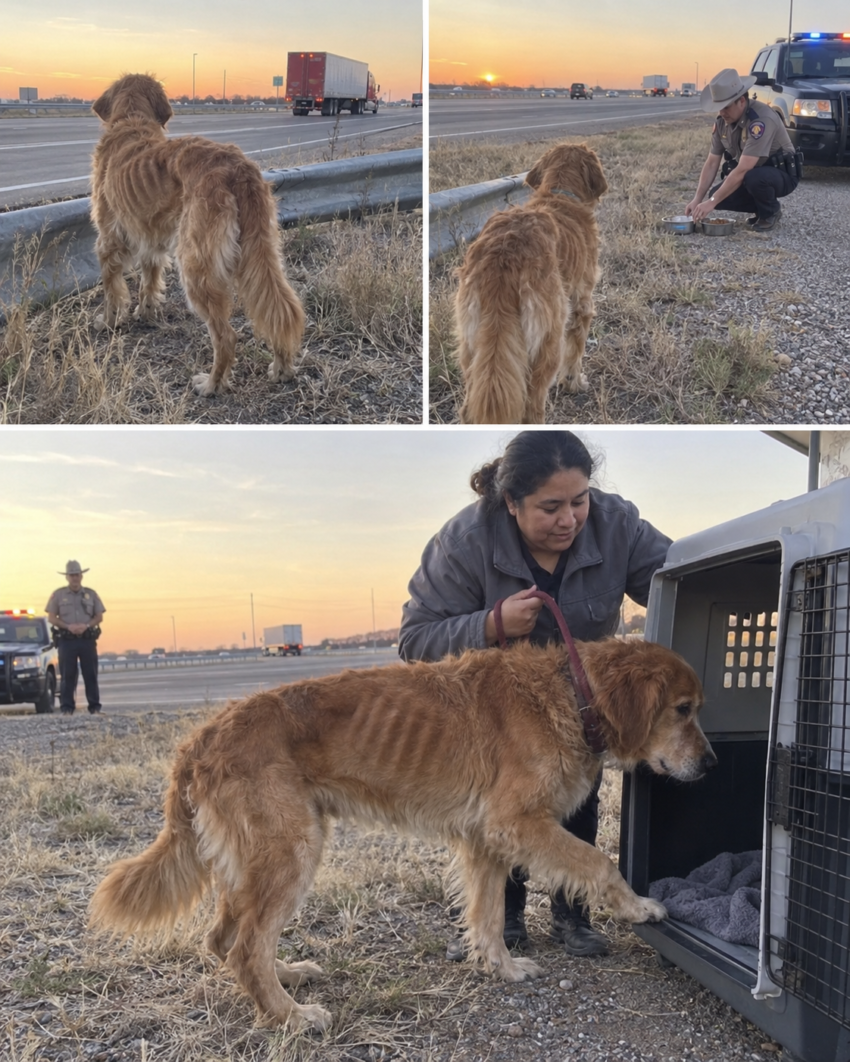
State Trooper Daniel Reed received the first call at 6:12 on a Tuesday morning. A motorist reported a large golden dog walking along the eastbound shoulder of Interstate 40, drifting toward traffic whenever a tractor-trailer slowed.
Daniel expected the dog to flee when the patrol car approached. Instead, the Golden Retriever pressed himself behind a damaged guardrail and stared past Daniel at the trucks moving east.
From ten feet away, Daniel could see ribs beneath the tangled coat, prominent hip bones, and reduced muscle along the rear legs. The dog’s dark-red collar was loose enough to slide several inches around his neck. There was no blood or visible fracture, but exhaustion changed how he stood; his rear paws spread wider whenever a truck shook the ground.
Daniel closed the nearest lane and requested animal-control assistance. He did not chase the dog or reach across the guardrail. A frightened animal near interstate traffic could bolt with one poorly timed movement.
He placed water and small pieces of cooked chicken several yards from the pavement, then sat sideways beside the patrol car. The Golden Retriever smelled the air but continued watching the highway.
A red tractor approached.
The dog’s ears lifted.
He stepped from behind the barrier and moved toward the shoulder.
Daniel used the open patrol door and a folded emergency blanket to form a visual wall without touching him. The dog stopped, stared until the red cab disappeared, then returned to the guardrail.
That response made one thing clear: the road was not merely where he had become lost. Something moving along it still held him there.
Animal-control officer Marisol Vega arrived with a transport vehicle, a crate, a slip lead, and higher-value food. She noticed that the dog reacted badly to keys striking metal. Each small clink made his shoulders contract and his weight shift backward.
Marisol removed the keys from her belt and placed them inside the cab.
For thirty-eight minutes, she tossed food in a gentle curve leading away from traffic. The dog ate the first pieces quickly, then slowed as he approached her. When he reached the final piece, she did not grab his collar.
She let him choose stillness.
Marisol slipped the lead loosely over his head only after he lowered his nose to her open hand. Daniel blocked the highway side while she guided the dog toward the transport crate.
Another red truck passed.
The Golden Retriever turned so suddenly that his weakened rear legs nearly folded. Marisol dropped to one knee, maintained slack in the lead, and waited until he regained balance.
“He’s looking for something,” Daniel said.
“Or someone,” Marisol answered.
The dog entered the crate only after she placed the gray emergency blanket inside. Once the door closed, he turned toward the ventilation slots facing the interstate. He did not struggle, but he remained upright throughout the seventeen-mile drive.
At Cedar Ridge County Animal Shelter, the intake scale read fifty-two pounds. A healthy weight for his frame would likely fall near seventy-four.
Rachel Moreno photographed his markings: a deep-gold saddle across his back, lighter feathering along the chest, a narrow white patch beneath the lower lip, and a small notch on the outer edge of his left ear. She documented his loose dark-red collar and scanning behavior.
The microchip scanner produced a number.
For several minutes, everyone believed the search was over.
The registry listed Elaine Mercer and a telephone number in Oklahoma. The number had been disconnected. The address belonged to a rental house vacated almost four years earlier.
Rachel left messages with the registry, checked lost-pet databases, and forwarded the information to county authorities. Nothing returned that day.
The shelter veterinarian, Dr. Samuel Price, examined the dog after allowing him time to settle. He diagnosed severe low body condition with marked muscle loss, dehydration, and superficial wear on the paw pads. Bloodwork showed changes consistent with prolonged inadequate nutrition but no immediate organ failure.
Recovery would be measured.
Small meals replaced one large bowl. Water remained available, but staff monitored intake. Exercise was limited to brief, quiet walks while his strength returned.
Rachel wrote “Cooper” on the kennel card because the dog needed a temporary name.
When she finished, a diesel engine sounded beyond the rear wall.
Cooper rose from his blanket.
For the first time, Rachel saw the direction of his hope.
Part 3 — Every Red Cab Became a Question
Cooper’s kennel sat in the quiet end of the adoption wing, away from the busiest doors. Staff covered one side with a sheet, provided thick bedding, and entered only after speaking softly from the corridor.
During the first week, his days revolved around measured meals, sleep, and traffic sounds.
He ate quickly but did not guard the bowl. After finishing, he licked the stainless steel, searched the floor for crumbs, and returned to the front of the kennel whenever a diesel engine passed.
Rachel began sitting outside with a clipboard. She wanted to separate random alertness from a repeatable pattern.
Cooper noticed large engines before smaller vehicles, but color changed what happened next. White and blue tractors made him raise his head. Red cabs brought him fully upright.
He could see a narrow stretch of county road from the exercise yard. When a red truck appeared, he moved to the fence and scanned the passenger window, the steps beneath the cab, and the side mirrors.
Those were not the movements of a dog chasing traffic.
He was checking the places where a familiar person should appear.
Laura Bennett, the senior kennel technician, tried a simple comparison. She parked her red pickup on the far side of the yard before bringing Cooper outside.
He noticed it, approached within fifteen feet, smelled the air, and turned away.
“It isn’t just red,” Laura said.
Rachel agreed. “But red tells him to look.”
They contacted the chip company again. Elaine Mercer’s registration had never been transferred, and privacy rules limited what the registry could disclose beyond recorded contact attempts. A secondary contact field contained only the first name “Joe,” with no telephone number.
Rachel searched public lost-pet posts across the Panhandle and western Oklahoma. She sent Cooper’s intake photograph to regional shelters, animal-control departments, rest-area maintenance teams, and trucking associations.
No one claimed him.
On day eight, Cooper completed his first slow lap around the smaller yard. His rear legs trembled before he reached the gate, so Rachel sat on the ground with him until the shaking eased.
A red livestock hauler passed.
Cooper dragged himself upright again.
That willingness frightened Rachel more than weakness did. He would spend strength he did not have whenever a red truck gave him a reason.
Dr. Price revised the exercise plan. Cooper would use the courtyard facing away from the road during the busiest hours, but complete isolation increased his pacing. The compromise was two short viewing periods each day, followed by rest and food.
His weight rose three pounds in ten days.
Then progress stalled.
Kennel noise reduced his appetite, and a thunderstorm sent him circling until his rear legs shook. Staff moved him into a small office overnight, where he slept beneath Rachel’s desk with his nose against the dark-red collar.
The next morning, she examined the collar under better light. Most of the surface was worn smooth, but several tiny impressions remained near the buckle.
They were not letters.
They looked like repeated pressure marks from a metal tag that had broken away.
Rachel also noticed pale fibers trapped beneath the collar—green synthetic threads unlike anything in the shelter. She sealed several in the property envelope, not as forensic evidence but as another identifying detail.
That afternoon, a red Peterbilt slowed at the nearby intersection. The driver sounded two quick horn notes.
Cooper sprinted toward the fence.
Halfway there, he stopped.
His ears lowered. He watched the truck pass, then returned to Rachel with his head close to the ground.
The horn had caught him.
The pattern had disappointed him.
From that day forward, Rachel understood that Cooper was not waiting for any red truck, and perhaps not even a particular engine. He was listening for a private signal hidden inside ordinary highway noise.
On day thirteen, a man called claiming Cooper belonged to his family. He described a female Golden Retriever, four years old, with no ear notch. Rachel ended the conversation politely.
A second caller insisted the dog was his but could not identify the collar color or white marking.
The shelter tightened verification. Cooper’s reunion, if it came, would require photographs, veterinary records, chip information, and behavior consistent with the claim.
Meanwhile, Cooper gained another two pounds. His coat was brushed, his paw pads healed, and his steps became steadier. Yet every red cab turned the fence into a place of unfinished waiting.
On the seventeenth evening, Rachel posted a short video.
It showed Cooper hearing a truck, rising carefully, and walking toward the fence. The caption contained no invented history. It simply asked whether anyone recognized an underweight Golden Retriever found near the eastbound interstate.
A trucker in Albuquerque shared it.
Another in Tulsa recognized the collar.
And in Oklahoma City, Calvin Brooks paused the video on Cooper’s left ear and reached for his phone.
Part 4 — The Driver Who Woke Without His Dog
Six weeks before Cooper entered Cedar Ridge, Joe Mercer pulled his red Kenworth into a rest area near Groom, Texas. He had been driving since dawn and felt unsteady while crossing the parking lot.
Joe lived with type 2 diabetes and carried medication, food, and emergency information in the cab. That morning, illness and poor appetite disrupted his usual routine. By the time another driver found him leaning against the fuel tank, he could barely answer questions.
Cooper stood between Joe and the approaching paramedics.
He did not threaten them, but he blocked their hands until Joe managed to say, “Bed.”
Cooper climbed into the sleeper compartment and remained there while the crew moved Joe onto a stretcher. Another driver, believing Joe would return quickly, closed the passenger door and promised to watch the dog.
Then the situation became complicated.
Joe was transferred from a local emergency department to a larger hospital. His tractor had to be removed from the rest area. During the towing preparations, someone opened the passenger door to check the cab.
Cooper jumped down.
The men called and followed, but he ran between parked trailers. A security camera later showed him returning to the space where Joe’s truck had been. When it was gone, he followed the access road toward the interstate.
Joe did not learn Cooper was missing until two days later.
His damaged phone contained most of his current contacts. His employer knew the dog traveled with him but assumed the tow company had secured him. The tow operator assumed another driver had taken him.
Responsibility had passed through too many hurried hands.
Joe’s niece, Amanda, began calling shelters. She searched under “Joe Mercer,” but the microchip was registered to Elaine Mercer—Joe’s wife, who had died four years earlier.
Elaine had handled Cooper’s veterinary appointments and chip registration. After her death, Joe changed addresses and telephone numbers but never updated the record.
He had not imagined it would matter.
From his hospital bed, he described Cooper’s ear notch, white chin marking, red collar, and habit of sleeping on a faded green bag. Amanda posted photographs throughout Oklahoma and northern Texas.
The search radius was too small.
Cooper had traveled farther west than anyone expected, perhaps climbing briefly into an open trailer yard or following the sound of departing trucks. By the time motorists began reporting him, he was moving between industrial lots and frontage roads.
Joe’s condition improved, but weakness kept him in rehabilitation. He called highway patrol offices and left messages with truck stops. Several people reported golden dogs; none were Cooper.
The hardest call came from a stranger who said a similar dog had been struck near the interstate. The description did not match, but Joe spent two days believing it might.
He stopped asking for certainty.
He asked only for something that had belonged to Cooper: the dark-red collar, the worn sleeping bag, any proof that his dog had reached another person.
Calvin Brooks provided that proof.
Calvin had known Joe casually for years, mostly through fuel stops and weather delays. He remembered Cooper because the dog never jumped from the cab until Joe sounded two short notes, paused, then held the horn once.
When Calvin watched the shelter’s video, he saw the left-ear notch.
He called Amanda first.
Within an hour, Rachel received photographs of Cooper at different ages, veterinary documents listing the microchip number, and images showing the same collar. One picture showed Cooper lying across a green sleeping bag inside a red Kenworth.
The chip registration made sense at last. Elaine Mercer had been Joe’s wife.
Rachel spoke with Joe that night. His voice was careful until she described the white patch below Cooper’s lip.
Then the line went quiet.
“I thought I’d lost the last thing that still knew both of us,” he said.
Rachel did not promise a reunion immediately. Cooper was recovering, and documentation had to be confirmed. She also warned Joe that separation, hunger, and shelter stress could change a dog’s response.
“He may need time.”
“He can have all of it,” Joe replied.
Joe’s own tractor remained in the repair yard, so his employer loaned him a red Freightliner for the trip. He was not medically cleared to resume long-haul work, and another driver accompanied him.
Before leaving Oklahoma City, Joe placed the faded green sleeping bag on the passenger seat.
The fabric held Cooper’s hair.
It also carried the home scent that no database could store.
Part 5 — Three Notes Beyond the Wall
The red Freightliner arrived at Cedar Ridge shortly before 3:00 on Friday afternoon. Rachel had not told Cooper when Joe would come because anticipation could not help him, and human schedules meant nothing inside a kennel.
Cooper was halfway through his afternoon meal when the truck stopped outside.
He did not react to the engine.
The Freightliner sounded different from Joe’s Kenworth, and its unfamiliar air brakes had passed Cooper’s private test.
Then Joe pressed the horn.
Two short notes.
A pause.
One long note.
Cooper’s head rose before the final sound ended. His body went still for less than a second, then he abandoned the bowl and pulled toward the corridor.
His nails struck the floor in an uneven rhythm. He slipped at the first turn because excitement outran the muscle his body had regained.
Rachel shortened the lead without tightening it and opened the lobby door.
Cooper saw the red cab through the glass. His tail moved for the first time in twenty-four days.
The reaction mattered, but Rachel continued verification. She met Joe outside, examined the veterinary records, compared old photographs, and confirmed the microchip number.
Joe carried a green sleeping bag and a small plastic container. Inside were Cooper’s old vaccination tags, a photograph of Elaine sitting in the truck with him, and a polished metal tag engraved with Cooper’s name.
The tag’s broken loop matched the pressure marks beside the collar buckle.
The meeting took place in the shelter’s enclosed yard. Joe entered first, placed the sleeping bag on the ground, and sat on a low bench. He did not call loudly or open his arms.
Cooper came through the opposite gate with Rachel.
At twenty feet, he stopped.
Joe looked thinner than he had before his hospitalization. Medication altered his scent, and unfamiliar shelter odors covered Cooper’s coat. Recognition was present, but so was caution.
Joe turned slightly sideways.
“End of the road, partner,” he said.
It was the phrase he had used every night before closing the truck curtains.
Cooper took one step.
Then another.
He smelled the green sleeping bag and pressed his nose into its folds. His breathing quickened. Joe kept both hands on his knees.
Cooper approached his boots, smelled the right one, and moved toward the bench. He inspected Joe’s hands, trouser legs, and coat.
Then he placed his head against Joe’s chest.
Joe did not seize him. He lowered one hand slowly until it rested behind Cooper’s ear.
The dog folded onto the ground between his feet.
Rachel had witnessed noisy reunions—jumping, barking, spinning, people falling to their knees. This was different. Cooper simply allowed the vigilance to leave his body.
His chin rested on Joe’s boot.
His eyes closed.
For several minutes, no one spoke.
The reunion could not end with Cooper climbing into the truck that afternoon. Dr. Price wanted him medically stable before travel, and Joe needed a safe plan compatible with his own recovery.
Joe listened without argument.
He arranged a nearby motel, returned twice daily, and learned Cooper’s feeding schedule. His employer approved another week away from duty. Amanda drove down with a folding ramp and a secured travel harness.
The next morning brought a setback.
Cooper refused breakfast after Joe left. He paced the yard, searching for the red Freightliner, and strained toward the road. Staff worried that each departure might recreate the original loss.
Joe changed the visits. Instead of appearing and vanishing unpredictably, he followed the same calm routine. He arrived after breakfast, sat beside Cooper, walked one short lap, then used the same phrase before leaving.
“End of the road, partner.”
Rachel remained with Cooper while Joe walked through the gate. A small portion of the green sleeping bag stayed behind.
By the third day, Cooper watched Joe leave but returned to the blanket within five minutes. By the fifth, he finished his meal after the visit.
Trust was no longer being tested by a single reunion.
It was being rebuilt through people who returned when they said they would.
On the seventh afternoon, Dr. Price cleared Cooper for the drive to Oklahoma City with scheduled breaks, measured meals, and follow-up care.
Joe fastened the travel harness in the Freightliner’s passenger area. Cooper stepped onto the ramp, paused, and looked back at Rachel.
Then the horn sounded softly.
Two short notes.
One long.
Cooper entered the cab.
Part 6 — Learning a Different Kind of Road
Joe did not immediately return to long-haul driving. His physician restricted travel while he rebuilt strength and adjusted medication, and Cooper’s veterinarian wanted several more weeks of controlled feeding and moderate activity.
They moved temporarily into Amanda’s small house outside Oklahoma City. The quiet guest room contained Cooper’s green sleeping bag, a new orthopedic bed, and the dark-red collar hanging beside the door.
During the first nights, Cooper slept on the floor near Joe rather than on the bed. He woke whenever a diesel engine moved along the distant highway.
Red trucks still mattered.
From Amanda’s fenced yard, Cooper sometimes watched them pass beyond a row of trees. His ears lifted, but he no longer ran to the gate if Joe stood nearby.
His weight increased gradually—fifty-eight pounds, then sixty-two, then sixty-seven. The hard outlines of his ribs softened beneath returning muscle. His rear legs stopped trembling during ordinary walks, though fatigue appeared after longer distances.
Dr. Price had warned against rapid exercise. A dog regaining weight could appear energetic before his muscles and endurance were ready. Joe followed a written plan: two short walks, measured meals, weekly weighing, and rest.
Cooper disliked rest.
Once he felt stronger, he attempted to jump into a pickup bed at Amanda’s house and slipped backward. No serious injury occurred, but his right hip became sore for several days.
The incident ended Joe’s assumption that familiarity made every old activity safe. Amanda installed a nonslip ramp, and Cooper learned to wait until it was secured.
Joe made changes too. He carried glucose tablets in several locations, wore a medical alert device, and arranged scheduled check-ins during future trips. Cooper would never again be left in a cab while responsibility passed informally between strangers.
Eight weeks after the reunion, Joe returned to work on a limited regional route. Cooper’s veterinarian approved short trips with frequent stops.
The repaired red Kenworth waited in the company yard.
When Cooper saw it, he slowed.
He smelled each tire, examined the passenger steps, and stood beneath the door. Joe lowered the ramp.
Cooper climbed halfway, then retreated.
Joe did not pull him.
They sat beside the truck for twenty minutes. Eventually, Cooper placed one front paw on the ramp, followed with the second, and climbed into the cab.
Inside, he walked directly to the sleeper compartment. The green bag lay in its old position.
Cooper turned three times and lowered himself onto it.
Joe remained outside until the dog’s breathing settled. Only then did he climb behind the wheel.
Their first journey covered forty-six miles.
At a fuel stop, Joe asked Amanda to hold Cooper’s leash while he moved the truck forward. Cooper watched the red cab begin to roll and immediately pulled toward it.
Joe stopped after twenty feet.
Through the open window, he sounded the signal.
Cooper’s body relaxed.
Amanda walked him to the passenger side, where Joe lowered the ramp. The exercise was repeated over several weeks, always at safe distances and never near active lanes.
The signal that had once meant find the missing truck became predictable again.
Come back.
The door is open.
The person inside is staying.
Joe replaced the broken identification tag with one that listed his updated telephone number, Amanda’s number, the veterinarian, and the trucking company. He corrected the microchip registration and added Cooper’s current photograph.
He kept the old tag in the dashboard drawer beside Elaine’s picture.
By spring, Cooper reached seventy-one pounds. His coat regained its color, and stronger muscle supported his hips, though the veterinarian advised continued monitoring because severe weight loss could not be erased merely by reaching a number on a scale.
Cooper still watched red trucks.
But now he usually did so from the passenger seat of one.
Part 7 — The Sound That Meant He Was Not Lost
Nine months after Daniel Reed found him behind the guardrail, Cooper and Joe returned to Cedar Ridge County Animal Shelter.
The visit happened on a Friday afternoon.
Cooper entered through the lobby door wearing the same dark-red collar, now fitted properly around his healthy neck. He was still careful on polished floors, but his rear legs no longer trembled beneath him.
Rachel came from the intake office and stopped several feet away.
Cooper smelled the air.
Then he walked toward her and placed his chin briefly against her hand.
Joe carried the faded green sleeping bag beneath one arm. He had washed it, repaired two torn seams, and cut a small square from one damaged corner. That piece remained on Cooper’s bed inside the truck.
He donated the rest to the shelter only after Cooper showed no distress when it was moved.
Rachel folded it inside a cabinet used for frightened dogs arriving without anything familiar. She did not describe it as magical. It was simply soft fabric carrying the scent of a dog who had once needed it.
Daniel visited during his break. Cooper recognized the patrol uniform cautiously, smelled his hand, and returned to Joe.
Before leaving, Joe parked the Kenworth outside the exercise yard. Cooper stood beside Rachel while Joe climbed into the cab.
The engine started.
A red truck waited beyond the fence—the same color that had pulled Cooper upright when his body lacked strength, the same shape he had searched through forty-one times without finding the right face.
Joe sounded the horn.
Two short notes.
A pause.
One long note.
Cooper’s ears lifted. His tail moved immediately, but he did not rush the fence or strain toward the road.
He knew where the sound came from.
More importantly, he knew the door would open.
Joe descended and lowered the ramp. Cooper crossed the yard at an easy walk, paused to look back at Rachel, then climbed into the passenger side.
The dark-red collar disappeared through the doorway.
The green square of sleeping bag waited behind the seat.
Joe closed the door and rested one hand on Cooper’s shoulder before starting toward the highway. This time, the Golden Retriever was not standing beside traffic, searching every passing cab for the life he had lost.
He was inside the red truck.
And when the familiar horn sounded again at the shelter entrance, it no longer called a missing dog home—it simply told him that home was moving with him.
Follow our page for more powerful dog rescue stories about loyalty, second chances, and the quiet moments when a familiar sound finally leads someone home.