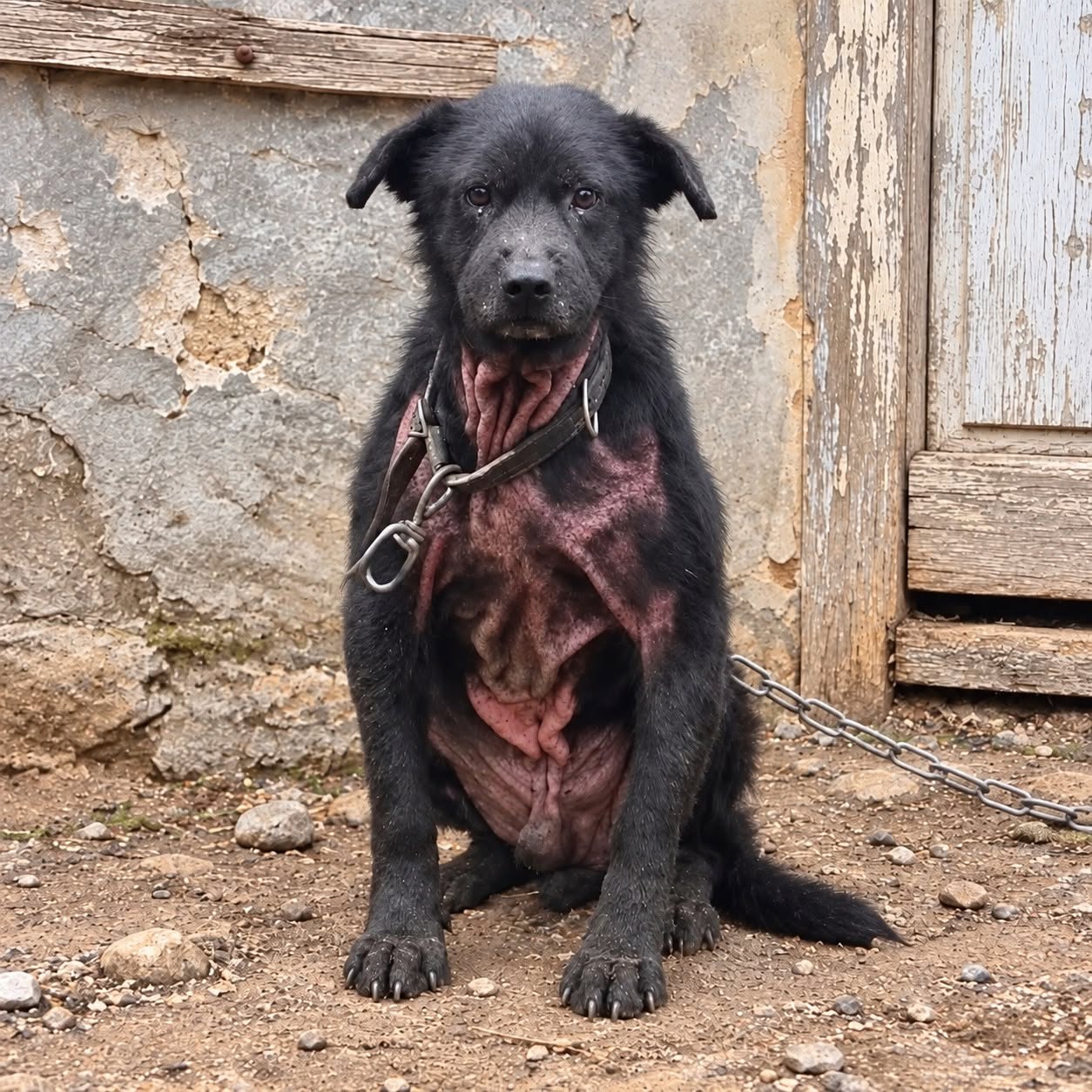
The chain around Lupinho’s neck was easy to see. What was happening inside his heart was not.
He sat on bare dirt beside a weathered wooden door, with a cracked wall behind him and scattered stones beneath his paws. A heavy chain hung from his worn collar. Much of the fur across his chest was gone, leaving his skin exposed, but it was his quiet, steady gaze that made the photograph so difficult to look away from.
Lupinho was only seven years old. He had been living without the comfort and care he needed, carrying health problems that had gone untreated. The dust on his coat and the condition of his skin told part of his story. The rest would only become clear once someone took him somewhere he could finally be examined.
Yet when rescuers approached, he did not pull away.
He stood calmly and allowed them to come close. After so much neglect, Lupinho was still willing to accept a gentle hand. His trust did not erase what he had been through, but it gave the people helping him a place to begin.
Medical tests revealed two serious conditions: heartworm disease and a heart defect he had been born with. Treating the heartworm would take months, with close monitoring throughout. The defect was a separate problem, and it could no longer be corrected with surgery.
His rescuers had to accept that they could not fix everything.
But there was still so much they could change. They could give him somewhere comfortable to sleep, arrange the treatment he needed, and make sure someone was paying attention to how he felt. An operation was not an option for his heart defect. Care, comfort, and companionship still were.
They brought Lupinho into their care in Boa Nova, where his treatment began. The bare ground in the photograph was no longer the only place he had to rest. At night, he could curl up comfortably while the people around him continued getting to know this gentle dog.
Being safe did not mean he was suddenly well. There were still months of treatment ahead, and his heart condition would continue to require attention beyond that. His rescue was not a quick transformation with every problem neatly solved. It was a commitment to caring for him through an uncertain recovery.
And alongside that care, ordinary, lovely things began to happen.
There were people who stopped to offer affection. There were other dogs to spend time with and new surroundings to explore. The gentle hands and unfamiliar voices he had first accepted became part of his days. Little by little, Lupinho had more to experience than discomfort and waiting.
His tail began to tell another part of the story.
The dog who had stood covered in dust was now accepting affection, settling into his surroundings, and enjoying the company around him. These moments did not mean his medical problems had disappeared. They meant that, even while he needed treatment, there was room in his life for comfort and happiness.
Look back at the dog beside that peeling wooden door. Then imagine him resting peacefully, lifting his face toward someone offering affection, or spending time beside his new dog friends.
That is the change his rescuers made possible. They could not repair the defect in Lupinho’s heart, but they could give him a place where his needs mattered—and where he no longer had to face them alone.
The first time Lupinho asked for a hand to stay, he did it so quietly that it could have been missed.
One of his caregivers had been sitting beside him, gently stroking the thick fur behind his ears. When she shifted her weight and began to stand, he lifted a paw and rested it against her knee. There was no barking, no frantic movement. Just that small touch, followed by a patient look up at her face.
She sat back down.
For a little longer, there was nowhere else she needed to be.
Lupinho settled beside her, his paw slipping back onto the blanket. Outside, someone was washing bowls. Another dog was moving around near the doorway. Ordinary sounds filled the space, and he listened without getting up. When her hand returned to the back of his neck, he leaned into it.
His days were beginning to fill with moments like this—small enough to pass unnoticed in another dog’s life, but worth pausing for in his.
There was the sound of breakfast being prepared. A blanket straightened beneath him. A familiar voice saying his name before someone came into view. At first, his caregivers had approached him carefully, learning where he liked to be touched and when he wanted to rest. Now he was learning about them, too.
He began to recognize who lingered for an extra scratch behind the ears. Who spoke softly while tidying his resting place. Who would sit nearby without expecting him to do anything at all.
And sometimes, when one of those people appeared, his tail moved before the rest of him did.
The people caring for Lupinho still had difficult responsibilities. His treatment remained a long process, and the heart defect discovered during his examinations had not disappeared. Affection could make his days gentler, but it could not replace the medical attention he needed. Beneath every peaceful afternoon was the same commitment: to keep caring for him, including on the days when there was nothing cheerful or remarkable to report.
They made room for those days, too.
When he wanted quiet, he could have quiet. When he settled down, nobody needed him to get up for a photograph. His rest did not have to become a touching moment for anyone watching. It could simply be rest—the thing he needed, in a place where someone would notice.
Then there were his new companions.
One afternoon, another dog paused a short distance from Lupinho’s blanket. Lupinho raised his head. The visitor sniffed the edge of the bedding, glanced toward the doorway, and eventually lay down nearby.
For several minutes, neither of them did much of anything.
A caregiver watched from across the room as Lupinho lowered his chin again. The other dog stretched out on the floor. There was no dramatic introduction, no instant burst of play. They were simply sharing a comfortable patch of space.
Later, when the other dog got up, Lupinho followed the movement with his eyes. His tail brushed the blanket.
Little by little, he was becoming part of the household’s ordinary rhythm. He had people to look toward when he heard footsteps and dogs whose presence was growing familiar. He could watch the activity around him, join in when appropriate, or remain where he was and let the afternoon unfold.
The photograph beside the old wooden door still mattered. It showed the conditions in which he had been found: the hard ground, the worn collar, the chain, the exposed skin beneath his dark coat. Nothing about his new surroundings could make that earlier part of his life disappear.
But the photograph could no longer tell his whole story.
There were other moments now.
Lupinho lifting his face toward a waiting hand. Lupinho resting beside a new friend. Lupinho looking up when someone called his name—not because something was being demanded of him, but because someone had come to spend time with him.
His future still held questions his rescuers could not answer. They could not promise that every appointment would bring good news or that treatment would be easy. They could not offer the operation that might once have changed things for his heart.
What they could offer was something they would have to keep choosing, day after day: the time, patience, and attention his care required.
That evening, after the bowls had been cleared away and the room had grown quieter, a caregiver stopped beside his bed. She checked that he was comfortable, then rested her hand briefly against his head.
Lupinho opened his eyes.
For a moment, he watched her. Then he shifted closer, tucked his paws beneath him, and settled again. She stayed until his eyes closed.
There was no grand celebration waiting at the end of that day. No announcement that every problem had been solved.
There was a clean blanket, another dog sleeping nearby, and someone who would come back to check on him.
For Lupinho, that was a very different ending to the day than the one he had known before.