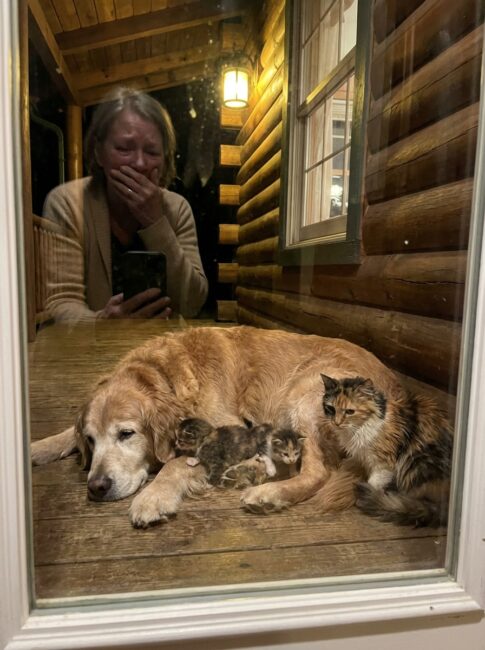
Every night at exactly nine, my thirteen-year-old Golden would drag himself to the porch for a skinny calico who wanted no food, no petting, and somehow left me crying behind the screen door.
My name is Evelyn Parker, I was sixty-three that fall, and most of my evenings in Maple Ridge, Indiana, looked exactly the same.
I washed one plate, checked my blood pressure, counted out my pills, and listened to the old refrigerator kick on in a house that had gone too quiet since my husband died.
Rex had slowed down that year.
His hips were stiff, his muzzle had gone white, and some mornings he took the porch steps one at a time like he was negotiating with gravity.
But every night at 8:58, he would lift his head from the rug before I heard anything.
At 9:00 sharp, the calico appeared.
She was little and rough-looking, all patchy orange and black and white, with one cloudy eye and the kind of ribs you could count from the driveway.
I set out tuna the first night, then chicken, then cream in a saucer like an old fool in a movie, and she ignored all of it.
She only wanted Rex.
She would step onto the porch without hurry, glance once toward me through the glass, then circle twice and settle her whole thin body against his stomach.
Rex would let out one slow breath, lower his head over her back, and the two of them would sleep under the porch light like they had signed some private agreement.
That went on for three weeks.
Then I noticed her belly.
Not just round.
Heavy.
Dragging a little when she climbed the step.
I told my daughter on the phone that some stray cat had made my into a bedtime appointment.
She laughed and said, “Mom, maybe Rex has better social skills than the rest of us.”
Maybe he did.
The little calico kept coming.
Every night.
Same time.
Same quiet.
No food, no sound, just trust.
Then she stopped.
The first night without her, Rex stayed on the porch until nearly ten-thirty, staring into the dark beyond the hydrangeas.
The second night, he whined once when a truck passed.
By the fourth, he was still dragging himself out there at nine, lowering down with a slow grunt, and waiting anyway.
I started waiting with him.
I would stand just inside the screen door in my cardigan and slippers, kitchen light behind me, watching my old dog look down the driveway like he was expecting a promise to keep itself.
Nothing came.
Four nights later, at 9:07, Rex stood up so fast he almost slipped.
The calico came out of the dark beneath the maple tree, thinner than before, fur damp from the grass, eyes fixed on the porch.
But this time she wasn’t alone.
Behind her, four tiny kittens stumbled after her on unsteady legs, all oversized ears and crooked tails and soft little cries I could barely hear through the screen.
One orange, one gray, one patched like her, one almost white.
Rex walked down the first step and stopped.
The calico paused, looked up at him, then at the kittens, and I swear she seemed to wait for his approval.
Rex lowered his head and sniffed each kitten one by one, tail moving in that slow old sweep that only happened when he felt something before I did.
Then the orange one climbed onto his front paw.
I put my hand over my mouth so hard it hurt.
The calico lay down beside Rex like she had finally reached the place she meant to bring them all along.
The kittens crawled over his legs, his chest, one even trying to climb his back, and Rex did not move except to breathe carefully around them.
That was when I saw the shape near the mailbox.
A child.
No, not a child.
A teenage girl in an oversized hoodie, standing perfectly still in the dark, watching my porch like losing it might cost her something she could not replace.
The girl did not come closer until I opened the screen door.
She looked maybe sixteen, though fear has a way of changing age.
Thin face, hair pulled back badly with a rubber band, sneakers soaked through, and one arm wrapped across her stomach like she was holding herself together by pressure alone.
The calico turned and looked at her once.
That was the first small reveal.
This cat was not a stray.
She belonged to someone, and that someone had followed her all the way to my porch because she trusted whatever Rex had become to her.
“You don’t have to be scared,” I said, though I knew from her eyes that she had good reason to be.
She nodded once, then looked at Rex instead of me.
“Her name’s Junie,” she said.
“She kept leaving every night. I followed her yesterday, but I didn’t want to scare your dog.”
Rex, who barely tolerated delivery men anymore, lowered himself back down and let one kitten wedge under his chin.
The girl’s mouth trembled.
“My name is Lucy Harper,” she said.
“Could they stay here tonight? Just tonight. I’ll come back for them in the morning.”
That sentence hit wrong immediately.
Not because of the kittens.
Because people only ask strangers that way when all their regular doors have already closed.
“Where’s your mother?” I asked.
Lucy swallowed hard and looked toward the road.
“She died in February.”
“And your father?”
“Never really had one.”
That was micro twist number one.
No safe adult at the other end of this night.
Then I noticed a dark sedan parked half a block down near the church lot.
Fog on the inside of the windows.
A little movement in the back seat.
Lucy followed my eyes.
“My brother’s asleep,” she said quietly.
“He has asthma. I didn’t want to wake him.”
I brought all of them inside.
Not because I’m brave.
Because there are moments when decent people either become useful or spend the next ten years thinking about why they weren’t.
Junie ate for the first time in my kitchen, but only after Rex lay down beside the towel-lined laundry basket where I put the kittens.
Lucy watched him like she was studying a language she had almost forgotten.
My granddaughter’s old pajamas fit her badly, but dry beats dignified.
The boy, Noah, woke up coughing around midnight, small for nine, sharp-eyed, carrying an inhaler that clicked empty when he shook it.
That was micro twist number two.
They were not just hiding.
They had already started running out of what kept him stable.
By one in the morning, I had the outline.
Lucy and Noah lived with their mother, Dana Harper, in a small blue rental on Oak Street until Dana died of an aneurysm on a Saturday morning while making pancakes.
Dana left no husband, no savings worth naming, but she did leave a life insurance payout, survivor benefits for Noah, and a modest wrongful-death settlement tied to a bad road crew barrier the county had later admitted was placed wrong.
After Dana’s funeral, Lucy’s aunt Pamela stepped in.
Pamela Harper Sloan.
Dana’s older sister.
Married to Brent Sloan, county commissioner, smiling face in campaign mailers, church deacon, firm handshake, polished boots.
That was micro twist number three.
Power had entered the room before I even knew this family’s last name.
Pamela told everyone the children needed structure.
She got temporary guardianship.
She moved them into her house on the west side.
She put Dana’s home “into probate review,” though Dana had rented, not owned.
“What happened to the money?” I asked.
Lucy laughed once without humor.
“That’s what I asked.”
She told me Pamela said the insurance money had to be “managed responsibly” because Lucy was still a minor and Noah had medical costs.
Then Pamela bought a Yukon, Brent paid off campaign debt, and Noah’s therapy bills started getting “delayed.”
Lucy started looking through drawers.
That was the escalation.
At first she found little things.
Bank envelopes tucked into recipe books.
Benefit letters opened and re-folded.
Noah’s inhaler refills skipped for a week, then two.
Pamela telling Brent at night, “Once the hearing’s done, she can’t touch any of it.”
“What hearing?” I asked.
Lucy looked at Junie.
“The one where they were going to send me away.”
The room went still.
Pamela had told the court Lucy was unstable, oppositional, unsafe around Noah, and possibly using drugs.
Brent had written a supporting statement.
A family attorney filed it.
A judge signed an emergency review order for the following Monday.
Lucy found the papers Friday night.
That was the first big twist.
This was not guardianship.
It was removal.
She packed what she could, took Noah, took Junie, and left in Dana’s old sedan with two hundred and twelve dollars from a coffee tin her mother kept hidden in the freezer.
Junie began slipping away every night after they parked in different church lots and motel edges.
Lucy thought the cat was hunting.
Instead, Junie kept coming to Rex.
That was micro twist number four, and the first beautiful thing in the middle of everything else.
A pregnant cat had found the only old creature in town who felt safer than the dark.
For two days, I believed the main problem was Pamela.
Then a deputy knocked on my door.
He was polite in the infuriating way men get when they assume age has softened your grip on facts.
He said Pamela had reported the children as endangered runaways.
He said harboring them could create legal trouble.
He said Brent Sloan was “very concerned.”
Rex stood up from the rug.
Junie stepped in front of the kittens.
Neither made a sound, but the deputy noticed.
I asked to see the order.
He handed it over.
That was micro twist number five.
I had worked twenty-six years in the county recorder’s office before retiring.
Not glamorous work, but paper teaches you where lies crease wrong.
The judge’s digital filing stamp was dated after the clerk acceptance mark.
That should not happen.
I looked up at him.
“Who filed this?”
He shifted.
“Family counsel.”
“Try again.”
He took the paper back too quickly.
That afternoon, I called an old coworker still in records.
By dinner, she called back whispering.
The guardianship file had been amended twice after hours.
The supporting affidavit from Noah’s pediatric specialist did not exist in the medical registry it cited.
And someone from the commissioner’s office had accessed the clerk queue the morning before the order was signed.
That was the second big twist.
Pamela wasn’t freelancing.
Brent was inside it.
Money and power almost always travel together in the same car.
One buys time.
The other blocks the road.
Lucy had taken one other thing when she left.
At first she didn’t mention it because she thought I would tell her to hand it over.
Maybe I would have, earlier in life.
Around sunrise, while Noah slept curled against Rex and two kittens slept on Rex’s flank as if they had been born knowing softness, Lucy pulled a cracked tablet from her backpack.
“Mom made me record stuff once,” she said.
Dana, it turned out, had grown suspicious months before she died.
Not of Pamela.
Of Brent.
Dana worked bookkeeping part-time for a paving subcontractor.
The same subcontractor tied to the barrier failure that caused the road incident leading to her settlement.
She believed Brent had pressured county bids toward friends and then leaned on departments to bury cost overages.
She kept notes.
She told Lucy to save everything if anything ever felt off.
There were photos on the tablet.
Letters.
Voicemails.
One short audio clip Lucy had recorded by accident while hiding in Pamela’s laundry room after overhearing her own name.
Brent’s voice came first.
“If the survivor account stays under Noah’s ID, nobody will question where it’s moving.”
Pamela answered, “Then get her out before she turns eighteen.”
I listened twice to make sure my hearing wasn’t inventing it.
That was the third big twist.
They were not just spending the children’s money.
They were laundering it through the boy’s protected benefits and trying to institutionalize the girl who noticed.
By noon, I had called someone I had not spoken to in nine years.
My daughter, Melanie.
She was a legal aid attorney in Indianapolis, and we had spent the better part of a decade being polite at Christmas and unavailable the rest of the year.
The split had started over my husband’s illness, then hardened the way family hurts do when nobody wants to use plain language.
She answered on the second ring.
“Mom?”
“I need you,” I said.
There was silence.
Then, “Tell me where.”
That was micro twist number six.
Sometimes the person power counts on you not calling is your own blood.
Melanie drove down that afternoon, hair half-up, files in the passenger seat, expression already sharpened.
She listened to Lucy.
Listened again.
Reviewed the order.
Heard the audio clip.
Then she said, “Do not answer the door unless it’s me or state police.”
By evening, she had emergency motions drafted, a contact at the inspector general’s office alerted, and a child-services supervisor willing to look past Brent Sloan’s church smile for exactly long enough to do her job properly.
Pamela arrived before the state did.
She came in pearls and soft cashmere and the perfume of a woman who believes appearance is evidence.
Brent came five minutes later in his campaign fleece, jaw tight, hands controlled.
Pamela cried the moment she saw Lucy.
“Oh, sweetheart.”
Lucy did not move.
Noah got closer to Rex.
Junie, from the windowsill, watched Pamela with both ears flattened.
That was micro twist number seven.
Animals know when grief is a performance.
Pamela told me Lucy had been traumatized by loss.
She said Noah needed medical consistency.
She said Brent had pulled every string he could because he cared.
Melanie stepped in then, all clipped vowels and clean fury.
“Good,” she said.
“Because state investigators are on their way to ask about falsified court filings and misdirected survivor funds.”
Pamela stopped crying immediately.
That was the fourth big twist, though it came wrapped in stillness rather than noise.
The mask fell that fast.
Brent tried bluster first.
Then outrage.
Then the old favorite, which is acting wounded that someone would question a public servant.
It lasted until Melanie played the audio.
You would think a man losing control would sound larger.
He sounded smaller.
State police came at 6:40.
Child services at 6:52.
By 7:15, Pamela was sitting at my dining table with her hands flat against the wood like pressing hard enough might keep the room from shifting.
The investigation widened quickly after that.
County accounts.
Campaign reimbursements.
Settlement distributions.
Guardianship filings.
Noah’s protected survivor fund had been skimmed through “consulting invoices” to a media company that existed mostly on paper and Brent’s cousin’s mailbox.
Dana’s settlement had not been placed in trust as promised.
It had been divided, delayed, and disguised.
And Dana herself?
She had not been part of the scam, but she had started seeing enough of Brent’s bid steering to become inconvenient.
There was no proof her aneurysm had anything to do with that, and I will not invent crime where medicine already broke a family.
But there was proof Brent and Pamela moved on her money before the grass settled over her grave.
That was enough for me.
The aftermath took months, because truth in America often walks while lies get county vehicles.
Brent resigned first, calling it a personal decision.
Pamela was charged with fraud, custodial interference, and theft from a minor beneficiary.
The attorney who filed the amended guardianship order lost his bar license pending review.
A deputy clerk retired early.
Lucy and Noah were placed temporarily with me under emergency kinship-adjacent care until Melanie got permanent protective placement moved to Dana’s cousin in Bloomington, a decent woman with tired eyes and no patience for liars.
They stayed with me eleven weeks.
Long enough for Noah’s cough to disappear.
Long enough for Lucy to sleep through a full night without jerking awake at headlights.
Long enough for four kittens to learn my kitchen corners and for Rex to accept, with mild dignity, that his retirement now included nursery duty.
Junie kept her habits.
Even after she and the kittens had food, blankets, and safety, she still met Rex on the porch at nine.
Only now the kittens trailed after her in a loose little parade, and Rex would lower himself carefully while they climbed him like he was a patient old hill.
One evening, Lucy stood beside me behind the screen and said, very quietly, “He’s the first thing that felt steady after Mom died.”
I looked at Rex.
Old, sore, white-faced Rex, who had spent a month becoming a harbor without needing to understand the whole storm.
“I think she knew that before you did,” I said, nodding toward Junie.
Lucy smiled without showing teeth.
By winter, Melanie and I had started talking like people who might survive each other honestly.
Not healed.
Not magically close.
Just willing.
That was my private aftermath, and I do not underestimate it.
The public one came in spring, when the court ordered restitution accounts opened for Lucy and Noah, supervised by a neutral trustee, and Brent Sloan walked past reporters without his usual grin.
He looked smaller on television.
Power always does once people stop mistaking polish for character.
Lucy texted me the first week she and Noah settled into Bloomington.
It was a picture.
Noah asleep on a beanbag, one kitten on his chest.
Junie on the windowsill.
Rex’s orange grand-kitten, now bigger, trying to eat a shoelace in the foreground.
A minute later, another photo came through.
Rex on my porch at nine.
Junie beside him.
No kittens this time.
Just the two elders of a strange little family, holding the hour together.
The ending came in a small way, which is the only kind I trust now.
A month after the final hearing, Lucy came back for a weekend visit.
She had cut her hair shorter.
Noah had new sneakers.
Junie hopped from the car like she owned my property taxes.
That night, at exactly nine, Rex made his slow way to the porch.
His hips were worse by then.
I could see it in the careful placement of each paw.
Junie reached him first and rubbed once against his chest before lying down.
The kittens, half-grown and ridiculous, tumbled around them for a minute, then settled too.
Lucy stood beside me at the screen door.
Noah leaned against my arm.
Nobody said anything for a long time.
Then Noah whispered, “He waited for us.”
Rex closed his eyes under the porch light, Junie warm against him, and his tail thumped once against the boards like that was answer enough.