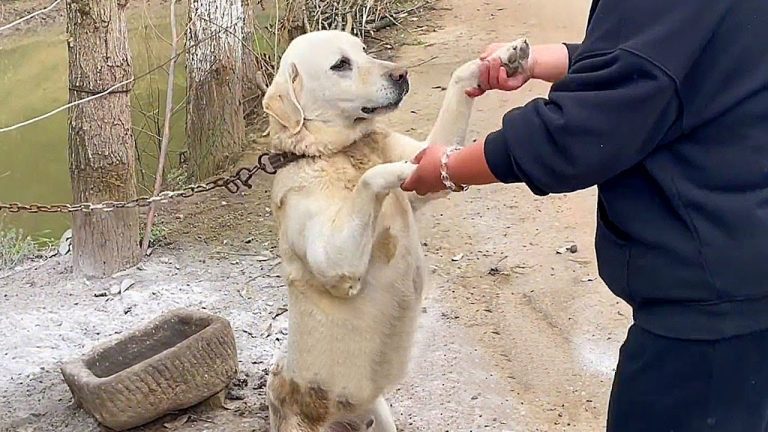
A quiet stretch of land held a story that no one seemed willing to confront, except for one person who refused to look away. Tied to a tree for more than a year, a Labrador endured a life that no living creature should ever know. The chain around his neck was short, limiting his movement to just a few painful steps in any direction. Beneath him, the ground was worn and filthy, a reflection of how long he had been left there without care. In the sweltering heat, with temperatures climbing to nearly 100 degrees, he survived on water that was no longer clean and food that had long since spoiled.
What made the situation even more heartbreaking was not just the physical hardship, but the emotional longing that radiated from the dog every time someone approached. When the rescuer first visited, the dog did not react with fear or aggression. Instead, he reached out in the only ways he could. His paws lifted eagerly, his tail wagged with desperate hope, and his eyes carried a silent plea for attention. It was as though he understood that this visitor might be different.
On one visit, in a moment that would stay etched in memory, the dog picked up a cucumber from the ground and gently pushed it forward, as if offering it as a gift. It was a simple gesture, yet it spoke volumes. Even in neglect, even in isolation, he still held onto kindness. That small act revealed a spirit that had not been broken, despite everything he had endured.
The rescuer did not come empty-handed. Each visit brought fresh food, clean water, and a determination to improve the dog’s living conditions. The area around the tree was cleaned, and offers were made to build a proper shelter. But every effort was met with resistance. The elderly owner and her daughter saw the dog not as a companion, but as a function. To them, he was there to guard the property, nothing more. The rescuer’s concern was seen as interference, an inconvenience rather than a necessity.
Conversations turned into repeated refusals. No matter how reasonable the offers were, they were dismissed. At one point, the owner set an impossibly high price, hoping it would end the discussion entirely. It was a barrier meant to discourage any further attempts. For many, that might have been the moment to walk away. But for this rescuer, it became a turning point.
There are moments in life when persistence becomes the only path forward. This was one of them. The rescuer returned again and again, not with frustration, but with quiet determination. Each visit was another chance, another conversation, another opportunity to advocate for a life that could not speak for itself. It was not about winning an argument. It was about saving a soul.
Finally, after months of effort, a breakthrough came. A long, exhausting negotiation unfolded, stretching over hours. It was not easy, and it was not immediate. But slowly, the resistance began to soften. Words that had once been firm refusals became hesitant considerations. And at last, an agreement was reached. The chain that had defined the dog’s world for so long was about to be removed.
Freedom is not always loud or dramatic. Sometimes, it arrives quietly, in a moment that feels almost unreal. As the dog was finally released, there was no confusion in his response. His body language shifted instantly. The tension that had once held him rigid began to fade, replaced by cautious relief. He stepped forward, unsure at first, as if testing whether this new reality was truly his.
The journey did not end there. In many ways, it was only beginning. The dog was taken to receive his first proper grooming, something he had never experienced before. Layers of dirt and neglect were gently washed away, revealing not just his physical form, but a glimpse of who he had always been underneath. From there, he was brought to a veterinary clinic, where a full assessment could be made.
The results were not surprising, yet they were still difficult to hear. He was significantly underweight, his body weakened from prolonged neglect. There were signs of internal inflammation, and his skin showed clear evidence of long-term irritation. These were not conditions that would heal overnight. They would require time, care, and patience.
But for the first time in his life, he had all of those things.
Recovery is rarely a straight path. It is made up of small steps, quiet victories, and moments of trust that slowly rebuild what was lost. In a safe and loving home, the Labrador began to experience a different kind of life. One where meals were regular and nourishing. One where water was clean and abundant. One where touch was gentle, not absent.
Perhaps the most remarkable transformation was not physical, but emotional. The same dog who had once reached out with a cucumber now reached out with confidence. His tail wagged not from desperation, but from genuine happiness. His eyes, once filled with silent pleading, began to reflect comfort and trust.
Stories like this remind us of something deeply important. Compassion is not always easy. It often requires patience, resilience, and a willingness to face rejection. But when it is sustained, when it is guided by genuine care, it has the power to change lives in ways that cannot be measured.
For one Labrador, that change meant everything. It meant leaving behind a year of isolation and stepping into a future defined by dignity. It meant being seen not as a tool, but as a living being worthy of love.
And perhaps most importantly, it meant that someone chose not to give up.