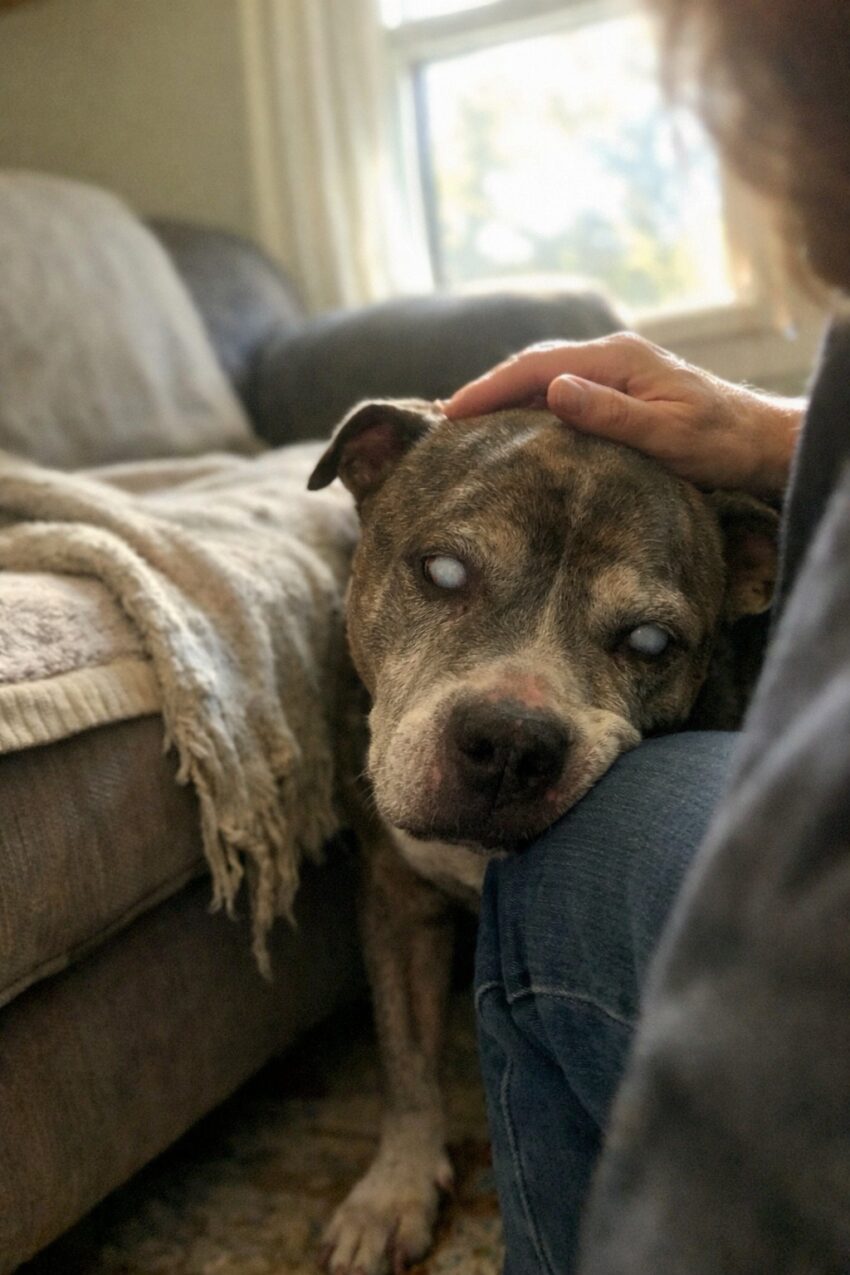
We adopted Bruno because we thought we were giving him a gentle place to die. Fourteen years old, covered in the scars of a long life, he arrived at our home with cloudy, milk-white eyes that could no longer track the world around him. The shelter had marked him as an inconvenient burden, returned by others because he was too much work, but to us, he was simply a soul who deserved a soft landing. We prepared for the inevitable goodbye, setting up an orthopedic bed in the quietest corner of the house and moving around him with deliberate, muffled steps.
For the first few days, Bruno did exactly what we expected. He slept, his body heavy and still, as if he had finally been relieved of the need to stay alert. He did not react to voices, nor did he respond to our touch. We assumed he was fading away, and we were content just to offer him the peace he had likely never known in a kennel.
Everything changed on the fifth day. I was sitting on the floor nearby, speaking in a casual, low murmur, when I noticed his ear twitch. It was a subtle movement, but it was deliberate. Over the next week, we began to realize that while Bruno could not see us, he was mapping our world through sound. He tracked the rhythm of our footsteps, the shifting of our weight on the furniture, and the subtle changes in air pressure near doorways. He was not just existing; he was learning to navigate the dark.
The transformation culminated one evening when I was sitting on the couch. The house was entirely silent, and Bruno was resting across the room on his bed. Suddenly, he stood up. There was no hesitation or confusion in his movements. He turned his head with purpose and began to walk, slow and steady, directly toward me. He navigated the furniture with precision, never bumping into a chair or wall, until he reached the couch. Without a single word from me, he bowed his head and rested it firmly against my knee.
The room went completely still as we realized he had found us not by sight, but by connection. It was a profound moment of trust that broke the silence of his isolation. From that night on, Bruno stopped being a dog waiting for the end and started becoming a part of our home. He began exploring the kitchen, showing curiosity toward our daily routines, and greeting the fresh air coming through the front door with a newfound sense of purpose.
We had brought him home believing our role was to oversee his final days, but Bruno had a different plan. He taught us that vision is not limited to what the eyes can see. By creating a space where he felt truly safe, we had allowed him to emerge from his shell. He may never see our faces, but he sees us in the ways that matter most. He is no longer defined by his blindness or his age, but by the quiet realization that he is finally, truly home.