Part 2
I want to tell you about Roy before the dog, because the dog only makes sense against the man.
Roy was not a sad man, exactly, and that’s the part that’s hard to explain to people. He wasn’t moping around. He laughed. He fixed your carburetor and gave you grief about your riding and remembered your kids’ birthdays. From the outside, most days, Roy looked fine.
It was just that there were rules to Roy that you learned over time and never asked about.
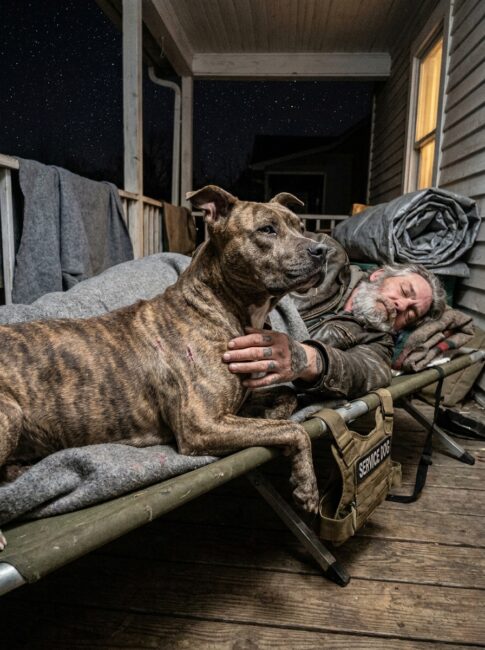
He sat with his back to the wall. Always. In a restaurant, at the clubhouse, anywhere — Roy took the seat that faced the door, and if he couldn’t get it he got quiet and left early. He did not like to be touched from behind. He flinched at sounds the rest of us didn’t even hear — a particular pitch of metal on metal, a car backfiring two streets over, the sound the propane heater made when it kicked on. And he did not sleep inside.
We learned, in pieces, over years, that the inside thing was about being closed in. About walls and a roof and one door, about a part of Roy’s brain that had learned in a very bad place that an enclosed space was a trap, that the only safe place to sleep was somewhere he could see the sky and hear what was coming and get out. Ten years home, and that part of him had never once stood down. It still ran every night, doing its job, keeping him out under the stars where nothing could close around him in the dark.
His ex-wife had left in year three. I’m not going to judge her for it. She tried longer than most would have. But you cannot build a marriage with a man who sleeps on the porch every night of his life, and eventually she stopped trying to drag him in and started just being gone, and Roy let her, because some part of him believed she was better off and some part of him couldn’t have followed her inside even to save it.
That was Roy when the dog came. A good man. A steady man. A man who had quietly arranged his entire life around the things he could not do, and had stopped, a long time ago, believing any of them would ever change.
Part 3
Here is what Service did, starting the first night, that none of us expected.
A service dog placed with a vet like Roy is trained to do certain things — interrupt a nightmare, create space in a crowd, wake the handler from a flashback, apply pressure during a panic spike. Real, concrete tasks. Roy knew all that. He’d been briefed. He figured the dog would sleep in the house, on the nice bed the program even sent home with him, and Roy would keep sleeping on the porch the way he always had, and they’d meet up in the mornings, and that would be the arrangement.
That is not what Service decided.
The first night, Roy did his usual thing. Checked the locks he didn’t sleep behind, turned off the lights in the house he didn’t sleep in, and went out to the porch with his blankets. And Service — who had a brand-new orthopedic dog bed sitting in the warm dry living room — walked out onto the porch behind him, turned around twice, and lay down on the cold boards next to the cot.
Roy told him to go inside. Service didn’t go inside.
Roy, being Roy, didn’t force it. He figured the dog would get cold and smarten up and go back to the warm house. The dog did not get cold and smarten up. The dog stayed on the porch all night, pressed against the side of the cot, and was there in the morning.
And the next night.
And the next.
Service made a choice that first week and never once went back on it: wherever Roy slept, Service slept. If Roy was on the porch, Service was on the porch. If a monsoon storm rolled through and Roy moved to the garage, Service moved to the garage. Rain, cold, the freezing clear nights when the stars came out so hard and close you could read by them — Service was there, on the ground, against Roy, every single night.
Four months.
The club noticed. Of course we noticed. Tank said it out loud one night, what the rest of us were thinking: “That dog won’t sleep inside without him. The dog’s doing the same thing Roy’s doing.” And there was a silence after that, because we all understood what we were looking at. The dog had been trained to help Roy. And the way the dog had decided to help, in the deepest way, was not to pull Roy toward normal. It was to go where Roy was and refuse to let him be alone in it.
Roy started sleeping a little better. Not a lot. A little. He told his counselor — we found this out later — that for the first time in ten years there was a warm weight against him in the dark, something breathing, something that would lift its head if anything came, and that it was easier, just slightly, to close his eyes when something else was keeping watch.
He started, without quite admitting it, to need the dog there.
And the dog was, always.
Part 4
The night it happened was in July, deep in monsoon season.
It came in hard and fast the way those storms do up there — a wall of rain off the mountains, lightning cracking close, the temperature dropping ten degrees in twenty minutes. The kind of storm where any sane creature is inside.
Roy was on the porch. Service was beside him. And as the storm built, Service did something he had not done before. He got up, walked to the front door of the house, and barked.
Roy heard him. Roy did not get up.
I’ve thought a lot about why. I think part of it was the storm itself — the noise, the lightning, all of it lighting up the bad wiring in Roy’s brain, pinning him down in a way that the rest of us are lucky enough to never understand. And I think part of it was just ten years of a habit so deep it wasn’t a decision anymore. The door was the door. He did not go through the door. Even with the rain coming sideways onto the porch, soaking through the blankets, even cold and wet and miserable, Roy stayed on that cot, because going inside was the one thing his body had spent a decade refusing to do, and a storm wasn’t going to change that.
Service barked at the door again. Roy didn’t move.
And so Service stopped asking.
He came back from the door. He climbed up onto the cot, onto Roy’s chest — sixty pounds of wet Pit Bull, settling his full weight down over Roy’s sternum — and he did not move. He pinned him. Deliberate, calm, immovable. He lay on Roy’s chest in the driving rain and he stayed there, and every time Roy shifted, Service settled heavier, and the message a service dog sends with his whole body in that moment is not subtle and Roy understood it: I am not getting off you, and you are not going anywhere, and we are going to be here together.
Two hours.
Two hours in the rain. Roy soaked through. Service soaked through. The two of them on a cot on a porch in a July monsoon, the dog refusing to move, the man unable to, both of them just enduring it together in the dark while the storm hammered down.
Roy doesn’t remember most of what came after. He was exhausted, hypothermic at the edges, somewhere past the end of his own strength. He remembers the weight on his chest. He remembers the rain. He remembers thinking, dimly, that the dog should go inside, that the dog was getting soaked for nothing, and not being able to make his own body do anything about any of it.
And then he remembers nothing.
Until morning.
Part 5
Roy woke up inside his house.
On the living room floor. On his back, on the hardwood, a foot inside the front door, which stood open to a wet bright morning and a porch with an empty soaked cot on it.
He did not know how he got there. For a long moment, he told me, he genuinely did not understand what he was looking at — the ceiling above him instead of the sky, walls around him, a roof, inside — and the panic should have come, the closed-in trap-feeling that had kept him out under the stars for ten years, and he braced for it.
It didn’t come. Because of the dog.
Service was lying on the floor next to him. Not on the bed. Not on his nice dog bed, not anywhere comfortable — on the hard floor, pressed full-length against Roy’s side, soaked, exhausted, both of them still damp from the storm. And Roy understood, slowly, lying on his own living room floor for the first time in a decade, what had happened in the part of the night he couldn’t remember.
Service had dragged him in.
We pieced it together later, and the vet program confirmed it’s a thing some of these dogs will do, a thing they’re not even specifically trained for, a thing that comes from somewhere past training. At some point in that storm, with Roy past responding, soaked and going hypothermic on a cot in the rain, Service had gotten a grip on the thick collar of Roy’s leather jacket — the leather he never took off, the second skin all of us wear — and he had hauled. Sixty pounds of dog, dragging a hundred-and-ninety-pound man off a cot, across a porch, through a door, out of the storm and into the dry. Inch by inch. However long it took. Until Roy was inside.
And then Service hadn’t gone to the bed. Hadn’t taken the warm dry comfortable spot he’d earned a hundred times over. He’d lain down on the hard floor next to Roy, in the wet, and kept watch, so that when Roy woke up inside the walls he’d feared for ten years, the first thing he’d feel wouldn’t be the trap closing.
It would be the dog. Right there. Not leaving.
Roy lay on that floor a long time, he told me, with his hand on the wet dog beside him, inside his own house, not panicking. And he said the thing he felt wasn’t relief exactly, and it wasn’t peace exactly. It was something more like — permission. Like a door he’d been standing outside of for ten years had been opened for him by someone who then refused to make him walk through it alone.
Part 6
I’ve turned the whole four months over in my head a lot since Roy told me all of it, and I think I finally understand what Service actually did, and it isn’t what it looks like from the outside.
From the outside it looks like a heroic dog dragged a man inside and cured him. That’s the version that goes around. That’s the version that isn’t true, and Roy is the first one to say so.
Service didn’t go where Roy needed to go. That’s the thing. For four months, Service did the exact opposite of what you’d think a service dog should do. He didn’t model the healthy behavior. He didn’t sleep inside to show Roy it was safe. He didn’t pull Roy toward the bed, toward normal, toward the life everyone wanted for him.
He went out to the porch. He went down into Roy’s broken place and slept in it, every night, in the cold and the rain, because that’s where Roy was, and the first thing — the only first thing — was to not leave Roy alone out there.
That’s the part we’d all understood, in the club, without words. You don’t drag a drowning man. You get in the water. You stay.
And then — only after four months of staying, of earning it, of becoming the one warm certain thing in Roy’s nights — Service did the second thing. The one night. He decided, on a night when Roy was too far gone to decide for himself, that this once, he would carry Roy across the line Roy couldn’t cross. Not every night. Not as a fix. Just once. Just to show him the other side existed and that he could survive being on it.
I think about the storm, the two hours, the dog pinning him to the cot in the rain. I used to think that was Service being stubborn. Now I think Service was waiting — keeping Roy still and present and there, riding out the worst of it together, until the moment came when Roy was spent enough, open enough, that the dog could finally do the thing he’d been building toward for four months.
He couldn’t fix ten years. No dog could. No pill could; God knows Roy had tried them. No brother of ours could, and we’d have given anything to.
What Service could do was get Roy inside for one night. And make sure Roy wasn’t alone when he woke up there.
One night. That was the whole gift. The rest, it turned out, Roy could do himself — but he had to be shown, once, that the door didn’t kill him.
Part 7
It didn’t happen all at once after that. I want to be honest, because the all-at-once version is a lie and Roy hates the lie.
The next night, Roy slept on the porch again. And Service slept beside him again, the way he always had. The storm night didn’t flip a switch.
But something had changed, and it changed slow. A few nights later, on a cold night, Roy brought the cot just inside the garage with the big door open — halfway, a compromise. Service came too. Then, weeks on, a night on the living room floor with the front door open and Service stretched out next to him, the two of them on the hardwood where they’d woken up that morning. Then the floor with the door closed, which took everything Roy had, and Service pressed against him the whole night so he could do it.
Months of that. Inches of that. Roy crossing the same threshold over and over, a little further each time, and every single time, the dog right there beside him on the ground — never on the bed, not yet, because Roy wasn’t on the bed yet, and wherever Roy was, that was where Service would be.
It took about a year.
A year after the storm, Roy slept in his own bed. In his own room. Inside the house, with the door closed, under a roof, the way he hadn’t done since before the second tour. And on the floor beside the bed — finally, only now — Service had a dog bed of his own, and he slept in it, because for the first time in a year Roy was somewhere Service could let him be without standing guard on the hard ground.
The night Roy told me he’d done it — slept in the bed, a full night, inside — he said it like it was nothing, the way Roy says the biggest things. And then he was quiet for a second, and he said, “The dog’s on a real bed now. First time. Took us both a year to earn it.”
Part 8
Roy said something to his counselor at the VA that she repeated to him, and he repeated to me, and I’ve never forgotten it, because it’s the truest thing anybody’s said about any of this.
She’d called Service his miracle. His cure. The dog that fixed ten years.
And Roy stopped her.
“Service didn’t cure my PTSD,” he said. “I want that on the record, because guys hear these stories and think a dog’s gonna fix them, and then it doesn’t, and they think they failed. Service didn’t fix me.”
He thought about it.
“All Service did was get me inside the house one night when I couldn’t do it myself. That’s it. One night. He made me find out I’d survive it.”
Then he said the last part.
“After that one night — I chose. Every night after, I chose. The dog just showed me there was a choice.”
He’s inside now. Most nights.
The dog finally got the bed.
They earned it together.
Follow this page for more stories about the ones who don’t drag us toward the light — they get down in the dark and wait with us until we can walk out ourselves.