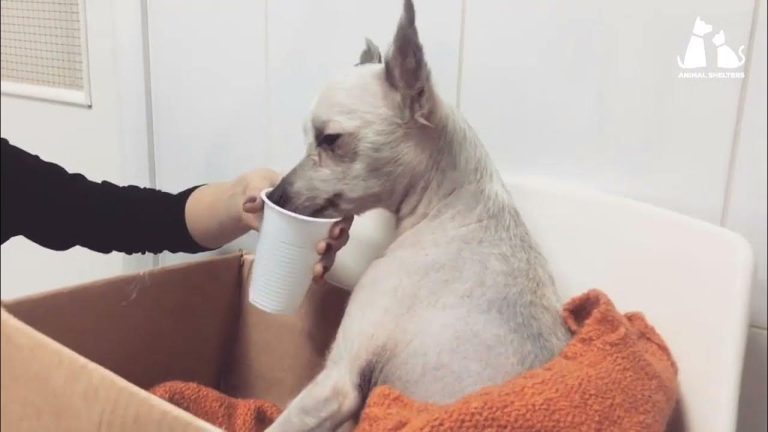
He was lying on a cold street corner, too exhausted to lift his head. A small dog, later named Luke, had been left there as though he were nothing — as though his life meant nothing. But the wound on his head told a story that no one who saw it could forget.
The cut was fresh, carefully stitched closed, and surrounded by dried blood matted into his fur. At first glance, rescuers hoped it might be the result of an accident. But when Luke was brought in for medical evaluation, the truth they uncovered was far more devastating than anyone had prepared themselves for.
An MRI revealed severe trauma deep inside his skull. Dangerous fluid had accumulated, pressing directly against his cerebellum — the part of the brain that controls balance, coordination, and basic bodily functions. The pressure was serious. The injury was not new, and it was not accidental.
The rescue team, working alongside veterinary specialists, pieced together what they believed had happened. Someone had discovered that Luke was seriously ill. Rather than seek help, that person chose a different path — one that is almost impossible to comprehend. It appeared that Luke had been struck with tremendous force, the wound hastily stitched afterward, and then he was carried to that street corner and abandoned. Left to die quietly, where no one would ask questions.
Luke had other plans.
Against every medical expectation, he survived. His small body held on through the initial trauma, and he was stable enough to undergo a minor procedure to begin addressing the injury. The rescue team exhaled for the first time in days. There was still a long road ahead — a high-risk major surgery would be necessary to properly drain the fluid from his brain — but Luke needed time to rest and grow stronger before that could happen.
He was placed in a loving foster home, and that is where something quietly beautiful began to unfold.
In the weeks that followed, Luke discovered what it felt like to be safe. He went on gentle walks in the cool air, wrapped in a cozy sweater that kept his thin frame warm. He leaned into the hands of his rescuer with a trust that seemed almost impossible given everything he had endured. There were quiet mornings and soft moments — the kind that don’t make headlines but mean everything to those who witness them.
Because his head remained vulnerable while he healed, Luke was fitted with a small protective hat in soft pink. It was practical, necessary, and — if you watched him for more than a few seconds — absolutely endearing. He was not a fan. He shook his head. He tried to wiggle free. He gave the most indignant looks a dog has ever given. And yet, every time the hat was gently placed back on, he eventually settled, as if he understood, on some level, that the people around him were only trying to keep him safe.
That trust was one of the most tender things anyone in the rescue team had ever seen.
When Luke had grown strong enough, the day of the major surgery finally arrived. The team prepared carefully. The procedure carried significant risk, but it also carried hope. Everyone who had watched Luke walk in that little sweater, everyone who had laughed softly at his pink hat protests, held their breath.
What the surgical team found when they opened that wound changed everything.
A massive bacterial infection had taken hold deep inside, spreading in ways that no imaging had been able to fully capture beforehand. The infection was extensive. It was untreatable. The doctors, as skilled and dedicated as they were, had no path forward. There was nothing left to do but keep Luke comfortable in his final moments.
He passed away on the operating table, surrounded by people who loved him.
The rescuer who had walked beside him, who had bundled him into that sweater, who had laughed at his stubborn hat-shaking and cried at his quiet trust — that person now faced a grief that words struggle to hold. The bond formed in those gentle weeks of recovery was real. The love was real. And now the loss was real too.
There is a particular kind of heartbreak that comes with losing a soul you fought so hard to save. It is not just sadness. It is the weight of knowing how close things came to being different. It is the silence where a small set of paws used to click across the floor. It is looking at a pink hat and feeling the whole world tilt.
Someone said it best in the quiet aftermath: the whole world changes when someone is gone.
Luke’s story is not easy to sit with. It asks us to look honestly at the cruelty that some animals endure and the extraordinary compassion that rises up in response. It reminds us that rescue work is not always a happy ending — sometimes it is simply the commitment to make sure that no creature spends their final days without kindness, without warmth, without someone who sees them.
Luke was seen. He was loved. And in the end, he did not die alone on a cold street corner. He died surrounded by people who had chosen him, fought for him, and would carry him in their hearts long after he was gone.
That matters. It always will.