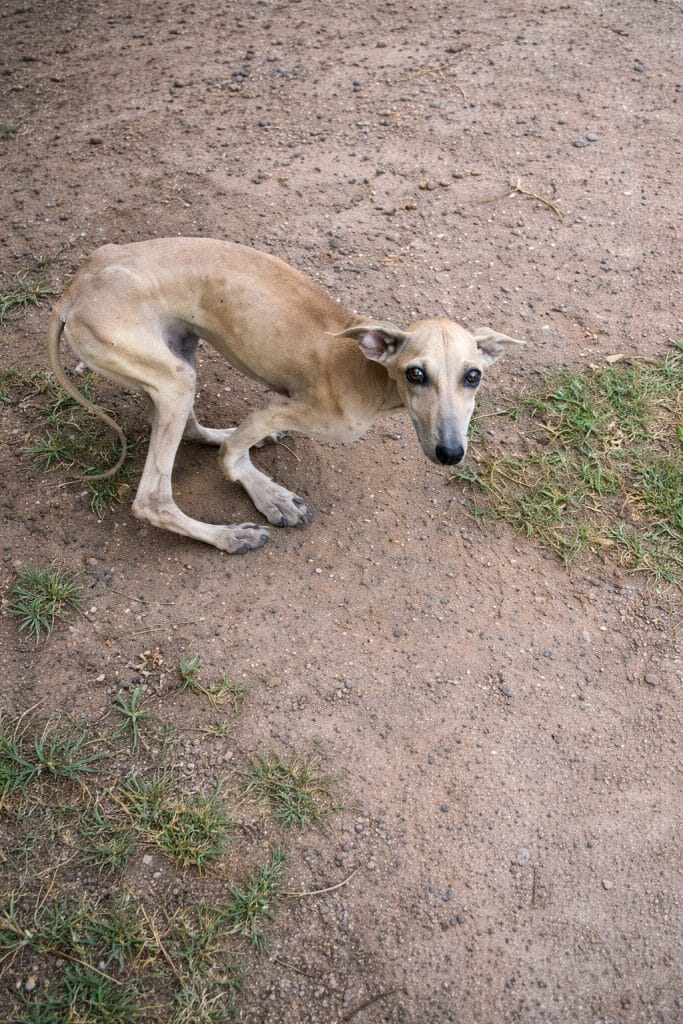
Dash had never been able to move like a healthy dog. His gait was so distorted that every attempt to get forward looked painful, as though his body had never been given the chance to learn how standing was supposed to feel. For a long time, people saw him struggling and simply passed by. The page that later told his story carried the date 16/4/2026.
He was terribly underweight, with his ribs sharply outlined beneath his coat and the effects of prolonged neglect visible across his body. Yet the condition of his front legs was what made his suffering impossible to miss. Both limbs curved inward at severe angles. Instead of placing his paws flat on the ground, Dash had to support himself on folded joints and use his elbows to pull his body along.
Running was out of the question. Even ordinary walking was beyond him. He dragged himself over hard pavement, moving through a place where there seemed to be no meal waiting, no safe corner to sleep in, and no person ready to stop. His expression did not show rage or panic. What remained in his eyes was weariness, the deep kind that comes after struggling alone for far too long.
Everything began to change when rescuers finally reached him. Dash did not fight them or try to escape. He was too depleted for that. They picked him up with great care, supporting his thin frame and making sure his damaged front legs were protected. For the first time in a long while, he was carried away from danger and into safety.
Cold ground was replaced by warmth and soft bedding. Instead of being ignored, he was handled gently. His recovery did not begin with an operation. The first part of his treatment happened in water.
Caregivers introduced Dash to hydrotherapy in a small pool. Because the water supported much of his weight, his joints no longer had to bear the same pressure they faced on land. It offered him a way to move his limbs with less pain and gave his body an opportunity it had never really known.
At first, Dash was cautious and unsure of what was happening. He did not immediately understand how to use the freedom the water gave him. With repeated sessions, however, he began to adapt. His muscles started responding, and his confidence slowly followed. Instead of fighting against his own body, he was beginning to discover what it felt like when his body could help him move.
Then the rescuers and medical team faced the more difficult decision: surgery. Correcting the severe deformity meant attempting to reposition his legs so that they could support him in a way they never had before. It was a demanding procedure that required careful work and patience, but the operation succeeded.
Surgery was only part of the journey. Dash still had a long recovery ahead of him. His legs had to remain protected in bandages while he was closely watched and guided through rehabilitation. He needed to relearn basic movements that most dogs perform without thinking. Balance had to be discovered. Each step had to be practiced. Most importantly, he had to learn that he could rely on his own legs.
In the beginning he shook, lost his footing, and stopped often. Progress was slow, but he continued making the effort. Eventually came a moment that once would have seemed impossible: Dash stood upright without leaning against anything and without falling. He was supporting himself.
From there, improvement arrived through small achievements rather than one dramatic leap. He crossed a room under his own power. Later he managed a short outing outdoors. Those brief successes grew into longer, steadier movement.
His physical condition changed along with his mobility. The weight he had been missing began to return. New muscle developed, and his coat took on a healthier appearance. His face changed too. The exhausted look that had defined him started giving way to interest in the world around him. Curiosity began replacing resignation.
The most emotional milestone came outside on grass. The soft surface beneath his paws was entirely different from the unforgiving pavement he had once dragged himself across. Dash moved forward carefully, testing his balance. He took another step, then another. Soon caution turned into motion, and he broke into a run.
It was not a flawless sprint, and his movement was not perfectly smooth. That did not matter. He was moving freely. His tail rose, his pace quickened, and there was playfulness in the dog who had once been forced to crawl on his elbows. He was no longer simply trying to get from one place to another; he was enjoying the ability to move.
Dash’s life now bears little resemblance to the one rescuers first encountered. He is strong, well nourished, and healthy. His front legs are straight and stable enough to carry him. More importantly, he moves with assurance instead of exhaustion. Trust has replaced the uncertainty that once followed every effort, and freedom has replaced the painful crawl that defined his earlier days.
His recovery did not come from a single astonishing event. It was built from many things working together: attentive care, medical treatment, rehabilitation, patience, and people willing to believe that the suffering dog in front of them was worth the work. Dash needed the right help and a real opportunity. Once he received them, the distance between dragging himself along the ground and running across the grass could finally be crossed.🐾🙏