My Neighbor Demanded That I Cut Down My Apple Tree — What Happened Next Changed Everything
Dean planted the apple tree in the corner of our backyard in the spring of 2013, just four months before he passed away.
By that point, he had already been sick for quite some time. Neither of us wanted to spend our remaining days talking constantly about what might happen, so we became very good at focusing on ordinary life.
Doctor visits became just another part of our weekly routine. Treatment appointments were discussed almost like grocery runs. We tried to concern ourselves only with whatever was happening that day.
One afternoon, Dean pointed toward the southwest corner of our yard.
“That’s the perfect spot,” he said. “It gets just the right amount of sunlight.”
I reminded him that his doctor had told him not to lift anything heavy.
He laughed.
“Sloane, it’s an apple tree. I’m not training for the Olympics.”
So we planted it together.
I did most of the physical work. I dug the hole, moved the soil, and secured the young tree with stakes. Dean sat nearby in a folding chair, drinking iced tea and giving me instructions as though he were supervising an important construction project.
Once we were finished, he carefully stood up and walked over to the little tree. He rested one hand against its thin trunk.
“Just be patient,” he said. “You’ll be surprised by what it becomes.”
Four months later, Dean was gone.
For the next two years, the apple tree remained healthy but produced absolutely nothing.
Every morning, I could see it through the kitchen window. Sometimes I wondered if keeping it was pointless.
Eventually, I contacted a tree company and got a quote to have it removed.
The workers were supposed to come the following morning.
But the night before, I canceled the appointment.
I couldn’t really explain why.
Maybe some part of me simply wasn’t ready to let it go.
Then, during the tree’s third spring, something finally happened.
One morning, I stepped outside and discovered that the branches were covered with delicate white blossoms.
I stood there staring at them for several minutes.
All I could think about was Dean and that afternoon when we had planted the tiny tree together.
That autumn, the tree produced twelve apples.
I actually counted them twice.
Over the years, it continued growing until it became large and productive. Eventually, it produced far more apples than I could possibly eat.
I made pies and applesauce. I even made cider.
But most of the fruit went to other people.
Neighbors started stopping by each fall. Children would ask if they could pick an apple. Families began arriving with baskets.
Something that had started as a private memory slowly became something the entire neighborhood enjoyed.
Then Ryan moved into the house next door.
He was very particular about his property.
Not long after moving in, he replaced his mailbox, redesigned his landscaping, and removed several plants that had been there for years.
A few weeks later, he knocked on my door.
“We need to discuss your tree,” he said.
A few branches had grown slightly over the fence, and from time to time, apples landed on his side.
I wasn’t opposed to solving the problem.
“I can have the branches cut back,” I told him. “And I’ll make sure any apples that fall over there are cleaned up.”
But trimming wasn’t what Ryan wanted.
“I want the entire tree removed.”
I explained that the tree was planted completely on my property and that I was already willing to deal with the branches and fallen fruit.
The conversation didn’t end well.
After that, Ryan continued finding reasons to complain.
Sometimes it was the apples.
Other times he mentioned insects, roots, or how the tree supposedly affected the appearance of his yard.
To remove any reasonable justification for his complaints, I hired a professional to trim the branches well inside my property line.
It wasn’t cheap, but I was willing to pay if it meant ending the dispute.
It didn’t.
The complaints continued.
Then I began noticing something else.
Ryan seemed to spend a lot of time watching my backyard from his property.
That made me uncomfortable.
So I installed a motion-activated camera behind a hedge. It was positioned to monitor my tree, the gate, and part of the fence.
I sincerely hoped I’d never have a reason to check it.
Unfortunately, I did.
One morning, I woke up and looked through the window.
My stomach dropped.
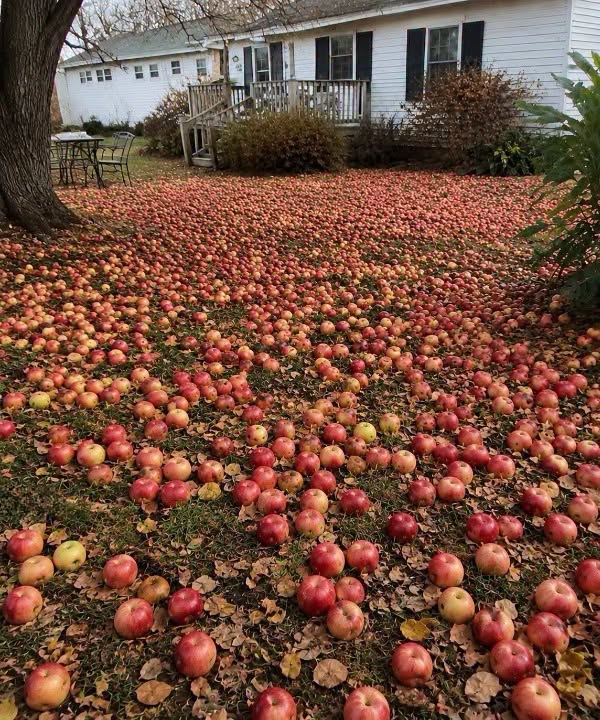
Apples were everywhere.
Hundreds of them were scattered across the grass.
The tree had been almost completely stripped, several branches were badly damaged, and one branch was hanging at an unnatural angle.
For several moments, I simply stood there trying to process what I was seeing.
Then I noticed Ryan standing on his porch, calmly drinking his coffee.
“Did you do this?” I asked.
He glanced toward my yard.
“Probably the wind,” he replied.
But there had been no storm.
The night had been completely calm.
Rather than argue with him, I went inside and pulled up the camera footage.
What I saw made everything clear.
Sometime during the night, someone had entered my yard carrying a fruit picker and several buckets.
The person repeatedly returned to the tree, removing apples and shaking the branches.
The footage even captured the moment some of the branches were damaged.
I saved every relevant part of the recording.
I didn’t confront Ryan immediately.
Instead, I began documenting everything.
I photographed the damaged branches, the scattered apples, the disturbed ground, and the condition of the tree.
I also contacted the homeowners association and explained what had happened.
The next morning, Ryan discovered something unusual in his front yard.
I had placed the apples I had recovered there while documenting the incident. Each one had a number attached to it along with a note showing where it had come from.
There was no screaming match.
No insults.
No dramatic confrontation.
I simply told Ryan that I had recorded what happened.
An HOA representative arrived soon afterward.
At first, Ryan denied ever entering my yard.
Then his explanation changed.
He claimed he had only been cleaning up fallen fruit.
A moment later, he suggested that he had been trying to prevent further damage to a branch.
Unfortunately for him, the camera footage told a completely different story.
The HOA representative reviewed the recording.
Local authorities were contacted, and the relevant footage was provided to them along with photographs of the damage.
An arborist was also brought in to examine the tree.
Thankfully, the news was good.
The main trunk and roots were still healthy.
Two branches had suffered significant damage and required professional treatment, but the tree itself was expected to survive.
I can’t fully describe the relief I felt.
For years, that tree had represented my connection to Dean.
Seeing it damaged had felt like someone had tried to destroy one of the few living things we had created together.
Learning that it would recover gave me an enormous sense of peace.
Eventually, Ryan was held responsible for the damage and the associated costs. The situation was handled through the proper channels.
After that, he stopped bothering the tree.
But the story didn’t end there.
Something unexpected began happening throughout the neighborhood.
People who had previously exchanged nothing more than a quick hello began checking on each other.
Neighbors started offering help with gardening and yard work.
Children continued coming by during apple season.
Then someone suggested organizing a small community apple day.
My first instinct was to say no.
The tree had always been deeply personal to me.
But then I remembered Dean sitting beside that tiny tree in his folding chair.
“Give it time,” he’d told me.
So I agreed.
That autumn, families gathered in my backyard.
There were baskets everywhere.
People brought homemade pies, apple butter, cider, and other food.
Children carefully picked apples while adults watched over them.
Neighbors exchanged recipes and shared stories.
And for the first time, I looked at that tree without thinking only about Dean’s death.
I started thinking about everything that had happened because of it.
It began with two people planting a tiny tree during one of the hardest periods of their lives.
Then it became a source of fruit.
After that, it became a reason for neighbors to stop by.
Eventually, it became something that brought an entire community together.
Ryan and I never became friends.
He also never gave me the emotional apology that people might expect in a story like this.
And honestly, I didn’t need one.
Eventually, we reached a quiet understanding.
He stayed on his side of the fence.
I stayed on mine.
And the apple tree remained exactly where Dean had planted it.
Years have passed since then.
The tree is now enormous compared with the tiny sapling we planted in 2013.
The damaged area healed.
Every autumn, it produces more apples than I could ever possibly use.
And I still give most of them away.
Sometimes children come to my gate and ask if they’re allowed to pick one.
I always tell them yes.
Because Dean was right.
Some things really do need time.
That little tree surprised me in ways I never could have imagined.
It survived losing the person who planted it.
It survived years without producing fruit.
It survived difficult seasons.
It even survived someone trying to damage it.
And somewhere along the way, it stopped being only a symbol of my past.
It became part of my life in the present.
Now, when I sit beneath its branches in the autumn, I don’t think about the night someone tried to destroy it.
I think about Dean.
I remember his terrible gardening advice.
I remember the tiny trunk beneath his hand.
I remember the first twelve apples.
And most of all, I remember how one small tree eventually gave an entire neighborhood a reason to come together.
That’s the memory I choose to keep.
Give things time.
Sometimes, they really can surprise you.